Best Portable Power Stations 2026: 7 LiFePO4 Picks Ranked
A power station is a battery with real wall outlets. These seven cover everything from a 4.7kg camping unit to fixed home backup, so you can buy for the job instead of the badge.

Updated 13 September 2026
SmartGadgetKit is reader-supported. We may earn a commission if you buy through links on this page, at no extra cost to you. We only recommend gear we would use ourselves.
Our top pick
EcoFlow RIVER 3 Plus
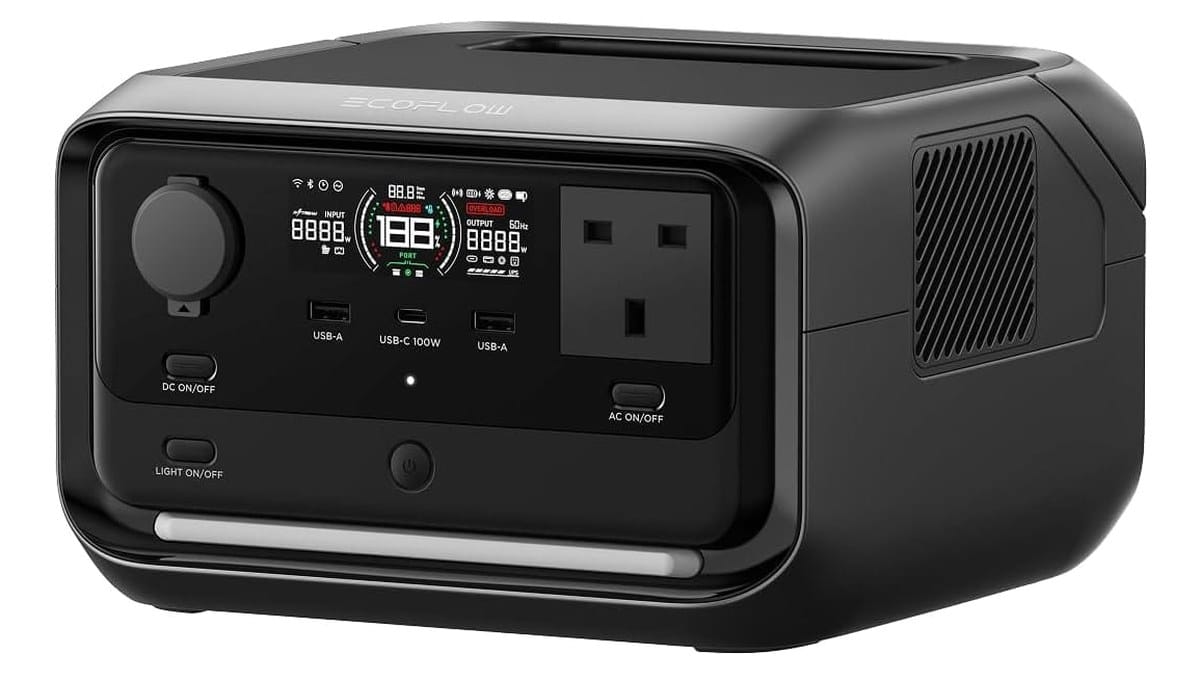
EcoFlow RIVER 3 Plus. The one you carry with one hand. At 4.7kg and 286Wh it is closer to a heavy shopping bag than a generator, and it covers a weekend of phones, a laptop, a camp light and a small fan.
The 600W output handles most low-draw gear, and EcoFlow quotes a one hour AC recharge and sub-10ms UPS switchover. StorageReview covered it as a compact 600W unit with real UPS support, which is what makes it double as desk backup rather than camping gear alone.
Good
- Lifts with one hand at 4.7kg
- Sub-10ms UPS switchover, so a desktop stays up
- One hour AC recharge
Watch
- 600W will not start a kettle or a heater
- 286Wh is a weekend of small devices, not a fridge overnight
Start here
What are you buying it for?
The right answer changes with the job, and weight decides one of these while mattering not at all in another. Tap the job that fits and the matching station lights up in the shortlist.
The shortlist
The seven best portable power stations at a glance
Ordered by size, smallest first, because that is how the jobs line up. Every pick uses LiFePO4 cells.
EcoFlow RIVER 3 Plus
Best small camping
BLUETTI AC70
Best value mid-size
Jackery Explorer 1000 v2
Best lightweight 1kWh
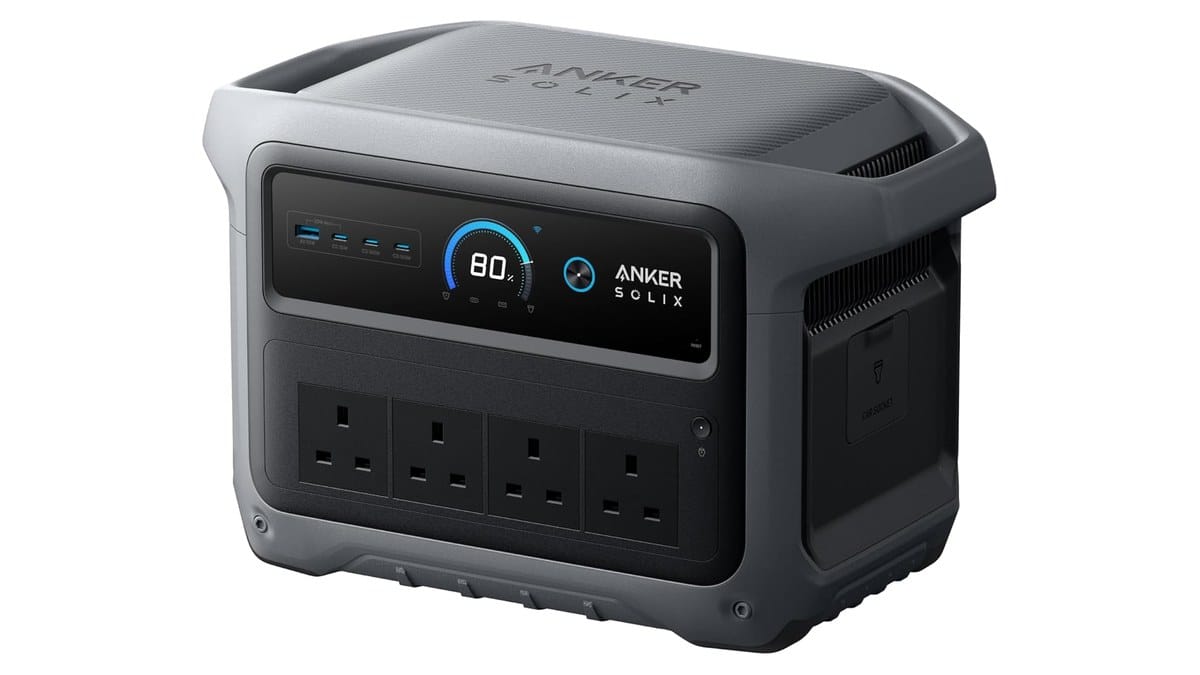
Anker SOLIX C1000 Gen 2
Best fast-recharge 1kWh
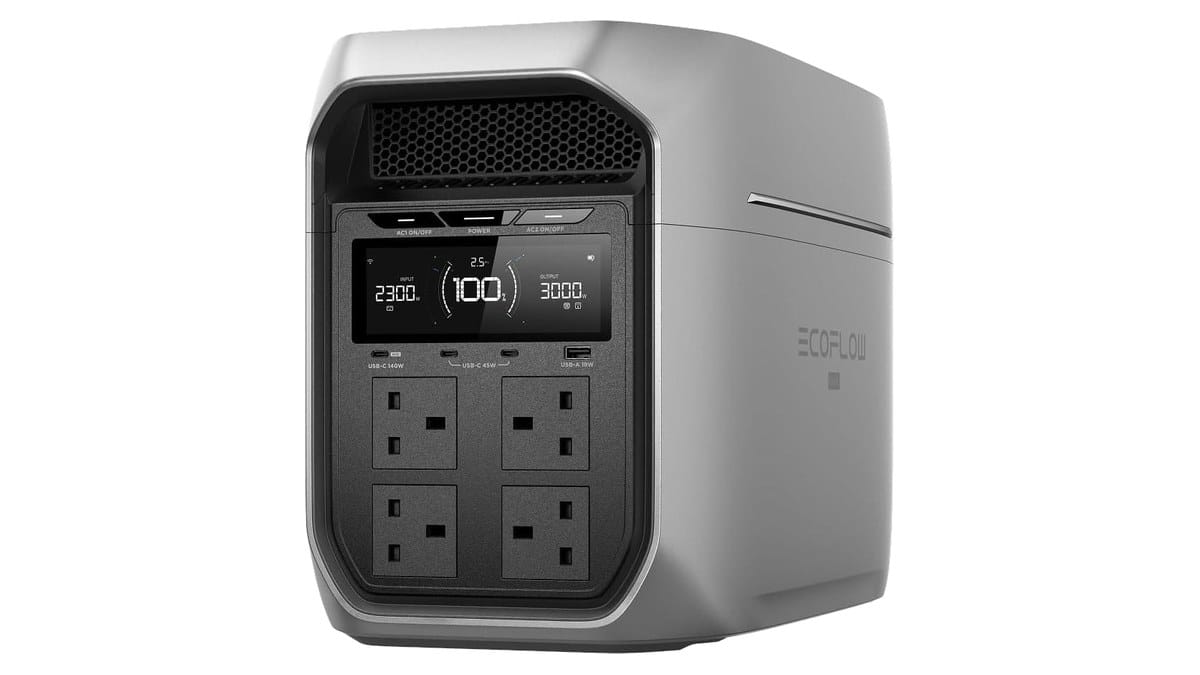
EcoFlow DELTA 3 Max Plus
Best expandable 2kWh
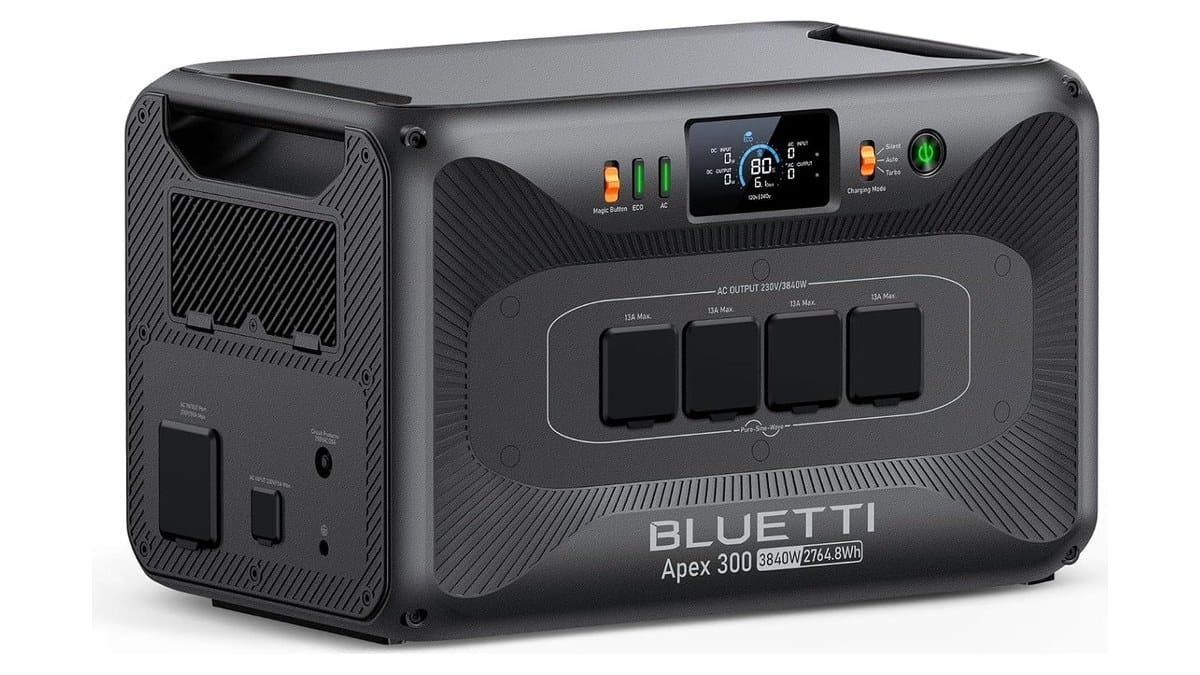
BLUETTI Apex 300
Best big home backup
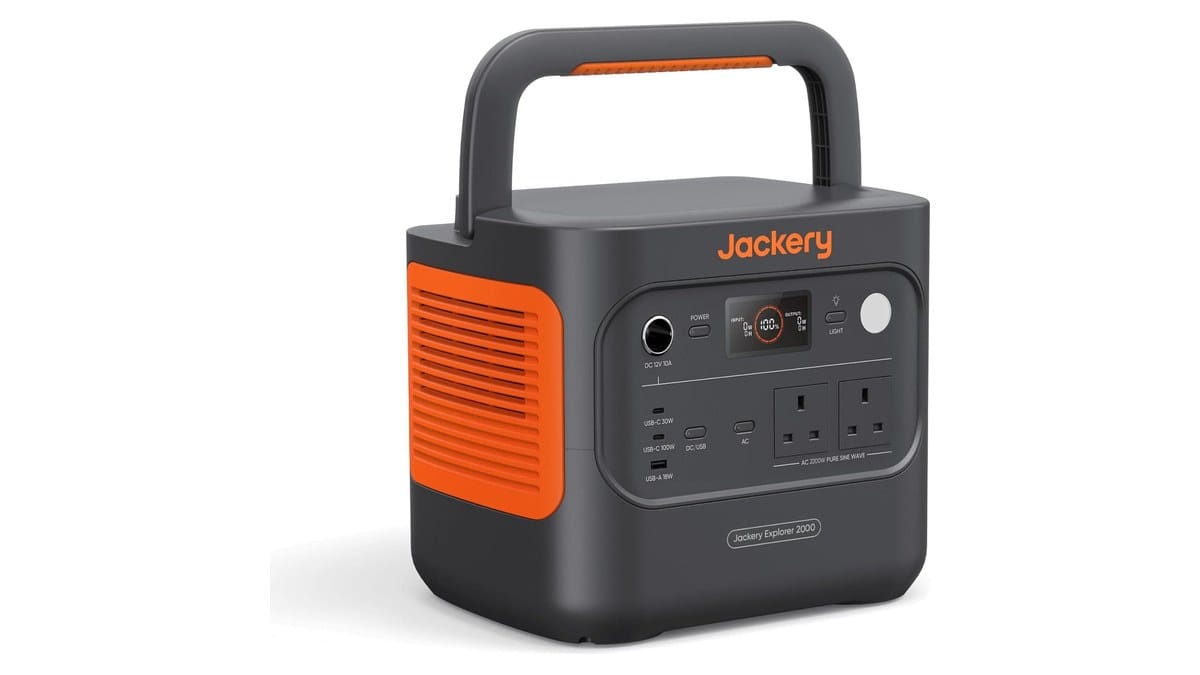
Jackery Explorer 2000 v2
Best lighter 2kWh
Compare
Side by side
The same seven portable power stations as a straight spec comparison, for narrowing a shortlist.
Capacity is the tank and AC output is the tap. Capacity decides how long it runs; output decides what it can run at all. Every unit here uses LiFePO4 cells.
 Darleene asks
“I already carry a big power bank for trips. How is one of these any different, and would I ever actually need one?”
Alisdair’s answer: They do different jobs. Your power bank pushes power out over USB, so it fills phones, a tablet, a laptop, and it lives in your bag.
A power station has actual three-pin wall outlets, so it runs the things that plug into a wall: a fridge, a fan heater, a CPAP, power tools.
If everything you charge has a USB cable, you do not need a station. The moment you need a plug socket where there is not one, a field, a campsite, a power cut, that is what a station is for.
Best small camping: EcoFlow RIVER 3 Plus
For campers, van-lifers, and anyone who wants a desk backup that keeps the router and laptop alive through a brief cut.
The one you carry with one hand. At 4.7kg the RIVER 3 Plus is closer to a heavy shopping bag than a generator, and 286Wh covers a weekend of phones, a laptop, a camp light and a small fan.
The 600W output (1200W with X-Boost) handles most low-draw gear, though not a kettle. EcoFlow quotes a one hour AC recharge and sub-10ms UPS switchover.
StorageReview covered it as a compact 600W unit with real UPS support, which is what makes it double as desk backup rather than camping gear alone.
Good
- Lifts with one hand at 4.7kg
- Sub-10ms UPS switchover, so a desktop stays up
- One hour AC recharge
Watch
- 600W will not start a kettle or a heater
- 286Wh is a weekend of small devices, not a fridge overnight
Best value mid-size: BLUETTI AC70
For the buyer who wants one do-most-things station without paying for 2kWh they will rarely use.
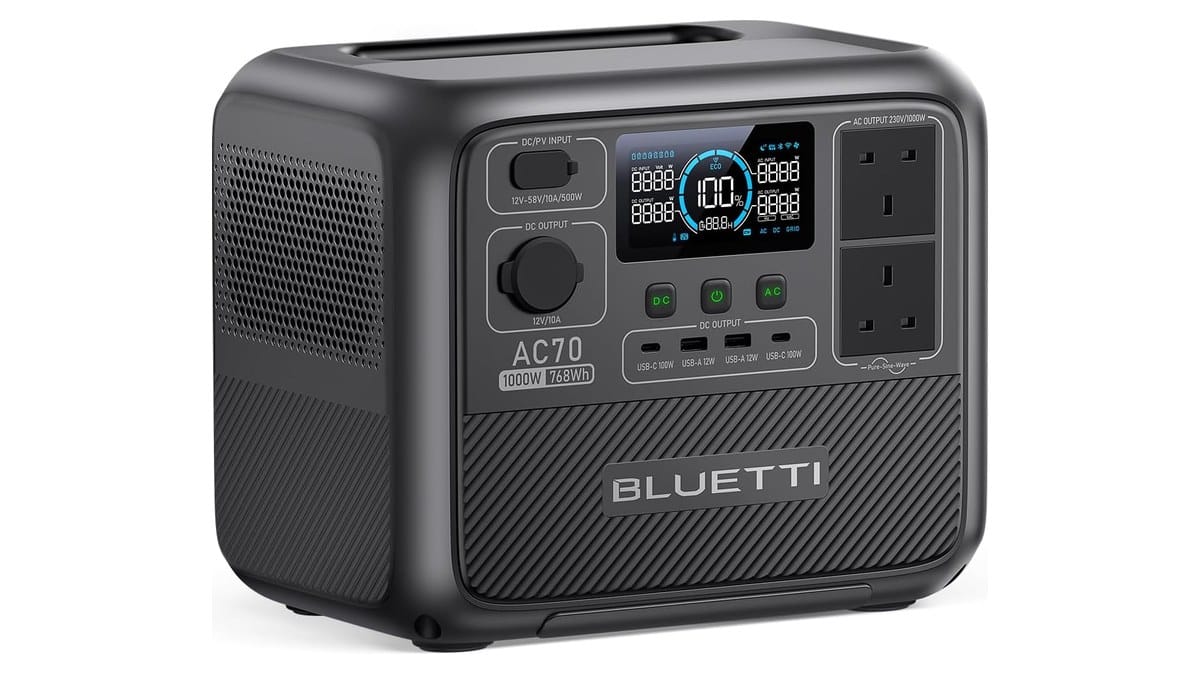
The best balance of capacity and price on this list. The full 1000W output starts and runs higher-draw kit that a 600W unit chokes on, and 768Wh covers an overnight camp or a decent chunk of a power cut.
BLUETTI quotes 45 minutes to 80 percent in turbo mode, and reviewers rate it as a compact LiFePO4 all-rounder.
It is the pick to take when you are not sure yet what you will use a station for.
Good
- 1000W output covers most household appliances one at a time
- 45 minutes to 80 percent in turbo mode
- 10.2kg is still a one-person carry
Watch
- 768Wh is the least capacity of the mid-size picks
Best lightweight 1kWh: Jackery Explorer 1000 v2
For campers and preppers who want a real 1kWh they can still move around easily.
Want one power station and no more reading? This is it.
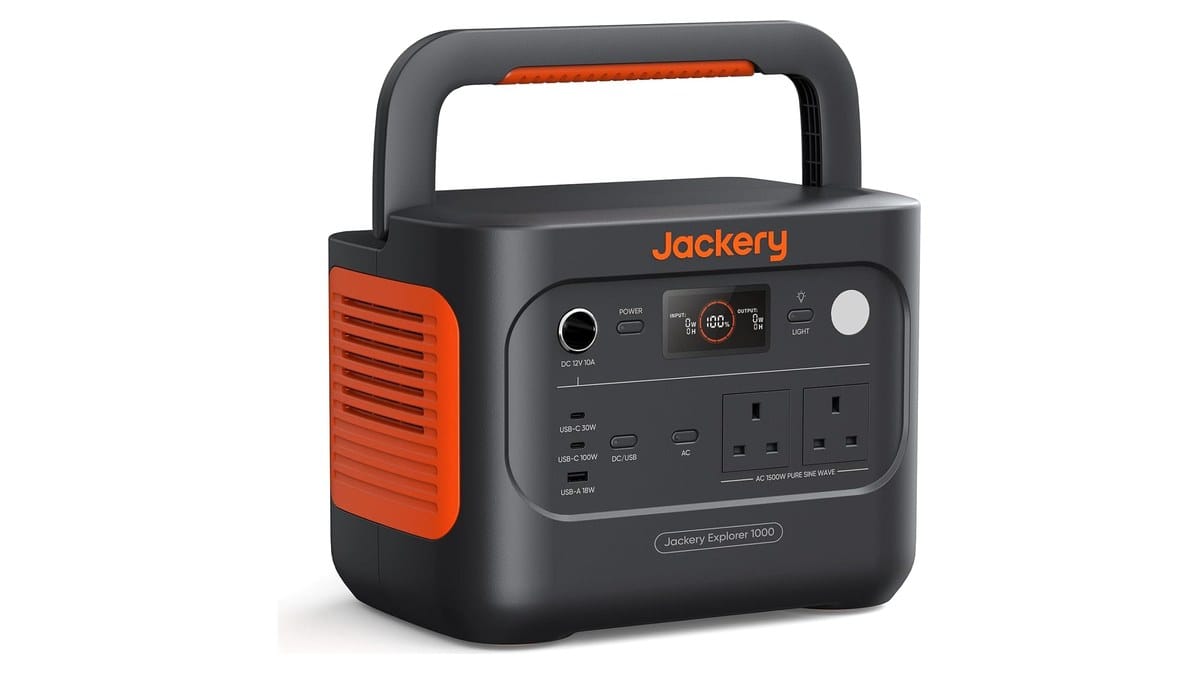
The most carryable way to get a full kilowatt-hour. At 10.8kg it is barely heavier than the 768Wh AC70 above, yet it holds a third more energy and pushes 1500W, enough for most kitchen small-appliances one at a time.
Jackery rates the cells for 4000 cycles and quotes a one hour emergency recharge. The Solar Lab tested it as a light 1070Wh unit that charged in about an hour.
The 1kWh class is where most buyers land, and this is the one that asks least of your back to get there.
The trade is that it does not expand. What you buy is what you keep, so if you think you will want more later, look at the DELTA 3 Max Plus instead.
Good
- Lightest genuine 1kWh station here
- 1500W output with a 3000W surge headroom
- 4000 charge cycles rated
- One hour emergency recharge, independently measured
Watch
- Not expandable, unlike the two EcoFlow and BLUETTI 2kWh picks
Best fast-recharge 1kWh: Anker SOLIX C1000 Gen 2
For backup buyers who may only get a short mains window to top up, and anyone running higher-wattage gear.
When refill speed is the point. Anker’s HyperFlash mode is quoted at 49 minutes to full, and The Solar Lab measured a real-world charge in around 47 minutes, among the fastest in the class.
The 2000W output is double the AC70’s, so it starts heavier tools and appliances a 1000W unit cannot.
If your outages are short and frequent, the refill time matters more than the last hundred watt-hours of capacity.
Good
- Around 47 minutes to full, independently measured
- 2000W output starts heavier tools
- 3000W peak headroom for motor start-up
Watch
- Heaviest of the 1kWh class at 11.3kg
- Slightly less capacity than the Jackery above it
Best expandable 2kWh: EcoFlow DELTA 3 Max Plus
For home-backup and RV buyers who want headroom now and the option to expand later.
The one that grows with you. 2048Wh runs a fridge, lights and devices through a long outage, and the 3000W output handles nearly everything in a normal home at once.
Add battery packs later and it scales to 10kWh, so it grows as your needs do.
StorageReview measured a full recharge to 80 percent in 64 minutes and an 8ms UPS switchover, quick enough to keep a desktop or router alive through a cut.
Make sure it is the Plus. The plain DELTA 3 Max is not expandable, which removes the reason to buy this one.
Good
- Expands to 10kWh with extra packs
- 3000W output with a 6000W surge
- 80 percent in 64 minutes, independently measured
- 8ms UPS switchover
Watch
- 22.1kg is a two-hands lift
- Easy to buy the non-expandable plain DELTA 3 Max by mistake
Best big home backup: BLUETTI Apex 300
For the buyer who wants serious whole-home backup headroom and will keep it in one spot.
The workhorse. At 2764Wh it holds more than any other pick here, and the 3840W pure sine inverter runs heavy household loads that stall smaller units.
Add expansion packs and one unit grows to about 19kWh. BLUETTI quotes a far larger ceiling than that, but only by running up to three units together, each with its own packs.
At around 38kg it is the heaviest station on this list by a wide margin. Treat it as fixed household backup that lives in one place, not something you carry to a campsite.
Good
- Most capacity on this list at 2764Wh
- 3840W pure sine inverter runs heavy household loads
- Expands to 19kWh with extra packs
Watch
- At 38kg it costs real payload in a campervan
- Overkill for camping or a single power cut
- Needs a permanent home with space around it
Best lighter 2kWh: Jackery Explorer 2000 v2
For anyone who wants a full 2kWh they can still lift into a car boot without help.
A full 2kWh you can still lift into a car boot alone.
At 17.9kg it is the lightest genuine 2kWh here, and Jackery rates the cells for 4000 cycles. The 2200W output is enough for most household appliances one at a time, and sub-20ms UPS switchover keeps sensitive gear alive through a cut.
The trade against the DELTA 3 Max Plus is expandability and raw output. This one does not grow, and its 2200W ceiling is lower. The win is portability within the 2kWh class.
Good
- Lightest genuine 2kWh here at 17.9kg
- 4000 charge cycles rated
- Sub-20ms UPS switchover
Watch
- 2200W is the lowest output of the 2kWh picks
- Slower solar charging than the DELTA 3 Max Plus
- Not expandable
The bottom line
For most people the best portable power station here is the Jackery Explorer 1000 v2: a full kilowatt-hour, 1500W of output, and the lightest body of anything holding that much.
Camping light or want desk backup? The EcoFlow RIVER 3 Plus lifts with one hand. Not sure what you need yet, the BLUETTI AC70 is the value call.
Backing up a house, the EcoFlow DELTA 3 Max Plus grows to 10kWh, and the BLUETTI Apex 300 is the biggest here if it can stay in one place. Want 2kWh you can still lift, take the Jackery Explorer 2000 v2.
How to choose
How to choose the best portable power station
Get these three things right and the shortlist picks itself.
Start with what you want to plug in. Write down the appliances, then find their wattage on their labels. Add up anything that will run at the same time. That total is your minimum AC output. A station below it will refuse to start the load no matter how large its battery is.
Then work out how long you need it. Divide the station’s watt-hours by the appliance’s watts for a rough runtime. A 1000Wh station running a 50W mini-fridge lasts roughly 20 hours. Real figures come in a little lower, because no station converts its stored energy at 100 percent efficiency.
LiFePO4 is why it is still working in five years. Lithium iron phosphate cells are rated for 3000 to 4000 charge cycles against a few hundred for older lithium chemistries. Every pick here uses it.
A LiFePO4 power station costs a little more up front and is still holding useful charge long after an older lithium unit has faded. If a listing does not say LiFePO4, assume it is not.
Recharge time matters more than people expect. For backup you may only get a short window at the wall between cuts. A station that refills in an hour is far more useful than one that takes six.
Check the UPS switchover figure too, quoted in milliseconds. Under about 20ms keeps a desktop computer and a router running through a cut.
Camping and home backup pull in opposite directions. A power station for camping has to be light enough to carry and big enough for a weekend of small devices. Under about 12kg and around 1kWh covers most trips.
A home backup power station is the opposite trade. Weight stops mattering once it lives in one spot, so spend on capacity and output instead. If you need both, two smaller units usually beat one heavy compromise.
Expandable or fixed. Expandable units take extra battery packs later, which spreads the cost and lets the system grow with the house. Fixed units are lighter and simpler. If you know the job and it will not change, fixed is the cheaper answer.
FAQ
Frequently asked questions
The questions readers ask before they buy a power station.
What is the best portable power station in 2026?
For most buyers the best portable power station is the Jackery Explorer 1000 v2. A full kilowatt-hour is the capacity most people need, and it is the lightest unit here holding that much, with cells rated for 4000 charges.
Buying for one specific job changes the answer. Camping light points to the EcoFlow RIVER 3 Plus, and whole-home backup points to the BLUETTI Apex 300.
Is it worth buying a portable power station?
It is worth it if you regularly need mains power where there is no wall outlet, or reliable backup when the power goes out. For camping, off-grid work, caravans and home backup, yes.
If everything you want to charge uses a USB cable, a power bank is lighter, cheaper and enough.
What can a 1000W portable power station run?
The 1000W figure is the output, so it can run appliances that draw up to 1000 watts at once: a small fridge, a fan, lights, a laptop, a TV, most power tools.
It will not run a 1500W to 3000W kettle, heater or hairdryer. How long it runs them depends on the watt-hours, not the watts.
How long does a portable power station run?
Divide the watt-hours by the appliance’s watts for a rough figure. A 1000Wh station running a 50W mini-fridge lasts roughly 20 hours; running a 500W appliance, roughly 2 hours. Real figures are a little lower because no station is 100 percent efficient.
Which is better, EcoFlow or BLUETTI?
Both make excellent LiFePO4 stations and neither is a wrong choice. EcoFlow tends to lead on charge speed and its app and expansion ecosystem; BLUETTI often gives you more capacity for the money and leans into home and RV backup.
Pick by the specific model that fits your job, not the badge.
What is the best portable power station for a campervan?
For most campervans the 1kWh class hits the balance of capacity and weight: the Jackery Explorer 1000 v2 if you want it light, or the Anker SOLIX C1000 Gen 2 if fast recharging on the move matters. Step up to a 2kWh unit only if you run a compressor fridge and appliances for days off-grid.
Can you take a portable power station on a plane?
No. Every station here is far above the 100Wh airline limit for lithium batteries in cabin baggage, and they are not allowed in the hold either. For flying you need a power bank under 100Wh; our plane guide explains the rules.
Keep reading
More buying guides from SmartGadgetKit
 Best of
Best Power Banks 2026
The USB batteries that fit in a bag, ranked for everyday carry.
 Best of
Best 20000mAh Power Banks
The size that clears most airline limits and still lasts a trip.
 Guide
GuideCan You Take a Power Bank on a Plane?
The 100Wh limit explained, and what happens above it.
 Guide
GuideHow to Choose a Power Bank
Match capacity, output and size to what you actually charge.
 Best of
Best Power Bank for Travel
Banks that clear airport limits and still last a long day.