

INDIVIDUAL REVIEW | Power stations | AC70
BLUETTI AC70 review: what its 2,000W Power Lifting is worth
BLUETTI puts 2,000W on the box. Its own manual puts 1,000W on page 17. This BLUETTI AC70 review measures what that difference costs you at the socket.

Scored against independent measured testing by Trusted Reviews and StorageReview
SmartGadgetKit is reader-supported. We may earn a commission if you buy through links on this page, at no extra cost to you. We only recommend gear we would carry ourselves.
Expert Score
A capable, fast-charging unit with an excellent port selection, though its Power Lifting mode delivers roughly 1,000W of actual power rather than the marketed 2,000W.
Pros
- Fast turbo charging (935W measured by Dustin Abbott) to 80 percent in 45 minutes
- Durable LiFePO4 cells rated for over 3,000 cycles
- Comprehensive port selection including two 100W USB-C ports
Cons
- Power Lifting mode delivers only about 1,000W to resistive loads
- No IP or MIL-STD rating for outdoor use
Key takeaways
Six numbers that decide whether this is your portable power station.
Quick specs
The paper numbers for the BLUETTI AC70.
| Capacity | 768Wh |
| Chemistry | LiFePO4 |
| Cycle Life | 3,000 cycles |
| Weight | 10.2kg (22.5lb) |
| AC Output | 1,000W |
| Solar Input | 500W |
Specs confirmed against the BLUETTI and Amazon listings for AC70. Performance figures come from independent testing by Trusted Reviews and Dustin Abbott. See how we test and score.
First impressions
The BLUETTI AC70 is a compact power station designed for portability in environments such as vans or on road trips. The manufacturer puts it at 10.2kg, which one person lifts without ceremony and without a second person holding the other end.
The build quality is solid, though TechRadar notes that the lack of an IP rating or MIL-STD certification means it should not be used in environments where it might be exposed to dust or moisture.
A clear display shows real-time output and status information. The inclusion of two 100W USB-C ports alongside other outputs signals a high level of connectivity for its class, providing more versatility than some smaller competitors.
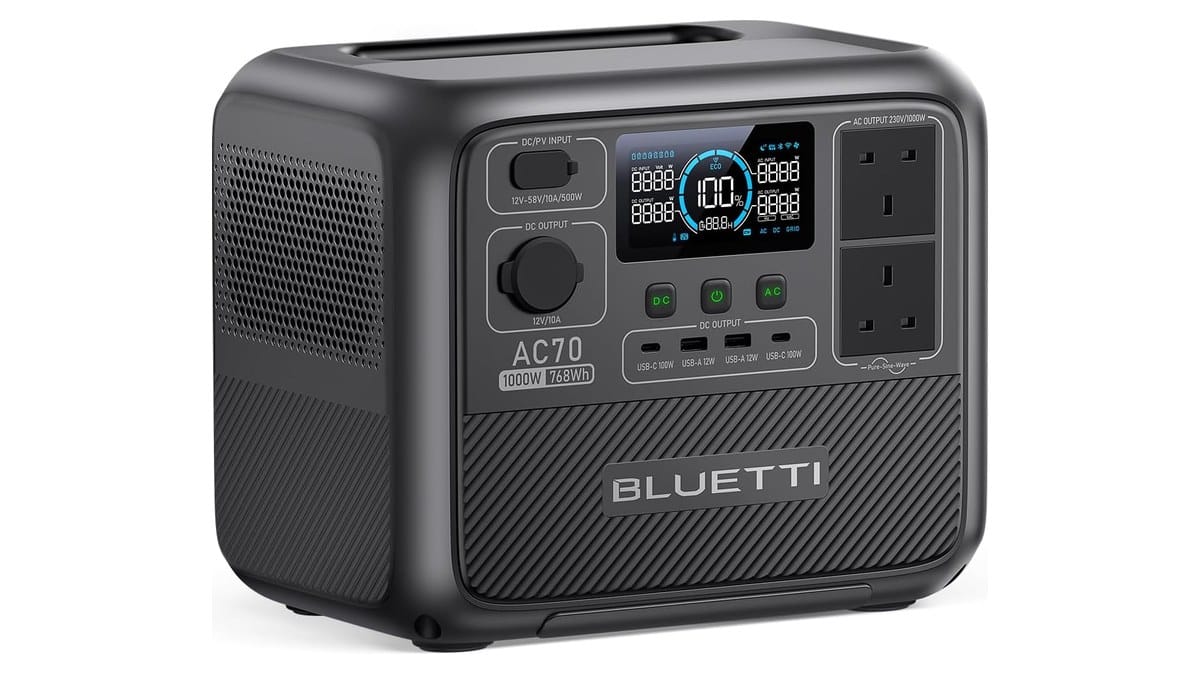
The unit includes seven outlets in total: two AC sockets sharing a 1,000W limit, two 100W USB-C ports, two 12W USB-A ports, and one car port. In practice you’ll live on the two USB-C ports and leave the AC sockets for the things that need them.
Design and build
A compact unit for its class that is easy for one person to move
The AC70 weighs 10.2kg (22.5lbs) according to manufacturer specifications. It measures 314 x 209.5 x 255.8 mm (12.4 x 8.2 x 10.1 inches), making it a compact unit for its class that is easy for one person to move during road trips or as a portable power source.
The internal battery uses LiFePO4 chemistry, which the manufacturer rates for over 3,000 cycles while retaining 80 percent of its capacity.
There are seven outlets in total: two AC sockets sharing a 1,000W limit, two USB-C ports capable of 100W each, two USB-A ports providing 12W, and one car port for 120W output.
The manufacturer specifies a UPS transfer time of 20ms. The unit does not have an IP or MIL-STD rating, meaning it is not designed to be used in environments with high dust or water exposure.
The front panel of the BLUETTI AC70 showing its selection of ports.
 Darleene asks
“I see ‘Power Lifting’ mentioned in the marketing for this model. Does that mean I can actually run a big appliance like my kettle?”
Alisdair’s answer: No. It doesn’t give your appliances more power, it gives them less voltage.
The Power Lifting mode works by lowering the output voltage to accommodate high wattage resistive loads such as heaters or kettles. While marketing materials claim 2,000W, the manufacturer manual states that the actual operating power remains at 1,000W.
Your kettle will run, and it’ll take longer, because it’s being underfed. That’s fine for a heating element. It isn’t fine for anything with a motor or a circuit board in it.
You do not need to worry about this if you are only powering devices like laptops, phones, or lamps, as these do not require the high wattage lift and will run normally on the standard 1,000W output.
Independent testing
What this BLUETTI AC70 review measured
The 2,000W Power Lifting figure is a marketing highlight; the manual states actual operating power remains at 1,000W. Trusted Reviews measured 976 watts on a 1.8kW kettle, and Dustin Abbott recorded an average of 1,015W on a 1,500W kettle.
That is not a scandal on its own. Most units this size stop at 1,000W too, and BLUETTI is one of the few that lets a big resistive load run at all. The problem is the number on the box, which reads like headroom you do not have.
For common appliances, Dustin Abbott tested an air fryer at 1,027W for ten minutes and a hair dryer at approximately 650W.
A toaster oven was successfully powered at nearly 900W during testing by NerdTechy.
It’ll take the everyday stuff without complaint. It won’t start a 3,000W kettle, and TechRadar found it wouldn’t even try.
Trusted Reviews measured a round-trip efficiency of 78.1 percent and a charging efficiency of 86 percent.
No independent lab has published a peak surge figure for it, so treat motor-driven kit, fridges and pumps and compressors, as untested rather than proven.
Here is the mechanism, and it is the part the listings leave out. Power Lifting does not find extra watts. It drops the output voltage, measured at 182V on a UK unit against a normal 230V, and an underfed heating element draws less and takes longer. Your kettle boils. It boils slowly.
Read it as a 1,000W station that will humour a kettle, not as a 2,000W station. On that basis, and it is the basis this BLUETTI AC70 review scores it on, it is a good one.
Darleene’s version: It can run your coffee maker or hair dryer easily, but do not expect it to power a massive kettle or heater.
If the measurements above match the job you are buying for, the current Amazon listing is one tap away.
bluettiCheck latest price amazonCheck latest pricePower Lifting and ECO Mode
The AC70 includes two internal modes designed to manage high-wattage appliances and low-power electronics.
Power Lifting is intended for resistive loads like kettles, while ECO Mode automatically shuts off the output when demand falls below 40W.
ECO Mode is the one to know about, because it ships switched on and it will make a working unit look broken. Draw less than 40W and it cuts the output, which is exactly what happens when you plug in a phone and walk away. BLUETTI’s own manual tells you to turn it off for small devices, and nobody reads the manual.
Portability and travel use
With a specified weight of 10.2kg (22.5lbs) and dimensions of 314 by 209.5 by 255.8mm, the AC70 is compact enough for one person to move easily.
This size allows for a large internal capacity and a full suite of ports, making it a practical choice for van life or as a dedicated backup during power cuts.
The inclusion of two 100W USB-C ports out of the box means no extra adapters are needed to charge high-power devices.
Because its capacity is over seven times the standard 100Wh limit for cabin luggage, it cannot be taken on a plane.
Travels by road, never by air
Take it camping. Take it hiking, to a festival, up a hill in the boot of the car, away for a weekend, out in the van. This is exactly the gear for that, and 10.2kg with a handle is a one-person lift at the other end.
What it will not do is fly. At 768Wh the AC70 is more than seven times the 100Wh a passenger may carry, and well past the 160Wh that needs written airline approval, so it goes in neither the cabin nor the hold.
That is true of the whole class. The smallest useful stations are around three times the limit and the big home units are twenty times it.
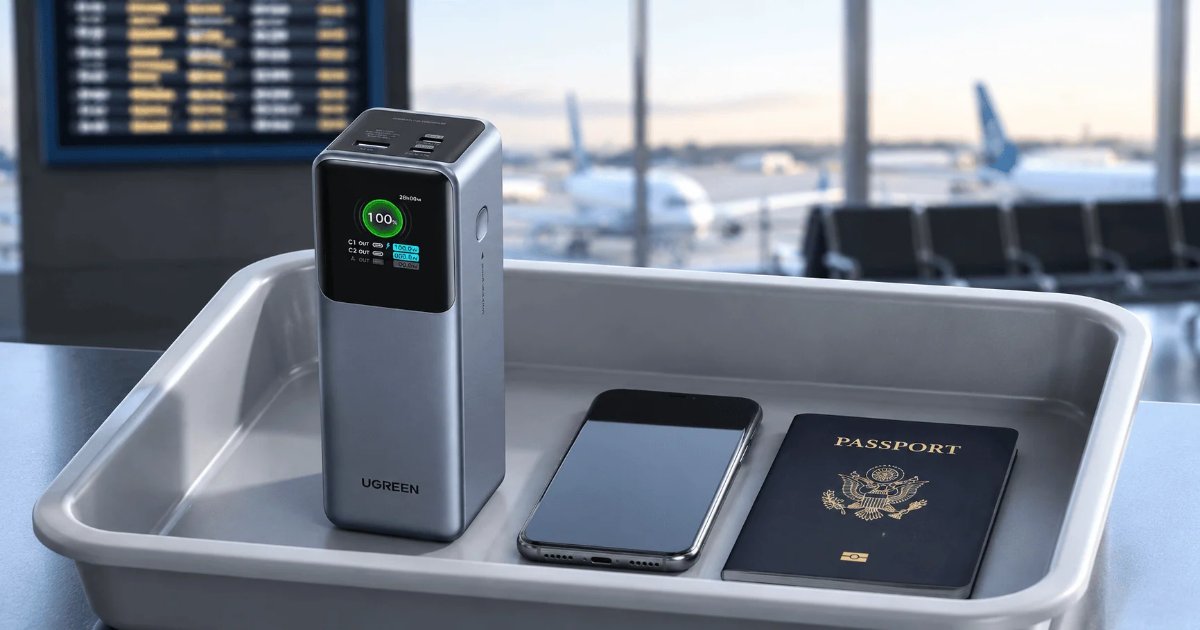
If you want power waiting at the far end of a flight, that is a power bank, and the rules there are tighter than most people expect.
Full rules are in our can you take a power bank on a plane? guide. Check any capacity in seconds with our mAh to Wh calculator.
Specifications
Every figure, with its source attached
Manufacturer figures are specifications or claims. Measured figures belong to the independent outlet named beside them. Nothing on this page was measured by SmartGadgetKit.
| Specification | Figure | Source |
|---|---|---|
| Model number | AC70 | BLUETTI |
| Capacity | 768Wh | BLUETTI |
| Chemistry | LiFePO4 | BLUETTI |
| Cycle Life | 3,000+ cycles to 80% capacity | BLUETTI |
| Weight | 10.2kg (22.5lb) | BLUETTI |
| AC Output | 1,000W | BLUETTI |
| USB Output | 2x 100W (USB-C) and 2x 12W (USB-A) | BLUETTI |
| Car Port Output | 120W | BLUETTI |
| Solar Input | 500W | BLUETTI |
| UPS Transfer Time | 20ms or less | BLUETTI |
| Protection | No IP or MIL-STD ingress rating | BLUETTI, as specified |
| In the box | AC70 unit, power cable, and charging cables | BLUETTI |
Sources: BLUETTI and Amazon listings (AC70), and the AC70 user manual, which is where the Power Lifting figure comes from. Independent measurements from Trusted Reviews and StorageReview.
If the numbers already make the case for you, the current Amazon listing is one tap away.
bluettiCheck latest price amazonCheck latest priceScoring
How the BLUETTI AC70 scores
Four category scores, fixed by editorial judgement. The overall is not their average.
The total score of 7.0 reflects a well built compact unit that performs its core functions efficiently, even if it sits at the bottom of the high performer tier due to the availability of larger rivals with more output.
The verdict
The BLUETTI AC70 provides an excellent port selection including two 100W USB-C ports and fast turbo charging measured at 935W by Dustin Abbott, making it a capable hub for mobile devices.
Set against that, Trusted Reviews measured round-trip efficiency at 78.1 percent, so roughly a fifth of what you put in never comes back out, and Power Lifting reaches heavy resistive loads by dropping the output voltage rather than by finding more power.
This unit is an easy recommendation for road-trippers or campers who need a compact, fast-charging station with plenty of ports for phones and laptops rather than high wattage appliances.
A compact, fast-charging station with plenty of ports for phones and laptops is the job it does properly.
bluettiCheck latest price amazonCheck latest priceShould you buy it?
The honest split
Buy it if
- You need a compact unit with high-quality ports, including two 100W USB-C outputs.
- Fast charging is a priority; the turbo mode reaches 80 percent in 45 minutes.
- A reliable UPS is required; the measured transfer time of 14ms beats the manufacturer’s 20ms specification.
Skip it if
- You need to run high-power appliances at full speed; the Power Lifting mode only delivers 1,000W of operating power.
- You require an IP-rated casing for outdoor use.
- You want more capacity or higher output; the Jackery Explorer 1000 v2 and Anker SOLIX C1000 Gen 2 offer more power.
Buy it if you need a compact station with high-quality ports and fast charging, skip it if high-wattage appliances are the main job.
bluettiCheck latest price amazonCheck latest priceHow it compares
The two products a reader is most likely weighing against it
| BLUETTI AC70 | Jackery Explorer 1000 v2 | Anker SOLIX C1000 Gen 2 | |
|---|---|---|---|
| Capacity | 768Wh | 1070Wh | 1024Wh |
| Inverter Output | 1,000W (2,000W Power Lifting claim) | 1,500W | 2,000W |
| Charging Speed | 80% in about 45 minutes | Not specified | 80% in about 49 minutes |
| Best for | Compact travel and van use | Larger capacity with high output | High power needs without compromise |
If this one is not the fit
Three alternatives, three different readers
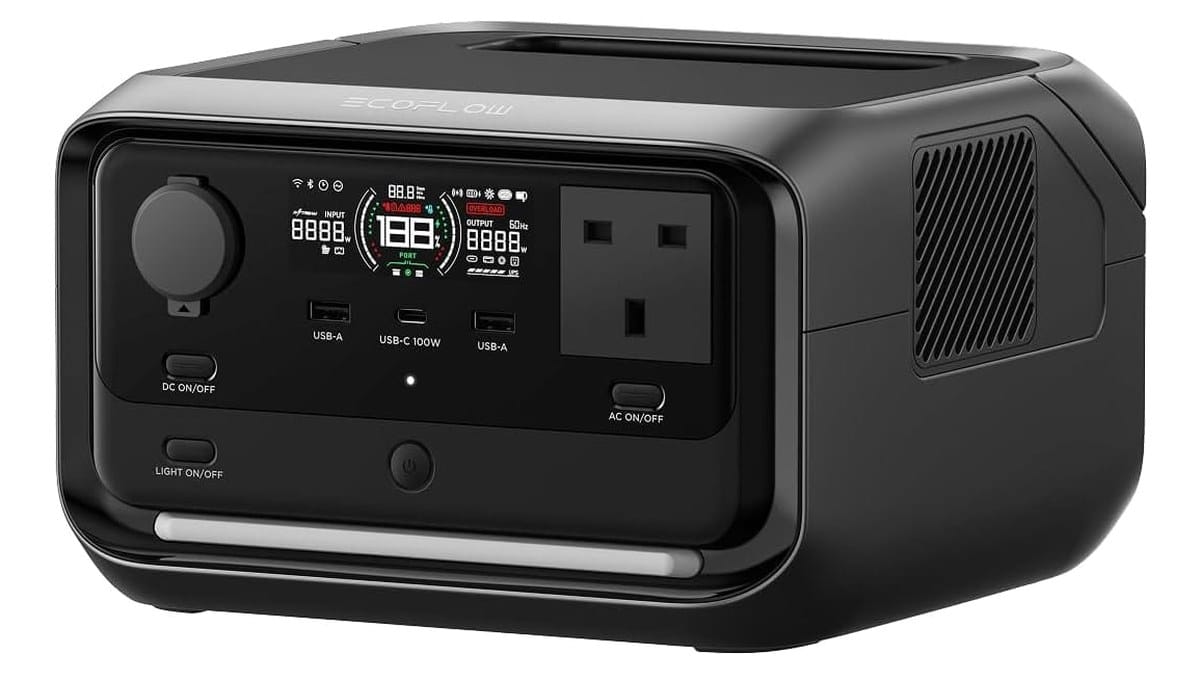
EcoFlow RIVER 3 Plus
A fraction of the AC70 capacity in a case one person can lift easily, but it will not attempt to run a kettle in any mode.
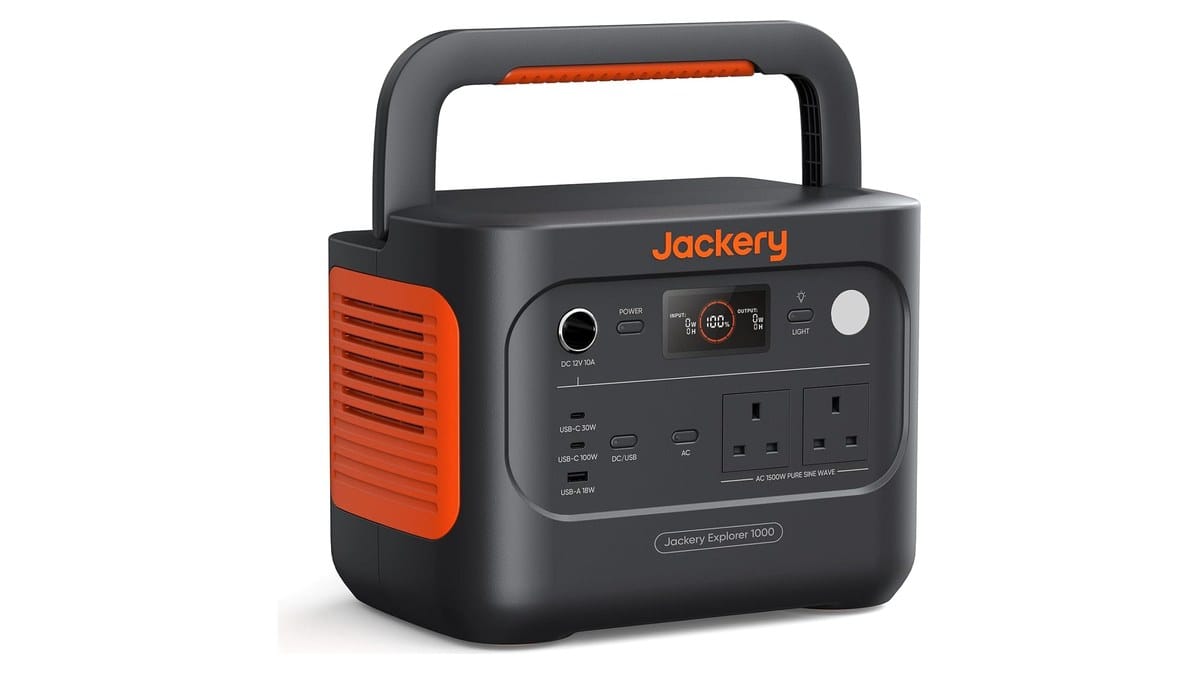
Jackery Explorer 1000 v2
Offers more capacity and a higher output ceiling so appliances run at full voltage, though it cannot be expanded with other batteries.
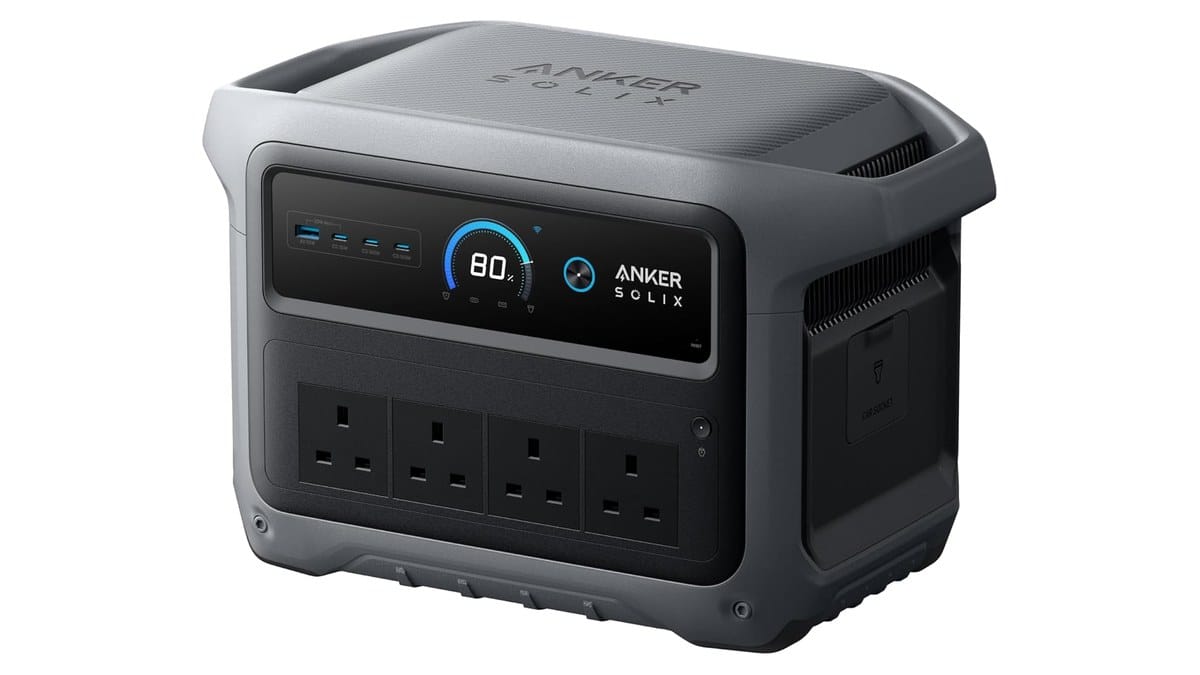
Anker SOLIX C1000 Gen 2
Features a higher power inverter so high demand items like air fryers or hair dryers run at full speed without needing a special mode, but it is larger and heavier.
See every model we rate in our power stations hub.
FAQ
Questions readers ask
Is the BLUETTI AC70 any good?
Yes, it features premium LiFePO4 cells and 100W USB-C ports; however, the 2,000W Power Lifting claim is misleading as the manufacturer manual states operating power remains at 1,000W.
Will the BLUETTI AC70 boil a kettle?
It can boil a kettle in Power Lifting mode, but only by lowering the output voltage. Trusted Reviews measured 182V on a UK unit against a normal 230V, delivering 976W, and Dustin Abbott measured about 1,015W on a US unit. A 3,000W kettle will not start at all.
What does Power Lifting mode do?
It allows high-wattage resistive loads to run by lowering the output voltage, but it limits those appliances to roughly 1,000W of operating power.
Can I take the BLUETTI AC70 on a plane?
No, because its 768Wh capacity is over seven times the standard 100Wh limit for cabin items. See the guide on what you can take on a plane.
How much power do you get out of a BLUETTI AC70?
The inverter is rated at 1,000W. While marketing claims 2,000W for Power Lifting, the manufacturer manual states operating power remains at 1,000W.
Does it come with USB ports?
Yes, it includes two 100W USB-C ports and two 12W USB-A ports in the box.
How fast does the BLUETTI AC70 charge?
In Turbo mode, it reaches 80 percent in about 45 minutes and full in approximately 1.5 hours, with a measured draw of around 935W by Dustin Abbott.
Can the BLUETTI AC70 be used as a UPS?
Yes, it has a UPS function with a manufacturer specification of 20ms; StorageReview measured a faster transfer time of 14ms.
How does it compare to the AC70 P?
The AC70 P has a larger 864Wh capacity, an extra USB-C port, and a wireless charging pad. Choose the AC70 if you prefer the standard configuration or want a slightly smaller footprint.
Final word
BLUETTI AC70 review: the bottom line
The BLUETTI AC70 is a compact power station that provides rapid turbo charging and long cycle life, though its 2,000W Power Lifting headline delivers approximately 1,000W to resistive loads by underfeeding the appliance.
This unit should be shortlisted by users seeking a portable solution for road trips or short power cuts who value LiFePO4 chemistry and fast charging over high-wattage output. See how we test, or see where it ranks against the rest in our best portable power station roundup.
Keep reading
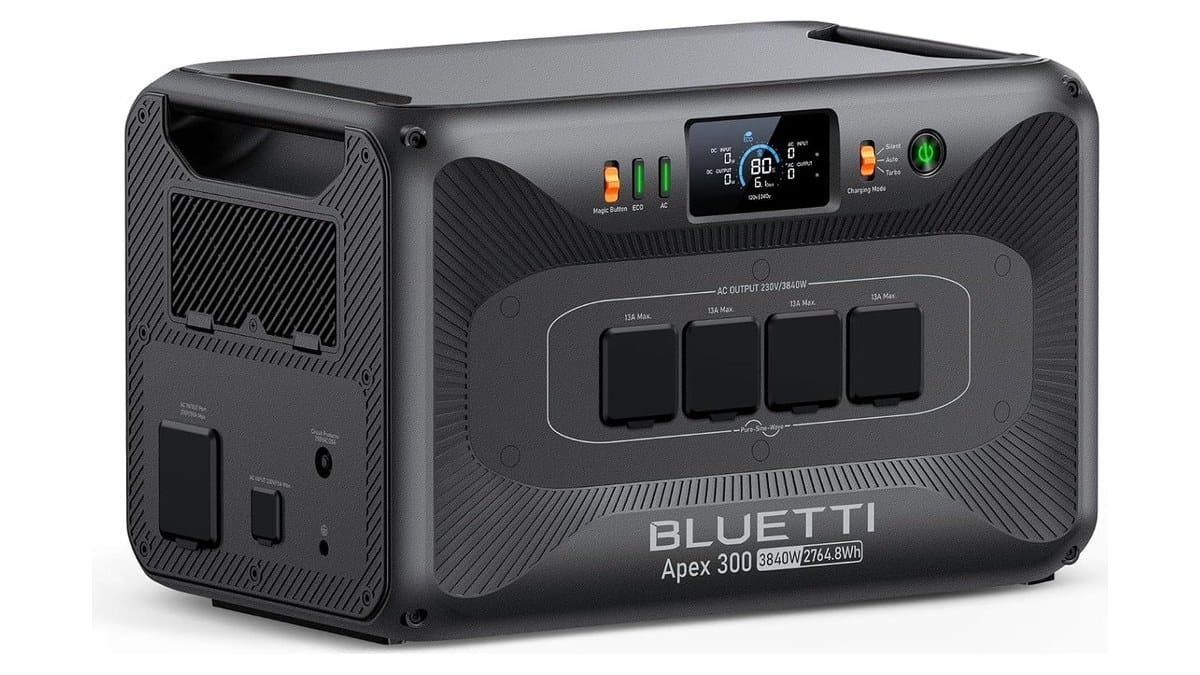
BLUETTI Apex 300 review
The same brand at four times the size, and the two parts it does not ship with.
Jackery Explorer 1000 v2 review
About four hundred watt hours more, and no compromise mode needed to use it.
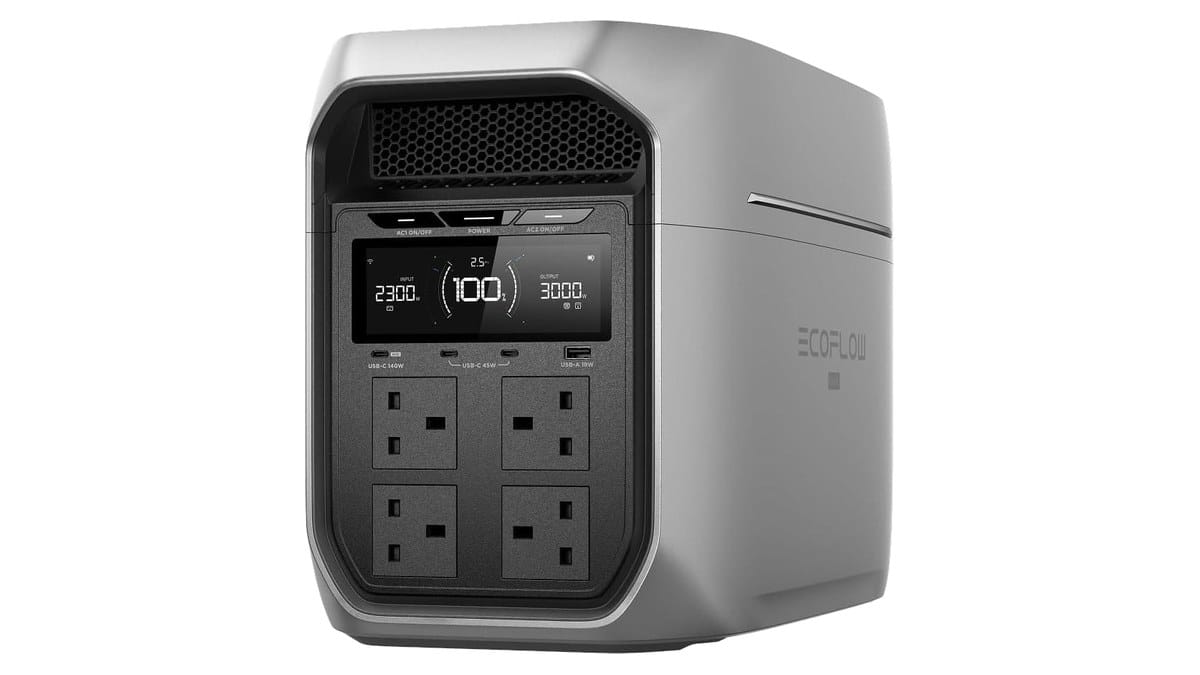
EcoFlow DELTA 3 Max Plus review
The larger EcoFlow station, and what 2,048Wh really gives you.
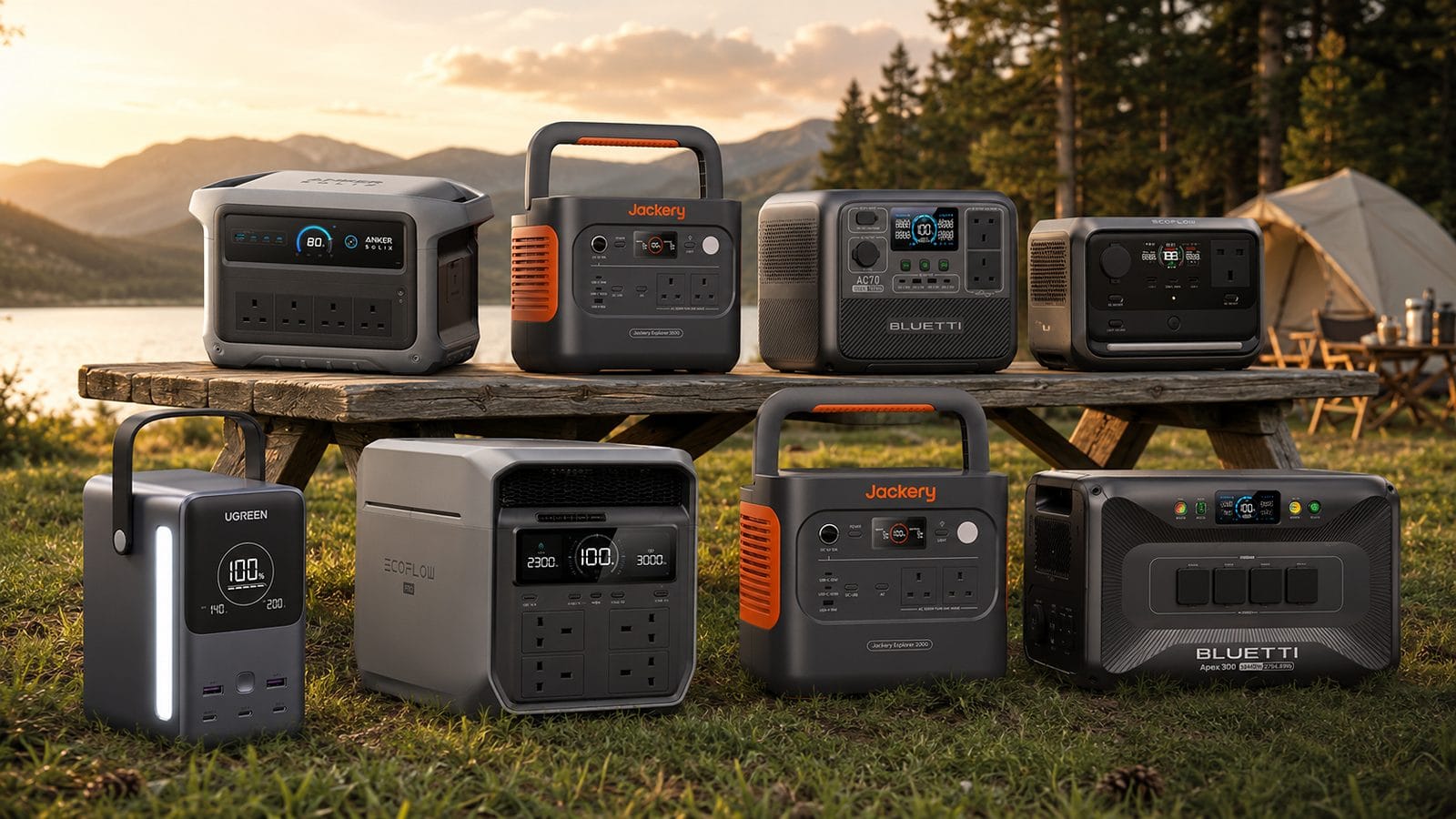
Best portable power station
The wider roundup across every size, from small camping units to home backup stations.
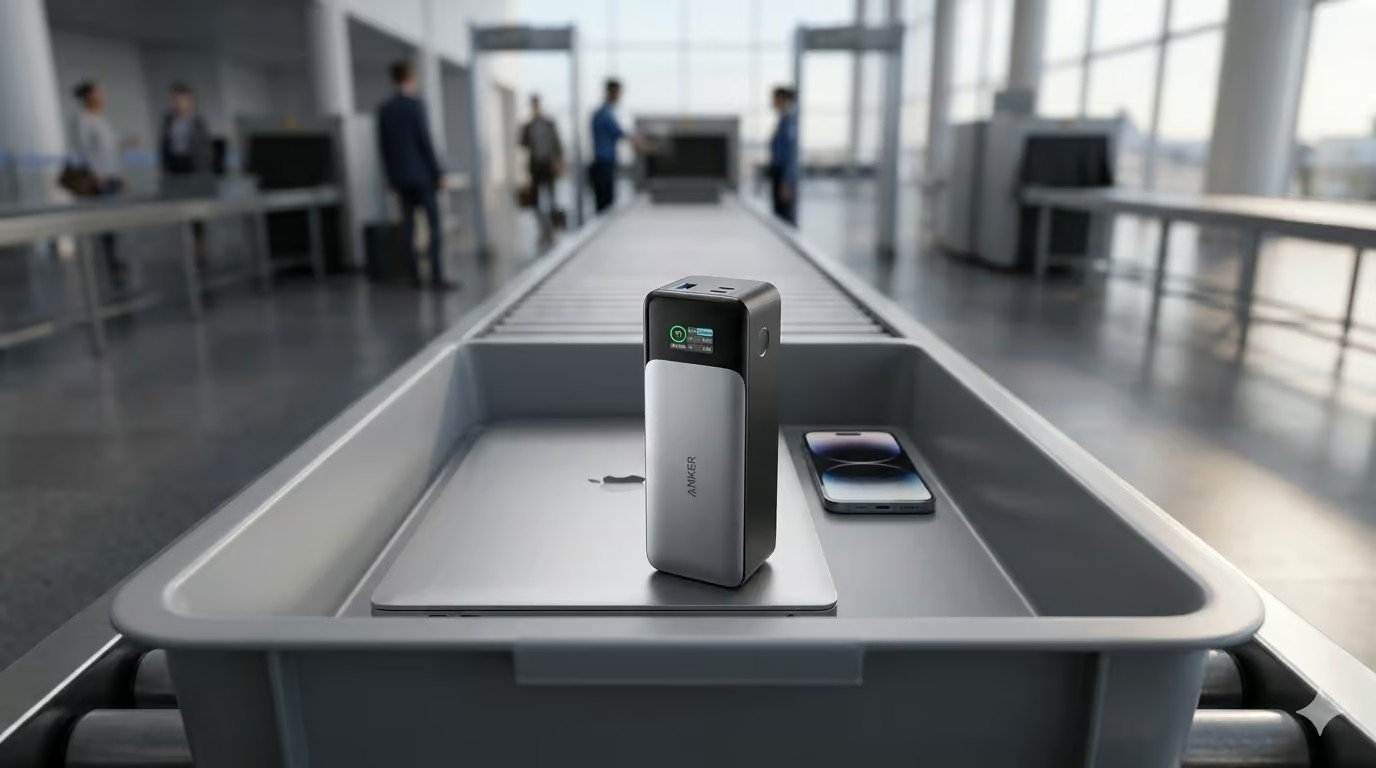
Can you take a power bank on a plane?
Where the airline limits sit, and why a power station is nowhere near them.
mAh to Wh calculator
Check any capacity in seconds against the 100Wh airline limit.
Latest from SmartGadgetKit
 Lithium Ion Battery Fire Statistics 2026
 LISEN Power Bank Review: The Qi2.2 25W MagSafe 10000mAh, Measured
 How Long Does a Power Bank Last? Charges, Years and Sizing
 Anker Prime 250W Charger Review: 6-Port Desktop Hub
 Anker Prime 300W Power Bank Review: Two Laptops, One Socket-Free Table
 Jackery Explorer 2000 v2 Review: The Lightest Way to Carry 2kWh?
 Anker SOLIX C1000 Gen 2 Review: The 49 Minute Recharge Is A Setting, Not The Default
 EcoFlow RIVER 3 Plus Review: The 1200W On The Box Isn’t The Number You Buy
Tested by people who know what the numbers mean
SmartGadgetKit checks every spec against the manufacturer and independent sources, and tells you the trade-offs, not only the wins. Independent testing for this page comes from Trusted Reviews, StorageReview and Dustin Abbott, credited where each figure appears.
