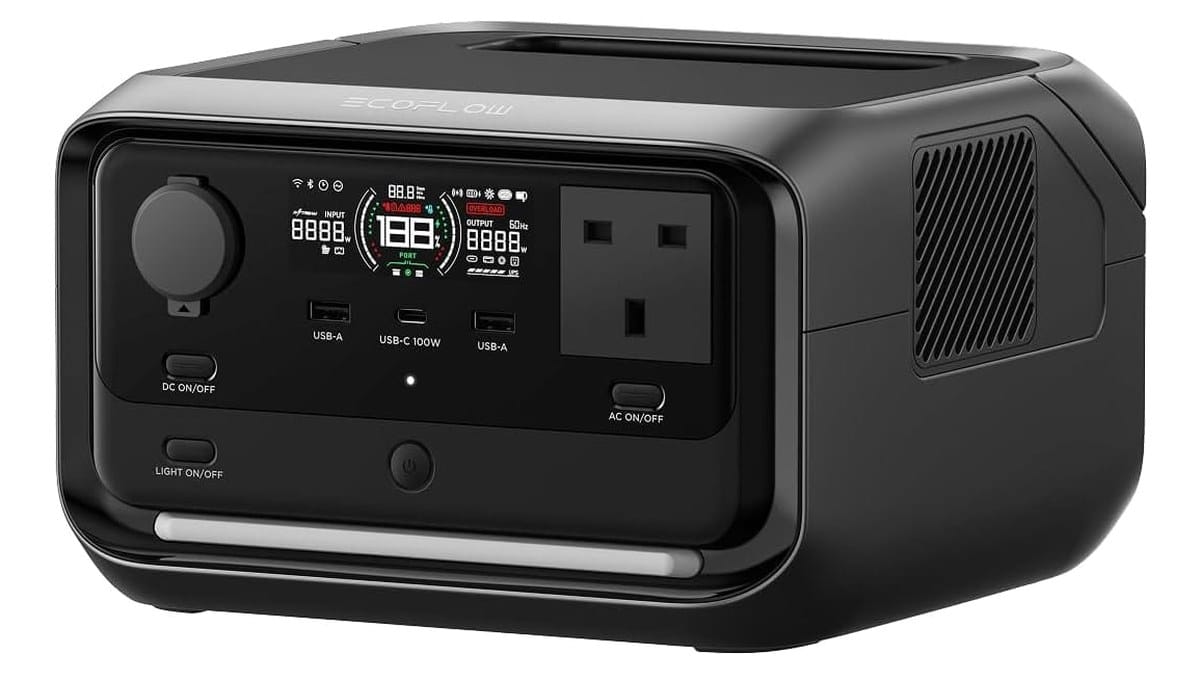
Individual Review · Power stations · RIVER 3 Plus
EcoFlow RIVER 3 Plus Review: The 1200W On The Box Isn’t The Number You Buy
Buy it for the backup switchover and the one hour recharge, not for the number on the box.

Specs cross-checked against the manufacturer and independent testing
SmartGadgetKit is reader-supported. We may earn a commission if you buy through links on this page, at no extra cost to you. It never changes which products we pick or what we say about them.
Expert Score
Score 8.0. Short version, and this EcoFlow RIVER 3 Plus review keeps returning to it: the number on the box is not the number you can plan around. The better number is the backup switchover, independently measured at 9 ms against a claimed sub-10 ms. The oversold one is 1200W. That’s a short burst, not a working output. Plan around 600W.
Pros
- Backup switchover independently measured faster than the claim
- Full recharge from a wall outlet in about an hour
- 4.7 kg with IP54 dust and water resistance, carried one-handed
- Takes an add-on battery to 858Wh, rare at this size
- Five year warranty on a 3,000 cycle LiFePO4 pack
Cons
- The 1200W headline is a brief boost, not a sustained output
- 286Wh empties fast on anything that heats
- Two of the three sockets face rearwards, and the USB-A ports are capped at 12W
Amazon ships worldwide. The EcoFlow button goes to their UK store, so it’s the better route if you’re buying in the UK.
Key takeaways
Six numbers that decide whether this is your power station
Quick specs
The paper numbers for the EcoFlow RIVER 3 Plus
| Capacity | 286Wh |
| Output | 600W continuous, 1200W boost |
| Chemistry | LiFePO4 |
| AC sockets | 3, all backup capable |
| USB | 1x 100W USB-C, 2x 12W USB-A |
| Weight | 4.7 kg |
| Full recharge | About 1 hour on mains |
| Expandable | Yes, to 858Wh |
Specs as published by EcoFlow and cross-checked against the UK retail listing. Retailers and reviews often shorten the name to RIVER 3 Plus, or to EcoFlow River 3. See how we test.
What it is, and who should be looking at it
A power station is a battery with plug sockets on the front. The RIVER 3 Plus sits at the small end of that world, so it’s the one you can carry in one hand and the one that runs out soonest.
Three people should be looking at it.
The camper who brings electronics, not appliances. You want a laptop, a string of lights and a fan running at a pitch in the Lake District or a campground in Oregon, without a generator ruining the quiet.
The home worker with something that must not reboot. A desktop PC mid-render, or a NAS mid-backup, and a supply that flickers twice a winter.
The household that wants one in a cupboard, charged and forgotten, for the evening the lights go out.
If you want to run a kettle at a campsite for a week, this is the wrong size, and the next section explains why. The bigger options sit in our portable power station roundup.
Power output
The 1200W question, answered first
The short answer: no. The RIVER 3 Plus delivers 600W continuously. The 1200W on the box is a brief starting boost, not a level it holds.
Does it run a 1200W appliance? Not for long, and that single answer is the reason this page exists.
EcoFlow’s own headline reads “High Power up to 1200W”. The steady output is 600W.
Both numbers are true, and they describe different things. 600W is what the inverter delivers continuously. 1200W is X-Boost, a short assist that lets a heavier appliance start rather than trip out.
The Solar Lab, who covered this unit independently, call the 1200W rating a marketing claim rather than a usable power level, put its duration at around four minutes, and warn it can stress sensitive electronics.
So plan around 600W. That’s a solid working figure: in independent testing by StorageReview, the unit ran a 600W multicooker and a 580W electric grill without complaint.
600W covers a laptop, a router, lights, a fan, a small fridge, a TV, a games console, a CPAP machine, a coffee grinder.
It doesn’t cover a kettle, an iron, a hair dryer or a microwave. Those sit well above 600W and would lean on a boost that isn’t built to hold.
Three AC sockets is generous at this size, and all three are backup-capable. Two sit on the rear face, which The Solar Lab found awkward for cable routing, and that’s a fair complaint once the unit is pushed against a wall.
 Darleene asks
“The box says 1200W. My hair dryer says 1200W. So it runs my hair dryer, doesn’t it?”
Alisdair’s answer: no, and that’s the most useful thing on this page. The 1200W is a short burst to help something heavy start up, not a level it holds. The number it holds is 600W.
A hair dryer pulls its full load the whole time it’s on, so it sits above what this can sustain. A laptop, a fan and a couple of lights together sit well under it, and it’ll run those for hours.
The rule of thumb: if the thing makes heat, this is the wrong size. If it makes light, sound or computing, you’re fine.
Capacity
What 286Wh gets you in practice
Capacity is where small units are honest and marketing goes quiet. 286Wh is the size of the tank, and this tank is small.
Bob Vila’s hands-on review measured a six-cup coffee brew consuming 43 to 45 percent of a full charge. They concluded the unit couldn’t be relied on to make coffee every morning across a week-long camping trip.
EcoFlow’s own figures bracket the range, and they’re refreshingly unflattering. The company quotes up to 35 hours running a 3W Wi-Fi router, and at least 21 minutes running a 600W computer.
Those two numbers tell you everything about a 286Wh pack. Heat and heavy loads empty it in minutes. Electronics sip it for days.
Watt-hours are the unit that makes this comparable across gear, and if your own devices are printed in mAh you can convert mAh to Wh before you judge whether 286Wh is enough.
Darleene’s version: it’ll keep your phone, laptop and lights going all weekend. It won’t make you a cup of tea on Sunday as well.
Real-world runtimes
Will 286Wh be enough for you?
Every figure below is attributed, and every one appears elsewhere on this page.
| What you’re running | Roughly how long |
|---|---|
| Wi-Fi router, 3W | Up to 35 hours (EcoFlow) |
| Laptop and a couple of lights | A full weekend |
| Desktop PC during an outage, 600W | At least 21 minutes (EcoFlow) |
| Coffee maker, six cups | A little over two brews (Bob Vila) |
| Kettle, iron, hair dryer, microwave | Won’t run them at all |
If your list looks like the top three rows, this is the right size. If it looks like the bottom two, you want a bigger unit, and no amount of X-Boost changes that.
Recharging
Recharging, and the solar figure that needs an asterisk
Mains charging is where this unit earns its keep. EcoFlow claim 0 to 100 percent in about an hour at up to 360W input, and no independent source has published a figure that contradicts it.
An hour changes how you use the thing. A station that refills over lunch is one you top up between jobs, rather than one you plan a day around.
Solar needs reading more carefully. EcoFlow quote a full charge in as little as 1.5 hours, and that assumes the full 220W of panel input.
Bob Vila field-measured a recharge from 10 percent on a 45W panel at close to eight hours. Both figures are honest. They describe different panels.
Own a folding 45W panel? Budget most of a sunny day. Running 200W or more of panel, and the 1.5 hour figure is within reach.
Backup supply
Using it as a backup supply, and the 9 ms
This is the strongest thing about the RIVER 3 Plus, and the least talked about.
EcoFlow claim a switchover under 10 ms when mains power drops. StorageReview measured 9 ms.
They did it properly: workstation connected, incoming supply pulled, transfer timed on a mains power analyser. That makes it a confirmed figure, not a repeated one.
Nine milliseconds is fast enough that a desktop PC, a router or a NAS carries on through a cut without rebooting. That’s the line between a power station and an uninterruptible power supply, and most units this size don’t cross it.
On how long it holds, EcoFlow are straight about it: at least 21 minutes running a 600W computer. That isn’t a working-through-the-outage battery, it’s a save-your-work-and-shut-down-properly battery. For most home offices that’s the difference that matters.
It also raises alerts through the app and the front screen, and can trigger a safe shutdown on a connected PC or NAS before the battery runs out.
For a home office, that combination is the whole argument. It sits under the desk, charges in an hour, and holds the machines up through the kind of brief cut that otherwise costs you an afternoon of unsaved work.
Battery
The battery, and why 3,000 cycles matters
The pack is LiFePO4, sometimes written LFP. That chemistry is why this class of product stopped being disposable.
A LiFePO4 cell takes far more charge cycles than the lithium chemistry in a phone or a laptop. EcoFlow rate this one at 3,000 cycles to 80 percent capacity or better, which they frame as more than ten years of use.
Being straight about it, 3,000 is a solid figure rather than a leading one. The Jackery Explorer 1000 v2 is rated at 4,000 cycles, and some rivals now quote higher again.
The five year warranty, stated on the UK listing, is what turns the cycle rating into something you can lean on.
Portability
Carrying it
At 4.7 kg and roughly the footprint of a shoebox, this is a one-hand carry and a one-hand lift into a car boot. Bob Vila confirmed the weight hands-on and noted its IP54 rating, which means it shrugs off dust and light rain.
IP54 at this size is unusual, and it matters more than the spec sheet suggests. It’s the difference between a unit you leave outside the tent and one you keep carrying back in.
The honest comparison is less flattering. In the same capacity class, the Jackery Explorer 300 Plus does a near-identical 288Wh at around half the weight.
What the extra kilos buy is the bigger inverter, the third socket and the expansion port. That’s a fair trade, but it’s still a trade. If outright lightness is the goal, lighter options exist at this capacity.
Expansion
The expansion question
You can add capacity, and the way it attaches is the best part of the design. The EB300 takes the total to 572Wh, the EB600 takes it to 858Wh, and both connect by pogo pins with no cable to lose.
An added battery brings a 140W USB-C port with it, so the port count grows along with the tank.
At 858Wh this stops being a weekend camping piece. That’s enough to see a house through an evening outage, keep a fridge cold for hours, or cover several days off-grid without rationing the laptop.
The real argument for it is modularity, and no fixed unit can match that. You carry 4.7 kg on the days that’s all you need, and bolt the rest on when the trip or the forecast says otherwise.
A single larger station is heavy every day of its life, including the days you only wanted to charge a laptop. This one lets you choose, trip by trip.
The counter-argument comes from The Solar Lab, who judge the expanded set-up weaker value than buying a bigger unit outright, since a bigger station brings a larger inverter as well as a larger battery.
That’s fair, and it holds if you’re buying both pieces at once, from scratch, and want more watts as much as more hours.
It holds less well in the two cases most people are in. If you already own the RIVER 3 Plus, adding a battery is the cheapest route to real capacity. And if what you lack is runtime rather than output, a bigger inverter buys you nothing.
Our suggestion: start with the base unit, live with it for a season, and add the battery when a specific trip or a specific power cut tells you which size you needed.
Limits
What it won’t do
The 600W ceiling rules out anything that heats. That’s the single biggest constraint on the product.
286Wh is a small tank, and Bob Vila’s coffee measurement shows how fast a heating appliance drains it.
Two of the three AC sockets face rearwards, a nuisance once the unit is against a wall.
The two USB-A ports are capped at 12W each, dated when rivals offer 18W. The single USB-C at 100W is strong, so the shortfall only bites if you’re charging several older devices at once.
One caution from Bob Vila matters more than the rest, because it affects health equipment: a CPAP machine will run, but comfort features such as a humidifier or heated tubing may need the expansion battery to see out a full night.
Travel
Can you take it on a plane?
No, and it isn’t close.
Airline rules cap spare lithium batteries at 100Wh in the cabin without permission, and 160Wh with airline approval. At 286Wh, the RIVER 3 Plus is nearly three times the first limit and well over the second.
It can’t go in the hold either. This is car, campsite and home equipment.
If you want something that flies, our guide to airline rules for power banks covers what does.
Specifications
Every figure, with its source attached
Manufacturer figures are specifications or claims. Measured figures belong to the independent outlet named beside them. Nothing on this page was measured by SmartGadgetKit.
| Spec | Value | Source |
|---|---|---|
| Capacity | 286Wh | EcoFlow |
| Continuous AC output | 600W, pure sine wave | EcoFlow |
| Boost output (X-Boost) | 1200W, about four minutes | EcoFlow, The Solar Lab |
| Chemistry | LiFePO4 | EcoFlow |
| Cycle life | 3,000 cycles to 80 percent | EcoFlow |
| AC sockets | 3, all backup capable | EcoFlow |
| USB-C | 1x 100W | EcoFlow |
| USB-A | 2x 12W | EcoFlow |
| Car socket | 1x 12V | EcoFlow |
| Weight | 4.7 kg, confirmed hands-on | EcoFlow, Bob Vila |
| Dimensions | 234 x 232 x 146 mm | EcoFlow |
| AC recharge | About 1 hour, up to 360W input | EcoFlow |
| Solar input | 220W maximum | EcoFlow |
| Solar recharge, claimed | 1.5 hours at the full 220W | EcoFlow |
| Solar recharge, measured | Close to 8 hours from 10 percent on a 45W panel | Bob Vila |
| Backup switchover, claimed | Under 10 ms | EcoFlow |
| Backup switchover, measured | 9 ms, mains power analyser | StorageReview |
| Runtime, 3W router | Up to 35 hours | EcoFlow |
| Runtime, 600W computer | At least 21 minutes | EcoFlow |
| Noise | Under 30 dB | EcoFlow |
| Ingress rating | IP54, confirmed hands-on | Bob Vila |
| Expandable | Yes, to 858Wh via EB300 or EB600 | EcoFlow |
| Warranty | 5 years | UK retail listing |
If the backup switchover and one hour recharge are the job you are buying for, the numbers above are the whole argument.
ecoflowCheck latest price amazonCheck latest priceAmazon ships worldwide. The EcoFlow button goes to their UK store, so it’s the better route if you’re buying in the UK.
Scoring
Why we scored it 8.0 out of 10
Four sub-scores on our current rubric, against the sub-300Wh class.
The overall lands at 8.0 rather than higher because the unit is honest but small. It is an editorial judgement about who should buy it, not an average of the four bars above.
Our EcoFlow RIVER 3 Plus review verdict
Buy it for the backup and the recharge speed, not for the number on the box.
As an under-desk uninterruptible supply that also comes camping, it does something few units this size do, and it does it with a confirmed switchover figure rather than a claimed one.
As a way to run kitchen appliances away from the mains, it’s too small, and the 1200W headline will mislead you if you let it.
Should you buy it?
Should you buy the EcoFlow RIVER 3 Plus?
The honest split.
Buy it if
- You want a backup supply that keeps a desktop PC or a NAS running through a cut
- You want a station one person can lift and carry in one hand
- You want a full recharge from the mains in about an hour
- You camp with electronics rather than appliances
Skip it if
- You want to run anything that heats, from a kettle to a hair dryer
- You want the lightest unit at this capacity
- You would rather buy one larger station than a modular pair
- You want something you can take on a plane
If the list on the left looks like you, this is the right power station.
ecoflowCheck latest price amazonCheck latest priceAmazon ships worldwide. The EcoFlow button goes to their UK store, so it’s the better route if you’re buying in the UK.
How it compares
How it compares in the sub-300Wh class
| EcoFlow RIVER 3 Plus This review | Jackery Explorer 300 Plus | Anker SOLIX C300 | BLUETTI EB3A | |
|---|---|---|---|---|
| Capacity | 286Wh | 288Wh | 288Wh | 268.8Wh |
| Sustained AC output | 600W | 300W | 600W | 600W |
| Measured backup switchover | 9 ms | None published | None published | None published |
| Best for | Desk backup that also camps | The lightest carry in the class | Matching output, no measured switchover | Matching output with a 1200W peak |
The sustained output row is the one to read. 600W is competitive here rather than class-leading, and the BLUETTI EB3A also peaks at 1200W, so the boost figure is not a differentiator either.
Only the Jackery Explorer 300 Plus sits behind on output, and it buys that back in weight, doing a near-identical capacity at around half the RIVER 3 Plus figure.
Two things do separate this unit. It is the only one in the group with an independently measured switchover time, and neither the Jackery Explorer 300 Plus nor the EB3A takes an expansion battery at all.
If this one is not the fit
Three alternatives, three different readers
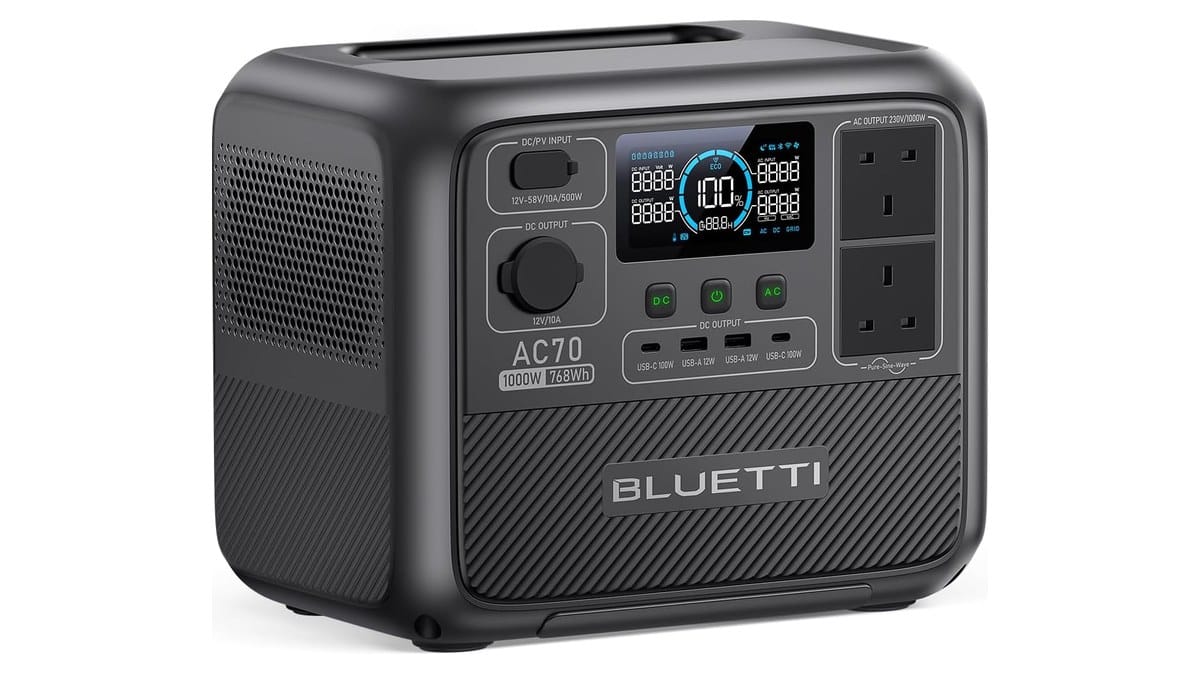
BLUETTI AC70
768Wh at 10.2 kg. The step up to take when a weekend of electronics is not the whole job.
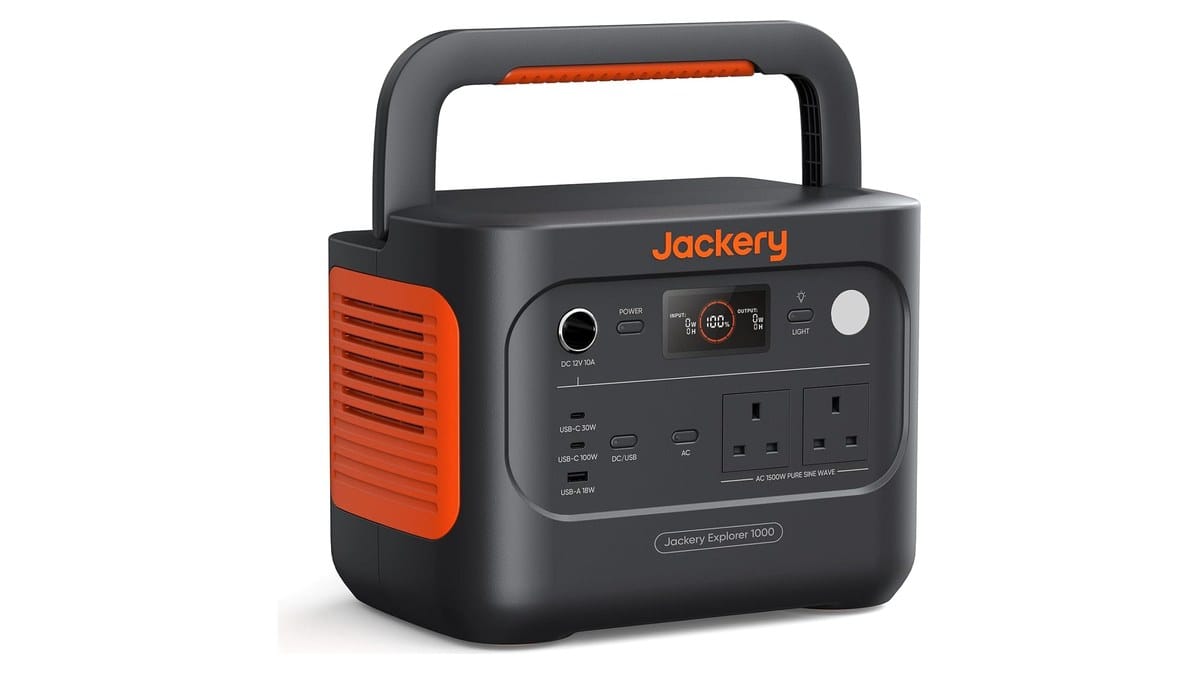
Jackery Explorer 1000 v2
1,070Wh at about 11 kg, and 4,000 cycles. Take it if you want mains power for a whole trip.
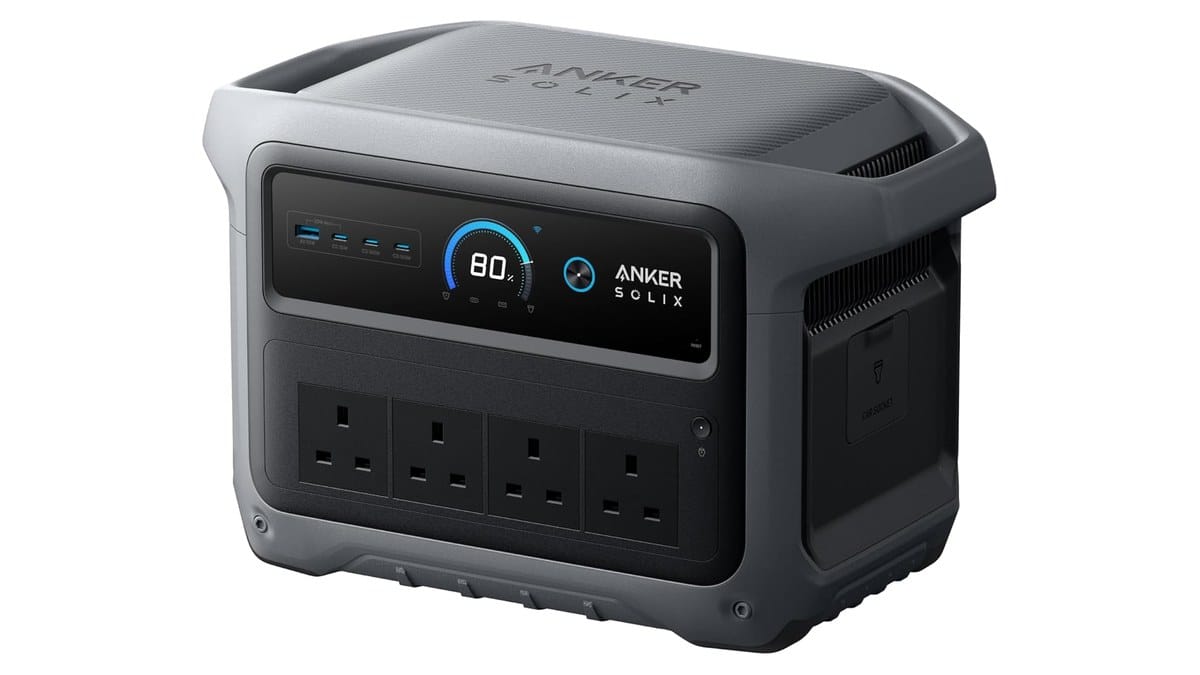
Anker SOLIX C1000 Gen 2
2,000W from about 11.3 kg. The one to take if the 600W ceiling is your sticking point.
All three sit in our portable power station roundup with the full reasoning.
FAQ
Questions readers ask
Can the EcoFlow RIVER 3 Plus run a 1200W device?
No. The unit delivers 600W continuously, and the 1200W on the box is X-Boost, a short assist that helps a heavier appliance start. The Solar Lab put its duration at around four minutes. Plan around 600W.
How long does the EcoFlow RIVER 3 Plus take to charge?
EcoFlow quote about an hour from empty on mains, at up to 360W input. On solar they quote 1.5 hours, though that assumes the full 220W of panel. Bob Vila field-measured close to eight hours from 10 percent on a 45W panel.
Can you take the EcoFlow RIVER 3 Plus on a plane?
No. Airlines cap spare lithium batteries at 100Wh in the cabin, or 160Wh with prior approval, and this holds 286Wh. It cannot travel in the hold either.
Does the EcoFlow RIVER 3 Plus work as a UPS?
Yes, and this is its strongest feature. EcoFlow claim a switchover under 10 ms and StorageReview measured 9 ms on a mains power analyser. That is fast enough for a desktop PC or a NAS to ride through a cut without rebooting.
What can a 286Wh power station run?
EcoFlow quote up to 35 hours on a 3W Wi-Fi router and at least 21 minutes on a 600W computer, which brackets the range. Electronics sip it and heating appliances empty it. Bob Vila measured a six-cup coffee brew taking 43 to 45 percent of a full charge.
How many sockets does the EcoFlow RIVER 3 Plus have?
Seven outlets: three AC sockets, all backup capable, one 100W USB-C, two 12W USB-A and one 12V car socket. The count is the same in every region, and only socket type and voltage change. An expansion battery adds a further 140W USB-C port.
Is the EcoFlow RIVER 3 Plus battery expandable?
Yes. The EB300 takes the total to 572Wh and the EB600 takes it to 858Wh, attaching by pogo pins with no cable. It does not raise the 600W AC output, so it buys more hours rather than more watts.
How long will the EcoFlow RIVER 3 Plus last before the battery degrades?
EcoFlow rate the LiFePO4 pack at 3,000 cycles to 80 percent of original capacity or better, which they frame as more than ten years of use. The UK retail listing states a five year warranty.
Final word
The number that holds
Most reviews of this unit repeat the bigger number. The useful review tells you which number holds.
This one holds 600W for as long as you need it, and switches over in nine milliseconds when the mains disappear.
Keep reading
Browse all our power station guides and reviews.
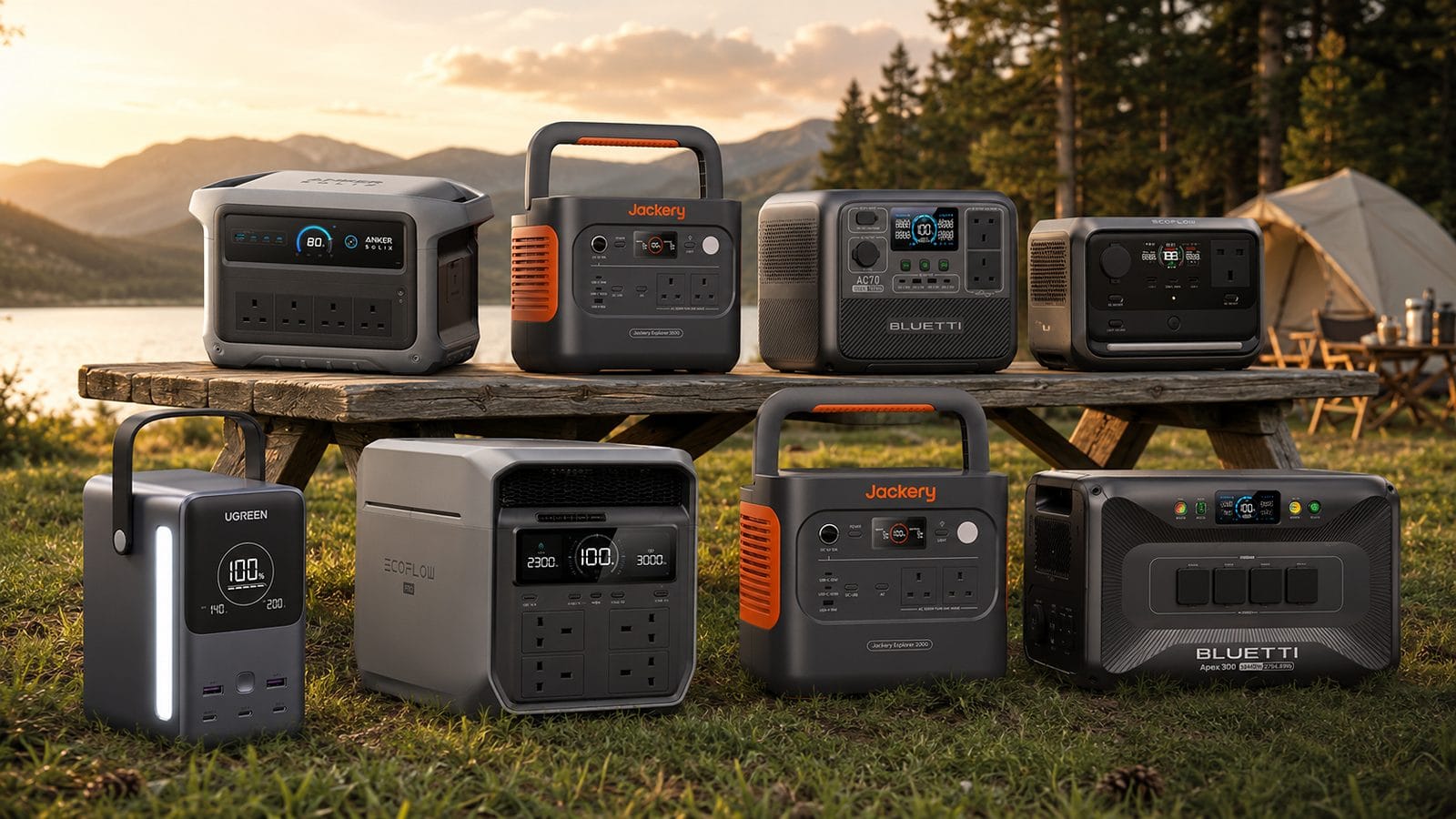
Best Portable Power Station 2026
The full shortlist, and where this one earns its place.
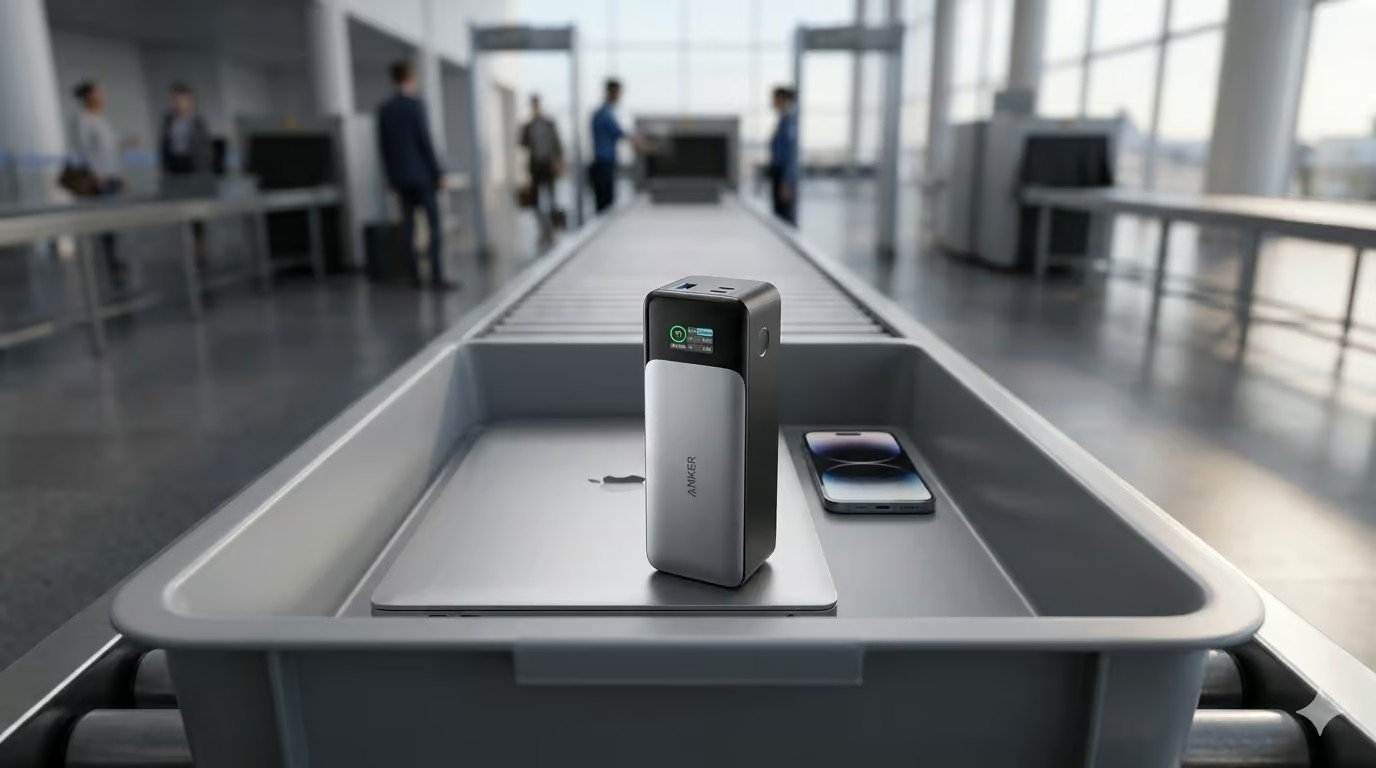
Can You Take a Power Bank on a Plane?
Every carrier’s watt-hour rules in one place.

mAh to Wh Calculator
Convert your own gear into the unit power stations are sold in.
Jackery Explorer 1000 v2 Review
A full kilowatt-hour in a light package, with 4,000 cycles.
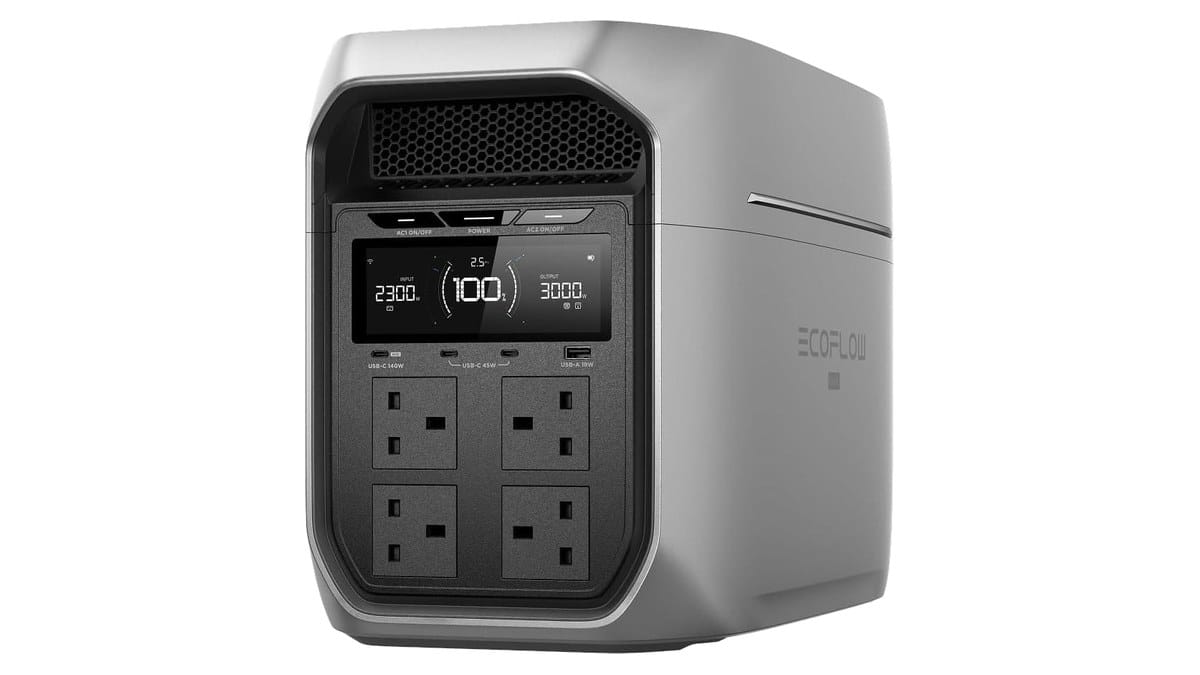
EcoFlow DELTA 3 Max Plus Review
2,048Wh and a one hour recharge for whole-home backup.
Anker SOLIX C1000 Gen 2 Review
2,000W output and a 49 minute recharge for bigger jobs.
Latest from SmartGadgetKit
 Lithium Ion Battery Fire Statistics 2026
 LISEN Power Bank Review: The Qi2.2 25W MagSafe 10000mAh, Measured
 How Long Does a Power Bank Last? Charges, Years and Sizing
 Anker Prime 250W Charger Review: 6-Port Desktop Hub
 Anker Prime 300W Power Bank Review: Two Laptops, One Socket-Free Table
 Jackery Explorer 2000 v2 Review: The Lightest Way to Carry 2kWh?
 BLUETTI AC70 Review: What 2,000W Power Lifting Is Worth
 BLUETTI Apex 300 Review: The Two Accessories That Are Not In The Box
How we score, and who stands behind it
Our verdicts pair manufacturer and retailer specs with named independent testing, and we tell you the trade-offs rather than only the wins. See how we test.