Buying guide
How to choose a power bank
A power bank is a battery in a box that refills your phone, tablet or laptop when there’s no socket in sight.
How to choose a power bank comes down to four numbers, and you can have all four in five minutes.
The quick answer
Want a good one without the research?
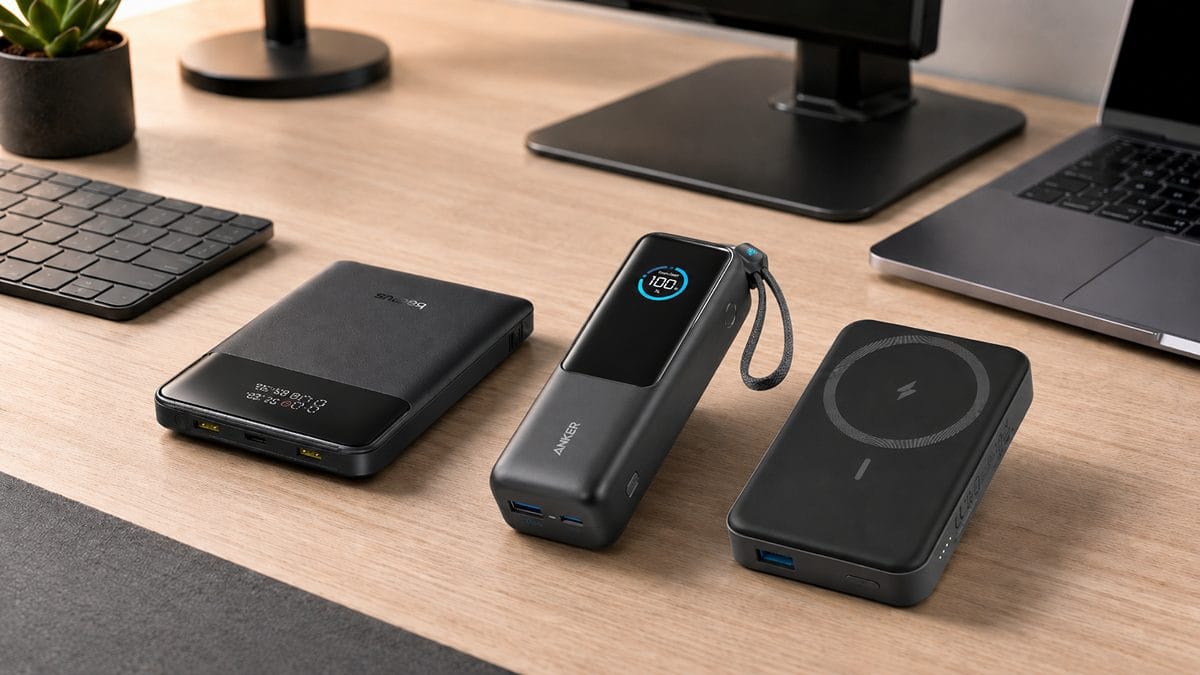
Get the Anker 87W 20K
- 20,000mAh is roughly four phone charges
- 87W fills a 14 inch laptop at full speed instead of trickling into it
- The USB-C cable is built into the body, so that’s one less thing to forget
- It’s our Best Overall in the full roundup too, so this guide and that page agree
Pick checked 17 Aug 2026, in stock at the time of writing. How we test and score.
That covers most people. If you want one matched to your exact devices, your trips and the bag you carry day to day, the next five minutes are for you.
The short version
The four numbers to shop with
Everything below unpacks these. If you only remember four things, make it these four.
In order of importance
How to choose a power bank: three questions decide it
Answer them in this order and the right power bank picks itself.
What are you charging, and how many times?
Sets the capacity. Capacity then sets the size and weight you carry.
Jump to sizeHow fast does it need to fill?
Sets the wattage. Get this wrong and your laptop charges while you sleep, not while you work.
Jump to speedWhere will it live?
A uniform pocket, a handbag or a suitcase. That’s what decides which tier you can live with, and it is settled inside the size tiers below.
Jump to the size tiersMake it yours
What are you charging?
Tap the hungriest thing you’ll plug in. The size tier and the wattage row that match you light up below.
Question one
What size power bank do you need?
Capacity is measured in mAh. What it tells you is how many refills you get, and how much you carry to get them.
5,000 to 10,000mAh
The one that stays in your pocket, because you stop noticing it’s there. Best for daily top-ups, nights out and commutes.
See the best magnetic power banks ›20,000mAh
The sweet spot, and where most people land. Enough for a weekend away, a long flight, or two people’s phones on a day out. Best for travel, weekends and heavy phone days.
See the best 20,000mAh picks ›25,000mAh and 100W or more
Heavy, and worth the weight only if a laptop is in the bag. Best for remote work and long-haul flights.
See the laptop-ready picks ›The honest caveat: the number on the box is the capacity of the cells inside, not what reaches your phone. Stepping the battery voltage up to USB voltage throws off heat, so expect roughly 60 to 70 percent of the rated figure in real use.
A 20,000mAh bank delivers around 13,000mAh of actual charge. Every brand is measured the same way, so the box number is still fair for comparing two banks. Don’t plan your day around it.
 Darleene asks
“The box says 20,000mAh and my phone is 3,000mAh. So that’s six charges?”
Alisdair: I wish. About four. The battery inside sits at roughly 3.7 volts and your phone wants 5 volts or more. The bank has to step the voltage up, and that conversion throws off heat. The heat is your missing charges. Every bank loses it, so the box number is still fair for comparing two. Just knock a third off before you plan around it.
Already know your answer? Skip the theory. Go straight to the best power banks we recommend right now.
Question two
How fast does a power bank need to charge?
Speed is measured in watts. The rule is simple: match the bank to the hungriest thing you’ll plug into it.
The honest caveat: the wattage in big type is usually the total across every port at once, not what a single port gives you. A 100W bank with three ports might hand your laptop 65W and split what’s left.
The cable counts too. A cheap USB-C cable with no E-Marker chip caps at 60W however good the bank is, per the USB-IF Power Delivery spec. Our USB-C cables explained guide covers which cable does what.
Worked out you need laptop power? That’s the tier where the numbers matter most. See the laptop-ready picks we recommend right now.
Before you compare anything else
What to avoid
Four things filter out most of the junk before you compare anything else.
No watt-hours or cell capacity printed
If a listing won’t tell you the Wh rating, you can’t check it against the 100Wh airline limit, and you can’t verify the mAh claim either. Reputable brands print both. Walk away from the ones that don’t.
“Fast charging” with no number next to it
Fast isn’t a spec. Watts are. If a listing promises fast charging but never says 20W, 30W or 65W, assume the slowest thing it could mean.
No safety certification, no named protection circuit
A power bank is a lithium battery that lives in your bag. Look for UKCA or CE marks and a named protection circuit. This is the one corner that’s never worth cutting.
Buying on mAh alone
The biggest number wins on paper and loses in your bag. Divide capacity by weight: under 40 mAh per gram is heavy for what you get, 50 or more is class-leading light. A bank you leave at home has a capacity of zero.
Ready to choose?
These pages do the comparing for you
You now know the numbers. Four routes, depending on where you landed.

Best Power Banks 2026
Eight picks ranked by the job you’d use them for, with the Anker 87W 20K as our Best Overall.
Best 20,000mAh Power Banks
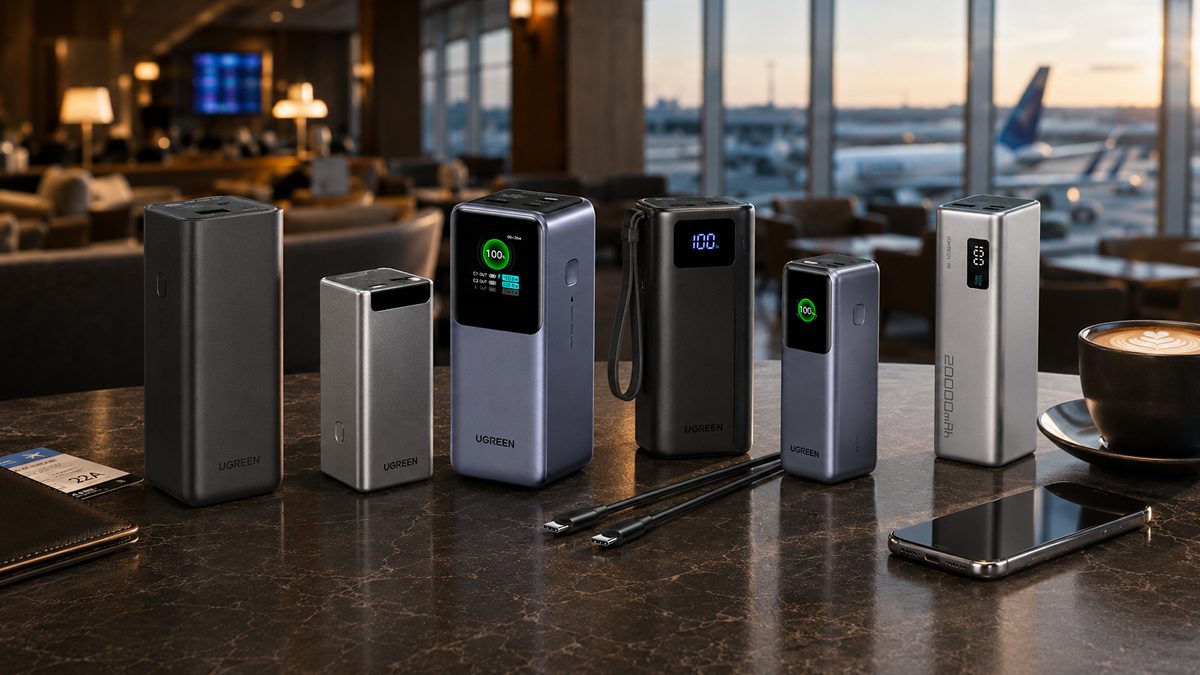
The tier most people land on, with six picks compared on real output, weight and ports.
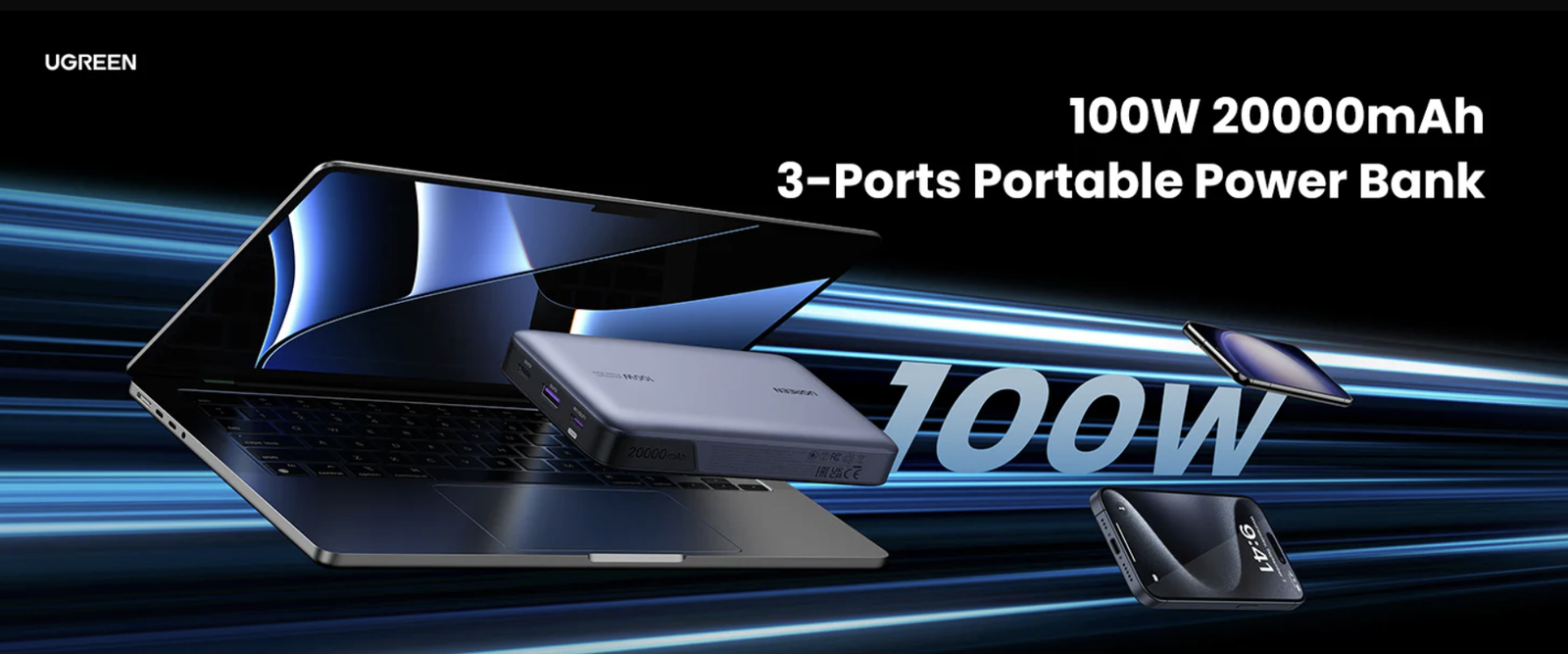
UGREEN Nexode 100W 20K
Everyday 20,000mAh capacity that still pushes 100W, so it covers a laptop without stepping up to the heavy tier.
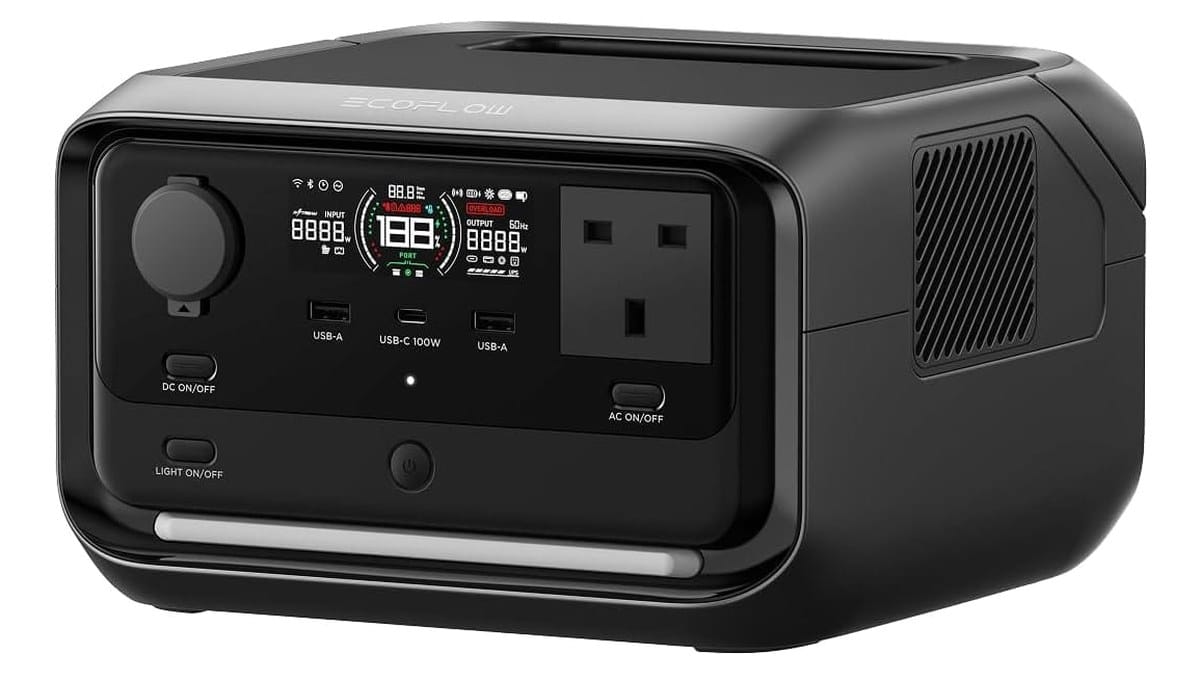
EcoFlow RIVER 3 Plus
If the answer to your question is a mains socket rather than a USB port, you want a power station. This is the small one.
Still narrowing it down? Browse all our charging guides and fixes.
Our verdicts combine hands-on testing by the SGK team with trusted independent lab data. See how we test and score.
Quick answers
Power bank questions, answered
The questions readers ask most, with the direct answer first.
How many phone charges will a 20,000mAh power bank give?
About four for a typical phone, not six. The rated capacity is measured at the battery’s own voltage. Stepping that up to USB voltage loses roughly 30 to 40 percent as heat, so a 20,000mAh bank delivers around 13,000mAh of usable charge. That is about four full charges of a 3,000mAh phone.
What does mAh mean on a power bank?
It stands for milliamp-hours, the size of the battery inside. It tells you how much charge the bank holds, not how fast it delivers it. Speed is watts. The two are independent: a big bank can be slow and a small one can be quick.
Can I take a power bank on a plane?
Yes, in your hand luggage. Under 100Wh (roughly 27,000mAh) needs no approval, and that covers nearly every consumer power bank sold today.
Between 100Wh and 160Wh needs the airline’s permission in advance. Above 160Wh is banned outright, per IATA’s lithium battery guidance. Our guide to taking a power bank on a plane covers the current UK, EU and US rules, and the mAh to Wh calculator converts yours.
Is a higher mAh always better?
No. Capacity costs weight, and weight decides whether you carry it at all. Divide capacity by weight to compare fairly: under 40 mAh per gram is heavy for its class, 40 to 50 is typical, and 50 or more is class-leading. Judge a bank against others in its own class. Magnetic and high-wattage banks carry extra circuitry and score lower as a rule.
What size power bank do I need for a laptop?
25,000mAh and at least 100W output for a 16 inch laptop, or 20,000mAh at 65W for a 13 to 14 inch machine. Below 65W a laptop gains charge slower than it spends it while you work.
How long does a power bank take to recharge?
Between three and six hours for a 20,000mAh bank, depending on the input wattage it accepts and the charger you feed it. Check the input rating, not only the output. A bank that takes 30W in refills roughly twice as fast as one that takes 15W.
Do power banks lose charge when they are not being used?
Yes, slowly. Expect to lose a few percent a month through self-discharge. Top a bank up before a trip rather than trusting a charge from weeks ago. Store it around half full if it will sit unused for months.
How does SGK test and score power banks?
We score every power bank on four criteria: charging speed, carry rating, value for money, and port and cable design. Our verdicts combine hands-on testing by the SGK team with trusted independent lab data, and we name the source behind every hard number. See how we test and score.
Behind this guide
SGK verdicts combine hands-on testing by our team with trusted independent lab data, and we tell you the trade-offs, not only the wins.