Review · Power banks · 25188
UGREEN Nexode 100W Power Bank Review: 20,000mAh Laptop Charger
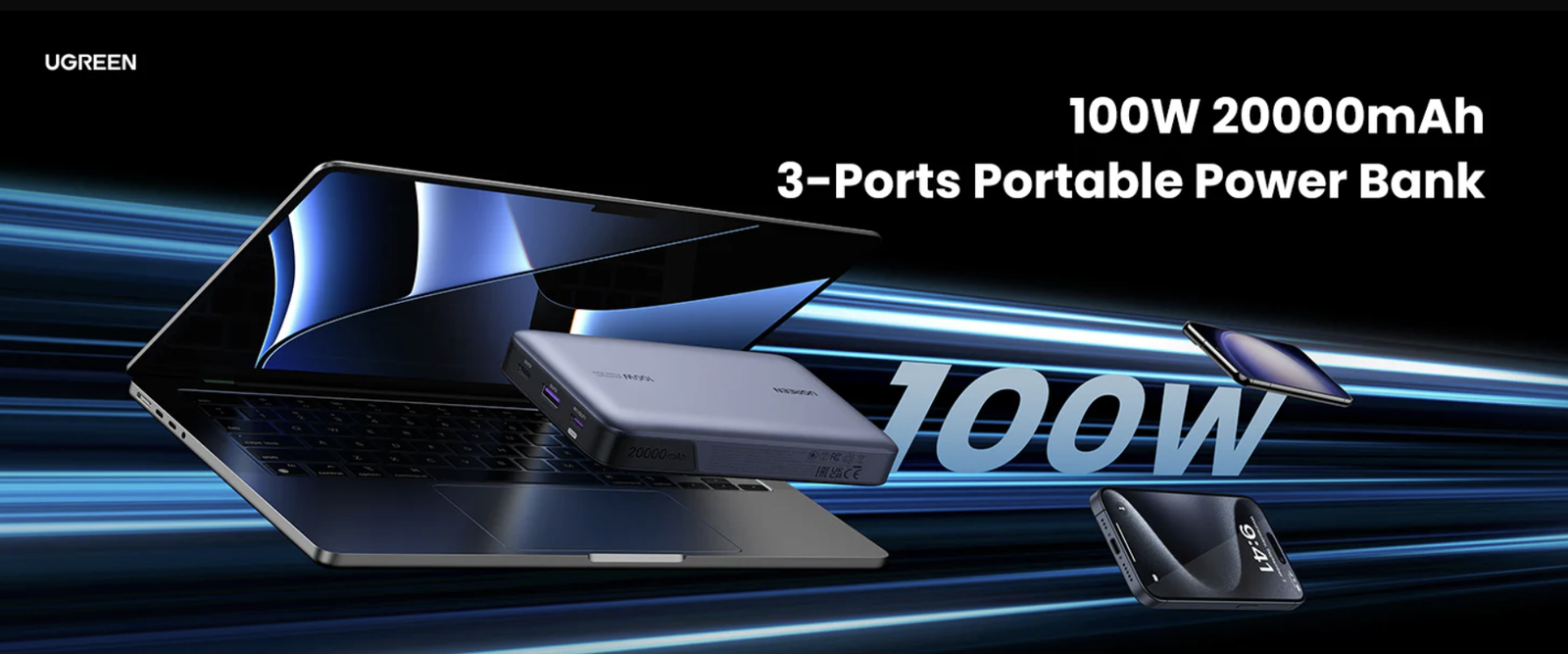
The UGREEN 100W power bank promises what most 20,000mAh banks cannot deliver: enough output to charge a laptop at close to full speed, rather than keeping it ticking over. This review covers the UGREEN Nexode 100W power bank, model 25188, for one-laptop buyers.

Scored against independent measured testing
SmartGadgetKit is reader-supported. We may earn a commission if you buy through links on this page, at no extra cost to you. We only recommend gear we would carry ourselves.
Expert Score
A genuine 100W, airline-friendly 20,000mAh bank that charges a laptop at near full speed, as long as you accept the weight and feed one device at a time.
Pros
- True 100W single-port output, independently measured at 98W into a laptop
- 72Wh rating keeps it airline carry-on legal
- Ships with a premium 240W USB-C cable and a travel pouch
- Strong measured efficiency of 81.4% in independent testing
Cons
- At 420g it is a laptop-bag brick, not pocketable
- No built-in cable
- Main port eases to around 60W as soon as a second device is connected
Key takeaways
Six numbers that decide whether this is your bank
Quick specs
The paper numbers for the UGREEN Nexode Power Bank (20K, 100W)
| Model number | 25188 |
| Capacity | 20,000mAh (72Wh) |
| Max output | 100W (USB-C1) |
| Ports | 2x USB-C, 1x USB-A |
| Weight | 420g |
| Dimensions | 139 x 80 x 26.5mm |
Specs confirmed against the UGREEN UK and Amazon UK listings for SKU 25188. Performance figures come from independent testing by Trusted Reviews and MacRumors. See how we test and score.
First impressions
Out of the box, the Nexode 100W reads as a serious laptop bank, not a pocket topper. It’s a dense, square-edged block at 420g, closer to a small hardback than a phone charger.
The matte shell picks up scuffs more readily than the brushed finishes on some rivals, something Trusted Reviews also flagged.
A simple LED readout on the front shows a rough charge level, four dots rather than the precise percentage screen UGREEN reserves for its pricier Nexode models.
What lifts the first impression is the kit in the box. UGREEN bundles a braided 240W USB-C cable rated well beyond anything this bank will draw, plus a soft travel pouch and a manual. There’s no cable built into the body, so that included lead is the one you’ll carry.
Design and build
A 420g laptop bank with the port layout that makes the 100W claim possible
The Nexode 100W measures 139 x 80 x 26.5mm and weighs 420g, putting it mid-pack for the 20,000mAh laptop class. UGREEN publishes both figures on its 25188 product page, and the weight there is the product weight rather than a shipping weight.
Inside are 21700 lithium-ion cells, the larger high-density format you want for sustained high-wattage output. UGREEN specifies this on the product page; we have not opened a unit to confirm it.
The port layout is two USB-C and one USB-A along the top edge: USB-C1 is the 100W input and output port, USB-C2 tops out at 30W, and the USB-A handles up to 22.5W. That is the layout that makes the 100W claim possible, and it is also why the USB-A port is best thought of as the phone or earbuds socket rather than a third serious output.
On safety, UGREEN specifies UL94 V-0 flame-retardant housing and a full protection suite covering over-voltage, over-current, over-charge, over-discharge, high temperature and short circuits. Confirm the exact certification marks on the unit and packaging when yours arrives.
In the box
You get the power bank, a 240W USB-C to USB-C cable, a travel pouch and a user manual, on UGREEN’s own list. If you want a sense of what a good 240W cable does for a pack like this, our UGREEN 240W USB-C cable review covers the one in the pouch.
 Darleene asks
“Everyone keeps saying 100W like it is the whole point. My phone charges fine off any bank. Why would I pay for 100 watts?”
Alisdair’s answer: Because phones were never the problem. Almost any power bank charges a phone.
The wattage only matters when you want to charge a laptop, and a laptop needs far more than a phone does.
At 100W this one charges a laptop at close to full speed, the same as its wall charger, instead of slowly losing the race while you work.
If you only ever charge a phone, you do not need 100W, and you would be paying for headroom you will not use.
Independent testing
What the UGREEN Nexode 100W delivers under test
Two independent reviewers put meters on this power bank. Each result below is theirs, named in full and never linked.
Measured over 98W from the main USB-C port while charging a Samsung Galaxy Book 3 set to a 100W ceiling, about as close to the rated figure as you will realistically see once cable and conversion losses are counted.
Charged an M3 MacBook Air 13-inch from 10% to 50% in around 25 minutes and from 10% to full in about an hour, leaving roughly 10% in the bank afterwards.
Logged 76.01Wh going in and 61.93Wh coming out, a measured 81.4% round-trip, which is good for a bank pushing this much power.
That is genuine laptop-grade output, not the 30W to 45W trickle that many 20,000mAh banks quietly cap at.
MacRumors ran the everyday laptop and phone tests. An iPhone 15 Pro reached about 60% in 30 minutes and full in under an hour, and the remaining capacity could refill that iPhone from near empty more than twice. So the practical picture is one full laptop charge with a little headroom, or two-plus phone refills.
UGREEN does not publish a surface temperature and no independent outlet recorded one, so we are not quoting heat figures we cannot stand behind.
Multi-device behaviour is the main caveat. The moment a second device is connected, the main port eases from 100W to around 60W, with the secondary USB-C and USB-A then sharing roughly 20W between them.
In Trusted Reviews’ all-three-port test, the USB-A delivered about 7W and the second USB-C a little over 14W. It’s a one-fast-device bank that can keep a phone and earbuds topped up on the side, not a true three-device hub.
Darleene’s version: Charge one thing fast, or a few things slowly. Plug the laptop in on its own and it flies; add a phone and earbuds and the power shares out.
The single figure that decides it for anyone who flies. The 72Wh rating sits well under the 100Wh cabin ceiling most airlines apply, so you are carrying laptop-grade output with clear carry-on headroom. Airlines set their own rules, so confirm with yours before you travel.
If genuine 100W laptop charging is the job you are buying for, the evidence above is the whole argument.
amazonCheck latest pricePass-through charging
The Nexode 100W supports pass-through, meaning it can charge a connected device while the bank itself is being recharged from the wall.
MacRumors confirmed this in use, which makes it handy as an overnight desk hub: leave it plugged in, charge your phone or laptop off it, and the bank tops itself back up in the background.
Because the input is capped at 65W, expect the bank’s own refill to slow while it is also feeding a device, so for the fastest top-up, recharge it on its own.
Portability and travel use
At 420g and 26.5mm thick, this is a laptop-bag or jacket-pocket power bank, not a jeans-pocket one.
That weight is the trade-off for genuine 100W output and a 20,000mAh cell, and it is in line with rivals in the class rather than unusually heavy.
The included pouch keeps the scuff-prone shell and the 240W cable together in a bag, which is more useful than it sounds on a travel day.
For air travel, the 72Wh rating is the number that matters, and it sits well inside the limits.
Can you take it on a plane?
At 72Wh, the Nexode 100W is under the 100Wh threshold airlines apply to lithium batteries, so it travels in carry-on hand luggage on the major carriers.
It must go in the cabin, never checked baggage. Always confirm with your airline before you fly.
Our guide to taking a power bank on a plane covers the cabin rules in detail, and you can check any capacity in seconds with our mAh to Wh calculator.
Specifications
Every figure, with its source attached
Manufacturer figures are specifications or claims. Measured figures belong to the independent outlet named beside them. Nothing on this page was measured by SmartGadgetKit.
| Specification | Figure | Source |
|---|---|---|
| Model number | 25188 | UGREEN |
| Capacity | 20,000mAh (72Wh), 21700 lithium-ion cells | UGREEN |
| USB-C1 output | Up to 100W (PD 3.0, PPS, QC 3.0) | UGREEN |
| USB-C2 output | Up to 30W | UGREEN |
| USB-A output | Up to 22.5W | UGREEN |
| Multi-device output | Main port eases to around 60W; secondary USB-C and USB-A share roughly 20W | Trusted Reviews |
| Input | Up to 65W (USB-C1) | UGREEN |
| Recharge time | 50% in about 50 minutes, full in roughly 99 minutes | Trusted Reviews |
| Measured output | 98W peak, 81.4% efficiency | Trusted Reviews |
| Display | Simple four-dot LED level indicator | UGREEN |
| Dimensions | 139 x 80 x 26.5mm | UGREEN |
| Weight | 420g | UGREEN |
| Protection | UL94 V-0 housing; over-voltage, over-current, over-charge, over-discharge, high-temperature and short-circuit protection | UGREEN |
| In the box | Power bank, 240W USB-C to USB-C cable, travel pouch, user manual | UGREEN |
UGREEN specifies UL94 V-0 flame-retardant materials and high-quality 21700 cells, with a protection suite spanning over-voltage, over-current, over-charge, over-discharge, high-temperature and short-circuit protection. Confirm the exact certification marks on the unit and packaging when yours arrives.
If the numbers already make the case for you, the current Amazon listing is one tap away.
amazonCheck latest priceScoring
How the UGREEN Nexode 100W scores
Four category scores, fixed by editorial judgement. The overall is not their average.
The overall lands at 7.4 rather than higher because the audience this suits is narrow. It is an editorial judgement about who should buy it, not an average of the four bars above. One gap stays open: we publish no surface temperature figure because UGREEN does not publish one and no independent outlet recorded one.
The verdict
The UGREEN Nexode 100W does the hard thing well. It charges a laptop at close to full speed from a 20,000mAh cell that still clears airline carry-on rules, and it backs that up with measured efficiency most rivals cannot match.
You pay for it in bulk and in the lack of a built-in cable, and you give up real speed if you try to charge several devices at once.
For one person who wants a single bank to keep a laptop and a phone going through a travel day, it is an easy recommendation.
One laptop away from the mains is the job it does properly, and it is the only job worth buying it for.
amazonCheck latest priceShould you buy it?
Where it wins, and where it costs you
Buy it if
- You need real 100W charging for a laptop on the move
- You fly often and want a carry-on legal 20K bank
- You value a bundled high-wattage cable and pouch
Do not buy it if
- You want something light enough for a pocket
- You routinely fast-charge two or more devices at once
- You prefer a bank with a cable built in
Buy it if working away from sockets with a laptop is your normal, skip it if a phone is the whole job.
amazonCheck latest priceHow it compares
The two products a reader is most likely weighing against it
| UGREEN Nexode 100W | Anker Prime 300W | INIU 65W 20K | |
|---|---|---|---|
| Cell capacity | 20,000mAh | 26,250mAh | 20,000mAh |
| Rated energy | 72Wh | 99.75Wh | 72Wh |
| Maximum total output | 100W | 300W | 65W |
| Maximum single USB-C | 100W | 140W | 65W |
| Weight | 420g | 600g | ~350g |
| Best for | One laptop at near full speed | Two laptops at full rate at once | Value buyers on a 65W budget |
Rival figures come from the manufacturer product pages for the Anker Prime and INIU models. No independent outlet we found has instrumented the INIU 65W 20K, so treat that column as manufacturer-stated.
If this one is not the fit
Three alternatives, three different readers
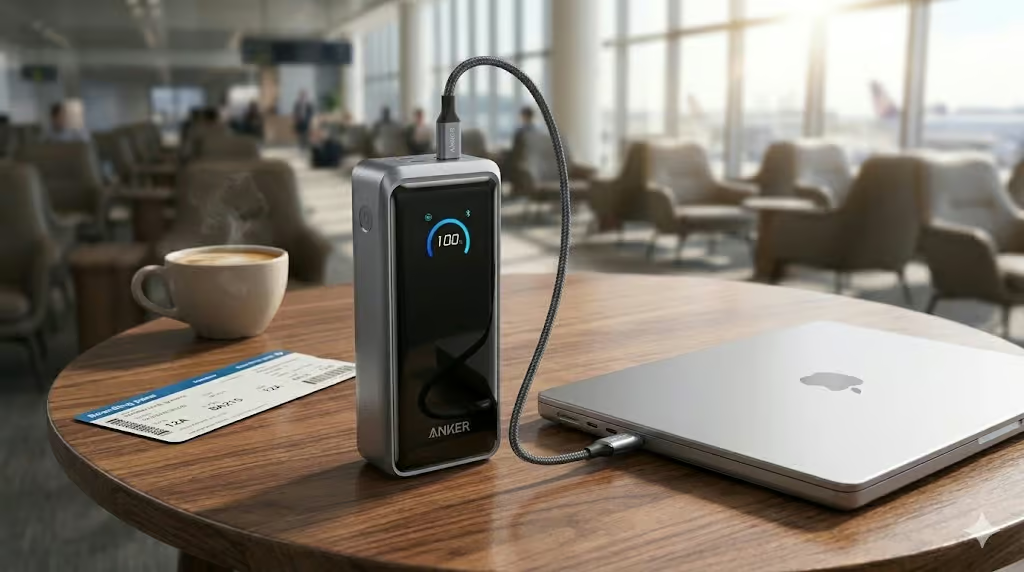
Anker Prime Power Bank (26K, 300W)
Steps up to 300W total and a bigger 26,250mAh cell with a full smart display, so it can charge two laptops at once where the Nexode eases off. It is our top premium pick in the best power banks roundup.
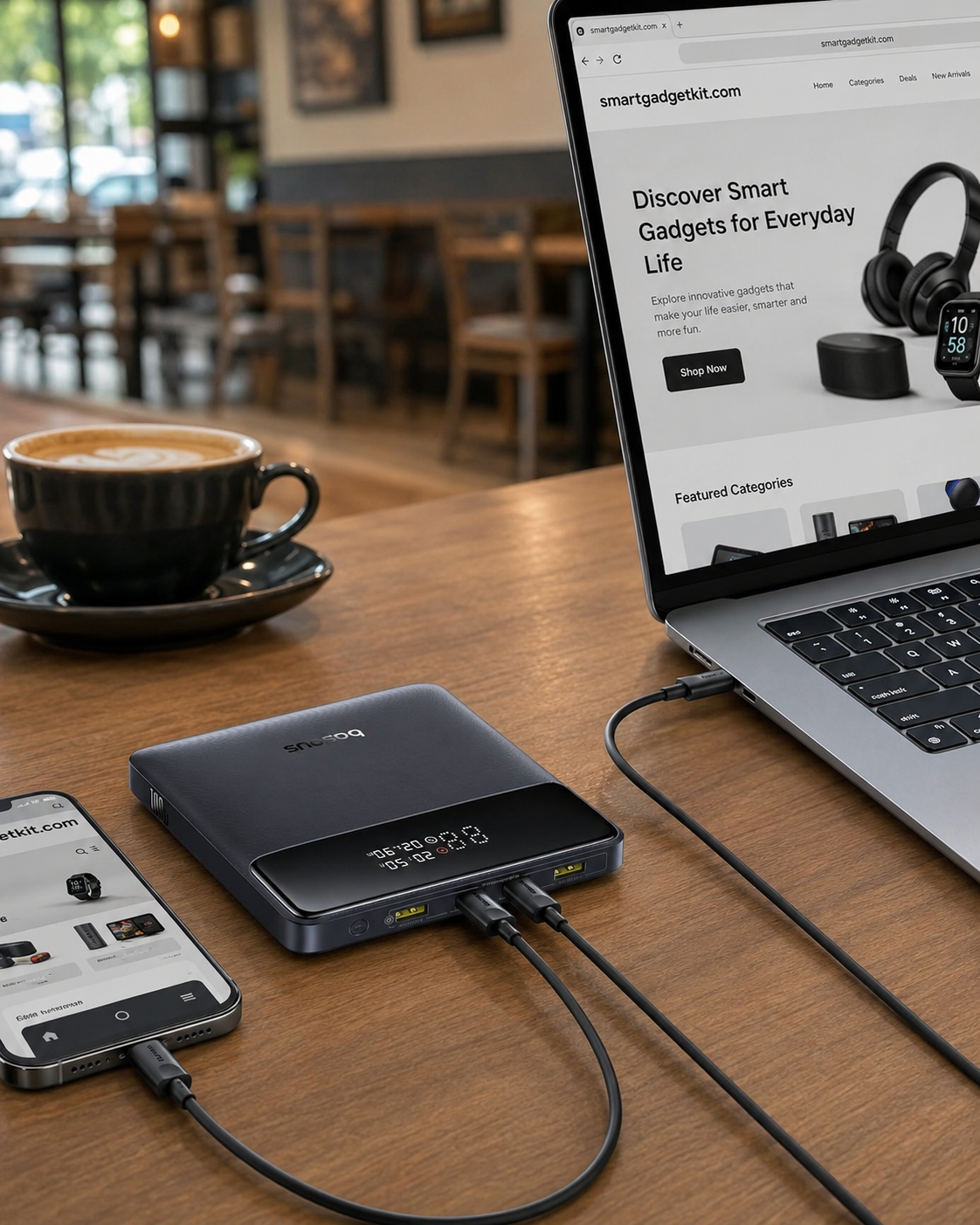
Baseus Blade2 12,000mAh 65W
A flat, slim 65W bank that slips into a bag far more easily than the Nexode brick. You trade capacity and top-end wattage for portability, and dispatch can be slow, so check delivery before you buy.
INIU 65W 20,000mAh
Same 20,000mAh class for less, with a 65W ceiling that still covers most ultrabooks and every phone. The sensible choice if you want laptop-capable charging without paying for the full 100W.
FAQ
Questions readers ask about the UGREEN 100W power bank review
How much does the UGREEN 100W power bank weigh?
420g. UGREEN lists it as the product weight rather than a shipping weight, which is the figure that matters when comparing bags.
Is the UGREEN Nexode 100W power bank any good?
Yes, for its intended job. Independent testing by Trusted Reviews measured 98W from the main port and 81.4% efficiency, both strong for a 20,000mAh bank. The main compromises are weight, at 420g, and the lack of a built-in cable.
Can it charge a MacBook Pro or MacBook Air?
Yes. MacRumors charged an M3 MacBook Air from 10% to full in about an hour. The 100W output also covers 14-inch MacBook Pro models, though a large 16-inch Pro under heavy load will draw more than the bank can sustain.
Why is USB-C1 sometimes less than 100W?
The full 100W is only available when one device is connected. As soon as a second device is plugged in, the main port eases to around 60W and the remaining power is shared across the other ports. That is normal behaviour for a single-cell bank.
Is it allowed on a plane?
Yes. At 72Wh it sits under the 100Wh limit airlines apply to lithium batteries, so it travels in carry-on hand luggage. It must stay in the cabin and cannot go in checked baggage. Confirm with your airline, and see our power bank flying guide.
How many times can it recharge a phone?
MacRumors found the remaining capacity could refill an iPhone 15 Pro from near empty more than twice after the bank’s own use. For most modern phones, expect two to three full charges from a single fill.
Does it have a built-in cable?
No. There is no cable attached to the body. UGREEN does include a high-quality 240W USB-C to USB-C cable and a travel pouch in the box, so you have a capable lead from day one.
How long does the power bank itself take to recharge?
It accepts up to 65W input. Trusted Reviews recorded 50% in about 50 minutes and a full recharge in roughly 99 minutes using a charger that can supply 65W.
Does it support pass-through charging?
Yes. It can charge a device while being recharged itself, which MacRumors confirmed in use. Because input is capped at 65W, the bank’s own refill slows while it is also feeding a device.
Does it work with Samsung Galaxy fast charging?
The main port supports USB-C PD with PPS, which Samsung’s fast charging relies on. Trusted Reviews measured 98W into a Samsung Galaxy Book 3, so phones and laptops that use PPS charge quickly.
How does the UGREEN Nexode 20K compare to the 130W model?
The 130W model is a separate, higher-output SKU with a more advanced colour smart display. This 100W version uses a simpler four-dot LED and a lower total output, but covers single-laptop charging fully. Choose the 130W only if you need more headroom across multiple ports.
Final word
A focused bank that knows what it is for
The UGREEN Nexode 100W is a focused bank that knows what it is for. It will not win on size or pocketability, but it delivers the genuine laptop-grade charging and airline-friendly capacity that most 20,000mAh banks only hint at, and the measured test data backs that up.
If you want one bank to carry a laptop and a phone through long days and longer journeys, it belongs on your shortlist. See how we test, or see where it ranks against the rest in our best 20000mAh power banks roundup.
Keep reading

Best 20000mAh Power Banks
Where the UGREEN Nexode 100W ranks against the rest of the 20,000mAh class.
Anker 737. Still the 140W benchmark?
The pack that set the 140W bar, and whether it still holds up against the newer Nexode line.
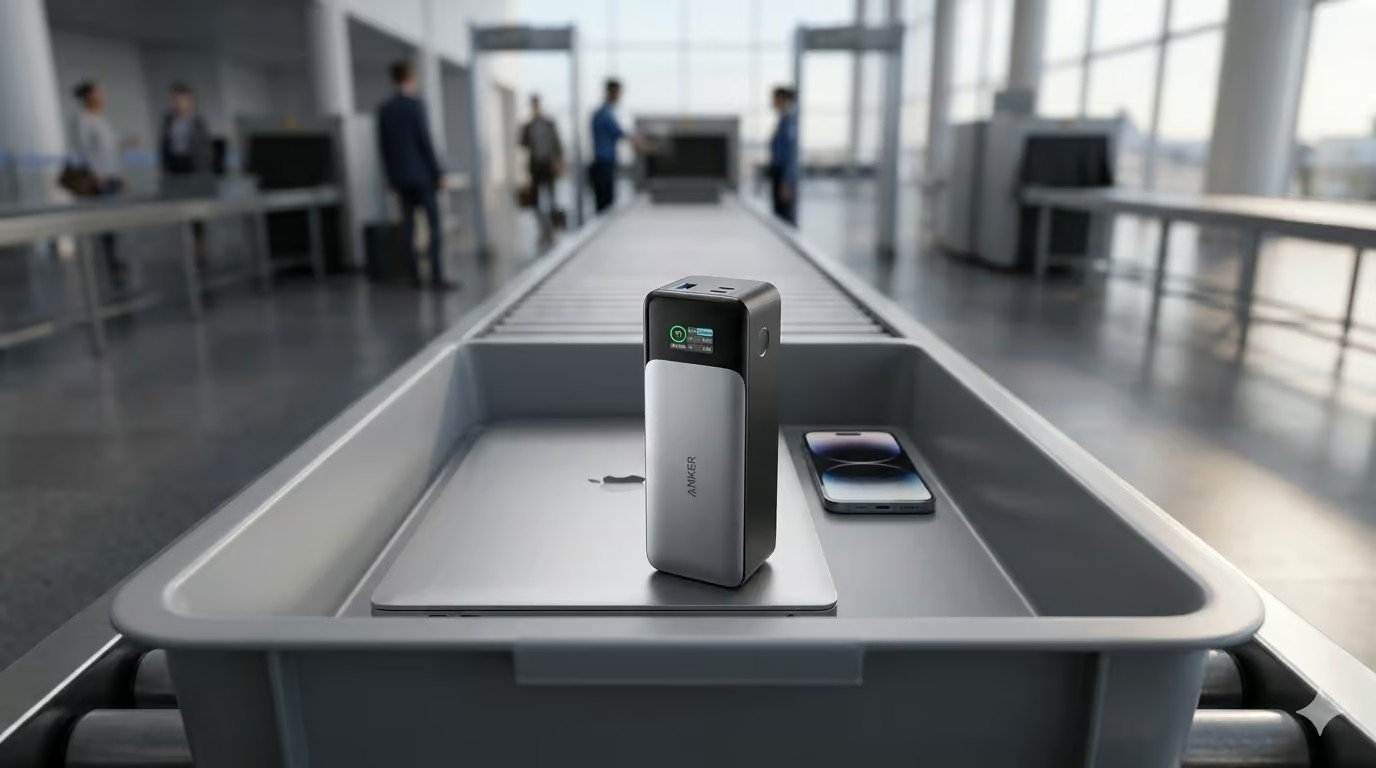
Can you take a power bank on a plane?
The 2026 airline rules: watt-hour limits, how many you may carry, and in-flight use.
Tested by people who know what the numbers mean
SmartGadgetKit checks every spec against the manufacturer and independent sources, and tells you the trade-offs, not only the wins. Independent testing for this page comes from Trusted Reviews and MacRumors, credited where each figure appears.