Review · Power banks · A1695
Anker A1695 Review: A Laptop’s Wall Plug, in Your Bag
The Anker Laptop Power Bank (25,000mAh, 165W) is a portable charger that carries two of its own cables and charges a laptop as fast as the wall charger, if you can carry around 594g. Anker sells this Anker 165W power bank as the Anker Laptop Power Bank (25K, 165W, Built-In and Retractable Cables), model A1695.

Scored against Anker’s published specs and our own travel use
SmartGadgetKit is reader-supported. We may earn a commission if you buy through links on this page, at no extra cost to you. We only recommend gear we would carry ourselves.
Expert Score
The Anker A1695 is a laptop power bank that carries its own cables and charges a MacBook Pro at wall outlet speed. The trade-off is real: around 594g makes it a bag item, not a pocket one.
Pros
- Up to 100W per USB-C port, so it charges a laptop at full speed
- Two built-in cables, one retractable, both carry the full output
- Smart display shows live battery, output, input and time to full
- 90Wh rating clears airline carry-on rules without special permission
- 165W total handles a laptop, phone, tablet and earbuds together
Cons
- Heavy at around 594g, a laptop-bag brick rather than a daily carry
- Premium price tier for the capacity and output
- Overkill if you only ever charge phones and small devices
Key takeaways
Six numbers that decide whether this is your laptop power bank
Quick specs
Anker 165W laptop power bank: the paper numbers
| Capacity | 25,000mAh / approx 90Wh |
| Max output | Up to 165W total |
| Per-port output | Up to 100W per USB-C port |
| Ports | 3x USB-C, 1x USB-A |
| Built-in cables | Two USB-C (one retractable, one lanyard) |
| Weight | Around 594g |
| Airline status | Carry-on approved (90Wh, under 100Wh) |
Specs confirmed against Anker’s official A1695 product page and the Amazon UK listing (SKU A1695, ASIN B0DCBB2YTR). The A1695H11 (Space Black) and A1695H41 (Silver) retail codes carry the same spec set. Charge and output figures are Anker’s published numbers. Our verdicts combine hands-on testing by the SGK team with manufacturer and retailer specs. See how we test and score.
First impressions
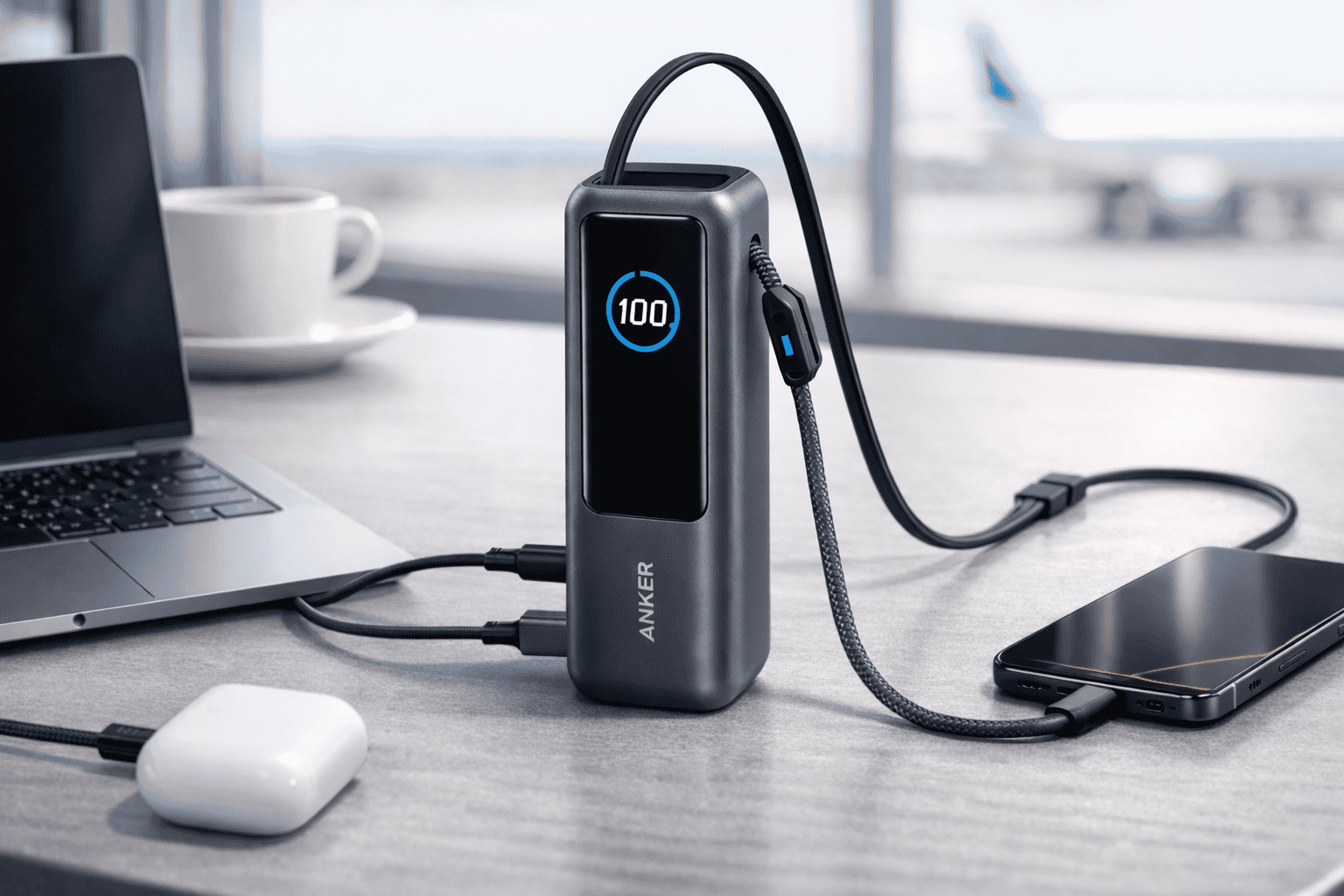
Out of the box the A1695 reads as a premium brick rather than a budget portable charger. The casing is matte black, the edges are rounded, and the smart display on the top face is the detail that signals this is a higher-tier unit.
The two built-in cables are the real surprise. One is a retractable USB-C cable that pulls out to about 0.7m and snaps back into the body. The other is a short lanyard-style USB-C cable that doubles as the carry strap. Both feel firmly anchored, and both are rated to carry the bank’s full output.
The display shows battery percentage, current output, current input and estimated time to full. It is genuinely useful for working out whether the bank is actually delivering the wattage a device is asking for, and how long it needs to refill.
In the box you get the bank itself and a short USB-C cable for recharging. The built-in cables mean the spare cable is optional for most trips.
If you are searching for an Anker 165W portable charger, the A1695 is the model that includes two built-in cables and a smart display rather than forcing you to pack a high-wattage lead.
Design and build
A thick paperback-sized pack with the cables built in
The A1695 is roughly the size of a thick paperback and weighs around 594g. That puts it in the same weight class as a full water bottle, which is fine in a laptop bag and too much in a jacket pocket.
Anker uses ActiveShield 2.0 for temperature and short-circuit protection, and the unit carries FCC, CE and UL marks. The cell layout is the standard high-density 18650-style pack you would expect in a 25,000mAh-class bank, with the extra thermal headroom needed for 100W output.
There are three USB-C ports and one USB-A port. Any of the USB-C ports can output up to 100W individually, and the USB-A port handles lower-power devices. The ports are clearly labeled, and the display lights up when a device is connected so you can see the live wattage at a glance.
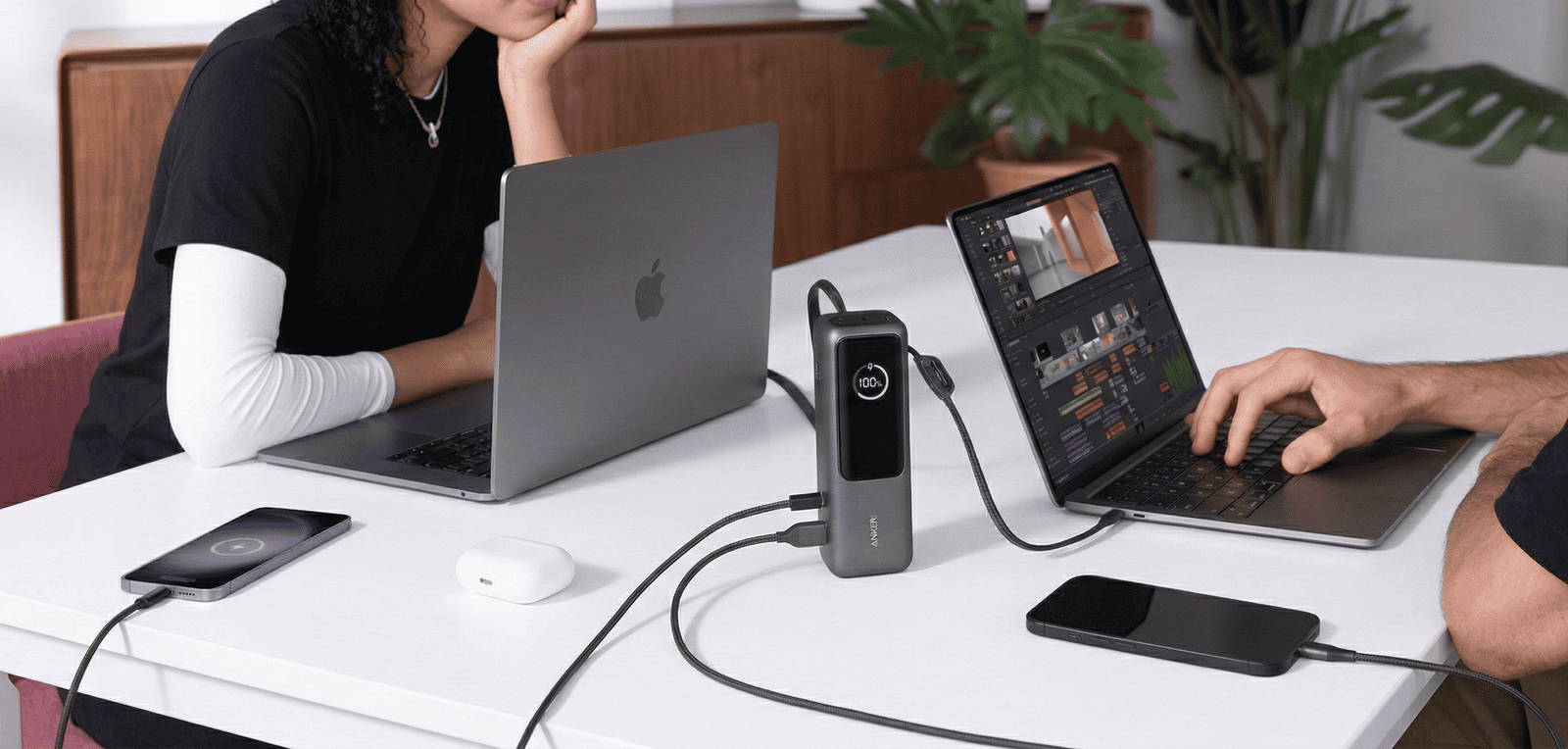
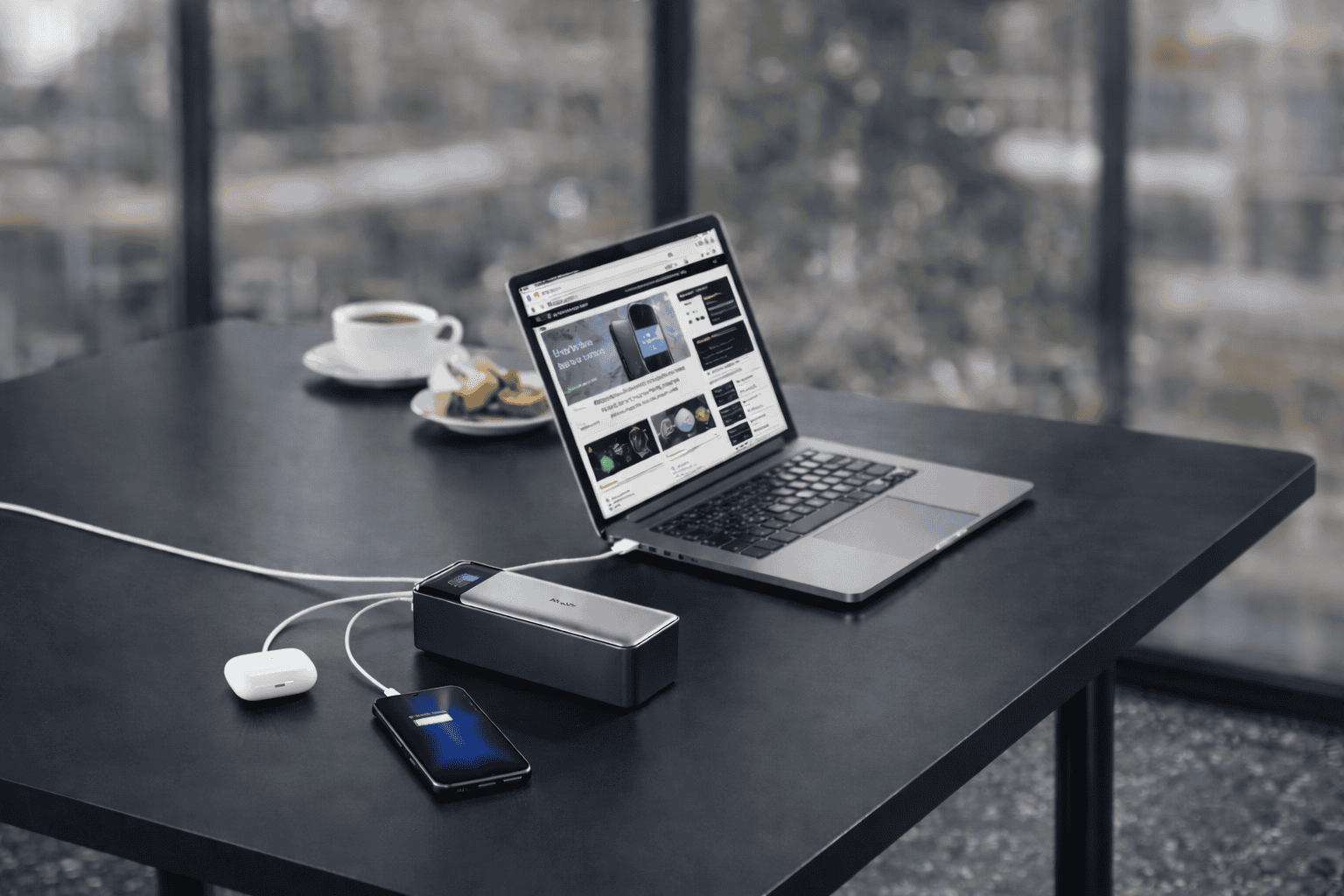
The A1695 charging a laptop and phone together through its USB-C ports.
 Darleene asks
“Do I really need 165 watts? That sounds like a lot just for charging things.”
Alisdair’s answer: For a phone, no. It is far more than you need, and a smaller bank would do.
The 165W matters the moment a laptop is involved. A laptop wants three to five times what a phone does, and most banks simply cannot supply it, so they charge it painfully slowly or not at all.
If the reason you are buying is “I want to top up my laptop on a train or a plane,” this is the spec that makes it possible.
If it is only ever your phone, save your money and your shoulder.
Charging performance
What the A1695 delivers for laptops, phones and travel days
This is the job the A1695 is built for, and the figures below are Anker’s own, read against our travel use of the unit.
Yes, and this is exactly the job the A1695 is built for. A laptop asks for far more power than a phone. A 13-inch MacBook Air wants around 30W to charge at full speed, a 14-inch MacBook Pro around 70W, and a 16-inch closer to 100W.
Most power banks stop at 20W to 30W, so they trickle a laptop instead of charging it. Each of the A1695’s three USB-C ports delivers up to 100W, so it charges a MacBook Pro at the same speed as the charger in the box. Anker quotes 50 percent in 33 minutes for a 16-inch MacBook Pro.
The 165W figure is the total the bank hands out when two devices charge together. Across three or four devices it eases to about 130W. In practice you can charge a laptop, a phone and a pair of earbuds at once, and each still gets a proper share.
I have been carrying the A1695 as my travel bank, and it earns its place on any trip where the laptop comes too. Flying long-haul with a MacBook Pro open on the tray table, it charged the laptop through two films and a work session and still had more than half its capacity left for phones on landing.
Recharging the bank itself is unusually quick for this size because it accepts up to 100W input. Anker quotes 30 percent in 20 minutes on a 100W charger. A low-power phone charger will be slow, so pairing it with a 100W GaN charger makes sense if you want the fast refill.
The one thing no spec sheet tells you is how much calmer travel is when the cables are already attached. You do not need to pack a separate high-wattage cable, and you do not need to remember which of your cables can actually carry 100W.
Darleene’s version: If your laptop comes on the trip, this bank means you do not need to find an outlet at the airport. If the laptop stays home, it is heavier than you need.
Portability and travel use
Here is the honest bit about carry. At roughly 594g the A1695 is heavy, about the weight of a full water bottle riding in your bag. You feel it if you carry it every day for a phone that a 200g bank would top up just fine. This is a laptop bag or backpack item. It is not something you slide into a jacket, and there is no world where it lives comfortably in a pocket.
Judge the weight against the job, though, and it reads differently. A portable charger that can run a laptop, hold two days of phone charge and carry its own cables is always going to be dense. That single distinction, laptop days versus phone days, decides whether the A1695 is right for you.
The 90Wh rating is the quietly important number for anyone who flies. Airlines cap spare batteries at 100Wh for carry-on without special permission, and the A1695 sits just under that, so it goes in the carry-on with no conversation at security.
The built-in cables also change how it fits into a day. There is no loose cable coiled in the bag, no hunting for the one that actually does 100W, and no leaving it on the hotel desk.
Can you take it on a plane?
The Anker A1695 is rated at 90Wh, which sits under the 100Wh threshold airlines apply to spare lithium batteries in carry-on. That means it travels in your carry-on without special permission on most major carriers.
It must go in the cabin, never checked bag. Spare lithium batteries are not allowed in the hold because the cargo environment cannot be monitored the way the cabin can.
Rules shift and some airlines add their own limits, so confirm with your airline before you fly. If you want to check any capacity in seconds, our mAh to Wh calculator does the math, and our guide on taking a power bank on a plane has the full rules.
The single figure that decides it for anyone who flies. The A1695 sits under the 100Wh cabin ceiling most airlines apply, so you are carrying close to the maximum energy allowed with laptop-grade output attached. Airlines set their own rules, so confirm with yours before you travel.
Specifications
Every figure, with its source attached
Manufacturer figures are specifications or claims. Where hard performance figures appear, they are Anker’s published numbers confirmed against the product listing. Nothing on this page was measured by SmartGadgetKit in a lab.
| Specification | Figure | Source |
|---|---|---|
| Model | Anker Laptop Power Bank (A1695) | Anker |
| Capacity | 25,000mAh / approx 90Wh | Anker |
| Per-port output | Up to 100W per USB-C port | Anker |
| Total output | 165W when charging two devices; about 130W across three or four | Anker |
| Ports | 3x USB-C, 1x USB-A | Anker |
| Built-in cables | Two USB-C: one retractable (approx 0.7m), one short lanyard strap cable | Anker |
| Display | Smart display: battery percentage, output, input, time to full | Anker |
| Recharge input | Up to 100W (Anker: 30 percent in 20 minutes on a 100W charger) | Anker |
| MacBook charging | 16-inch MacBook Pro to 50 percent in 33 minutes (Anker) | Anker |
| Weight | Around 594g | Anker |
| Protection | ActiveShield 2.0; FCC, CE and UL | Anker |
| In the box | A1695 power bank, USB-C charging cable | Anker |
Sources: Anker’s official A1695 product page and Amazon UK listing (SKU A1695, ASIN B0DCBB2YTR). Anker specifies ActiveShield 2.0 temperature monitoring and the usual over-current, over-voltage and short-circuit protections. Confirm the exact certification marks on the unit and packaging when yours arrives.
If the numbers already make the case for you, the current Amazon listing is one tap away.
amazonCheck latest priceScoring
How the Anker A1695 scores
Four category scores, fixed by editorial judgment. The overall is not their average.
The 7.5 is an honest average of a bank that is superb at its job and heavy in the hand. The overall lands there because the audience this suits is narrow: laptop travelers who will use the cables and the wattage.
The verdict
The Anker A1695 is one of the best laptop power banks you can carry, provided you are actually carrying a laptop. It charges like a wall outlet, brings its own cables, and slips under airline limits.
It is heavy, and it sits at a premium price, but for travel with a laptop those are easy costs to accept. For phone-only days, look lighter. For everything else, this is the bank that means you never pack a wall charger for the road again.
The reader this is an easy recommendation for is the laptop traveler who wants real 100W charging without carrying a kit of cables and wall chargers.
Genuine laptop charging, two built-in cables and airline-safe capacity: this is the job it does properly.
amazonCheck latest priceShould you buy it?
Where it wins, and where it costs you
Buy it if
- You travel with a laptop and want real 100W charging on the move
- You fly often and want a carry-on legal bank without special permission
- You want the cables built in, so you never pack a kit
Do not buy it if
- Your daily need is a phone and the occasional tablet
- You want something light enough for a pocket
- You would rather not pay for laptop power you never use
Buy it if working away from outlets with a laptop is your normal, skip it if a phone is the whole job.
amazonCheck latest priceHow it compares
The two products a reader is most likely weighing against it
| Anker A1695 Our pick | Anker 737 | Anker 87W (A1383) | |
|---|---|---|---|
| Max output | 165W total / 100W port | 140W | 87W / 65W |
| Capacity | 25,000mAh (approx 90Wh) | 24,000mAh | 20,000mAh (approx 72Wh) |
| Weight | Around 594g | Around 630g | Around 440g |
| Built-in cable | Two (one retractable) | None | One |
| Display | Smart display | Smart display | No display |
| Best for | Laptop travel with cables built in | Highest single-port wattage | Lighter, lower-wattage travel |
Figures come from the Anker and Amazon listings for each model. The A1695 trades raw single-port wattage against the 737 for built-in cables and a lower carry weight.
If this one is not the fit
Three alternatives, three different readers
Anker 737 (PowerCore 24K)
A similar 24,000mAh travel bank with a smart display and a higher single-device ceiling, but no built-in cable, so you pack your own lead. Excellent if you prefer top-end single-port wattage.
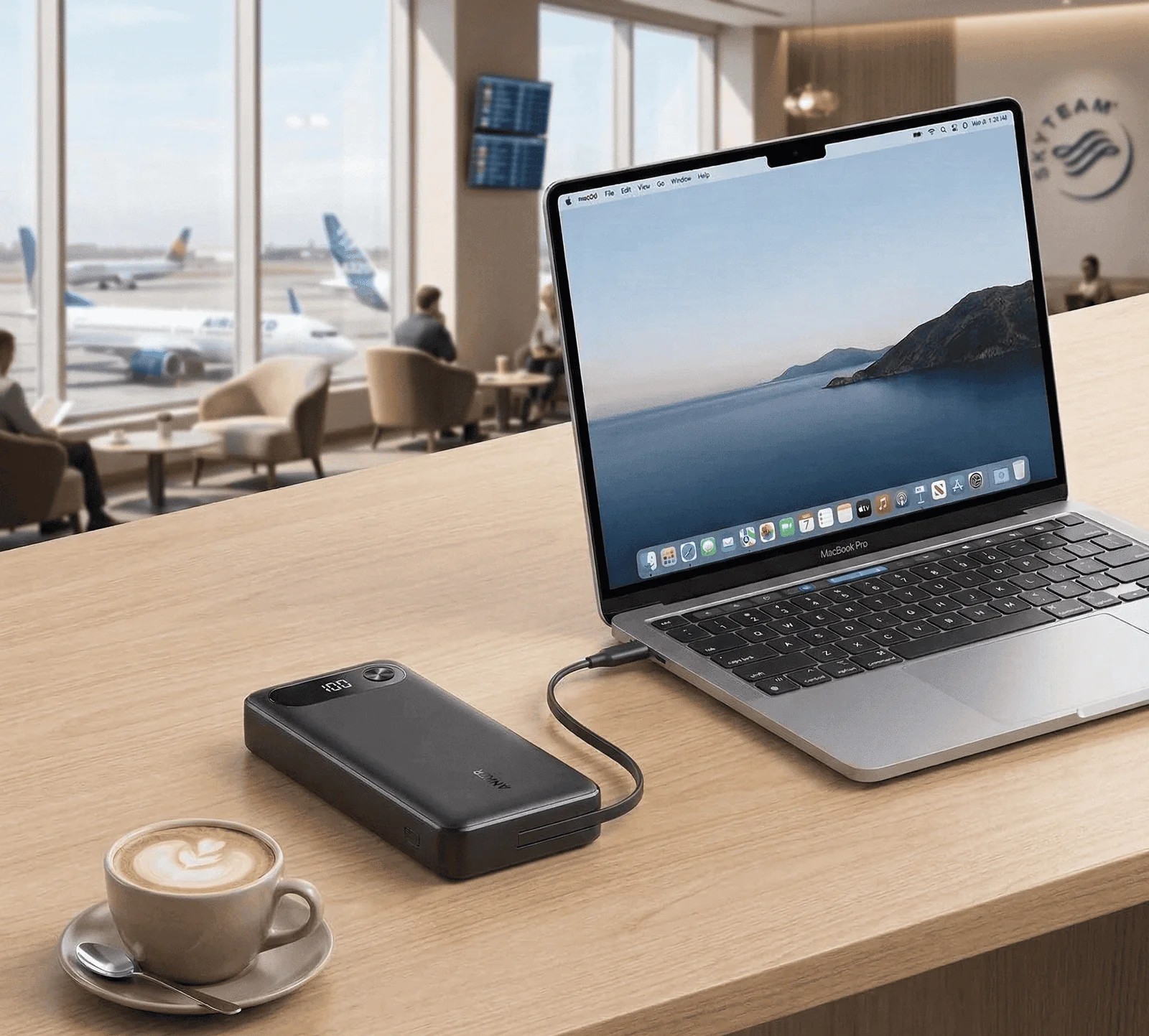
Anker 87W (A1383)
Lighter at around 440g and easier on the wallet, with one built-in cable. It tops out at 65W, so it covers ultrabooks and phones but not full-speed 100W laptop charging.
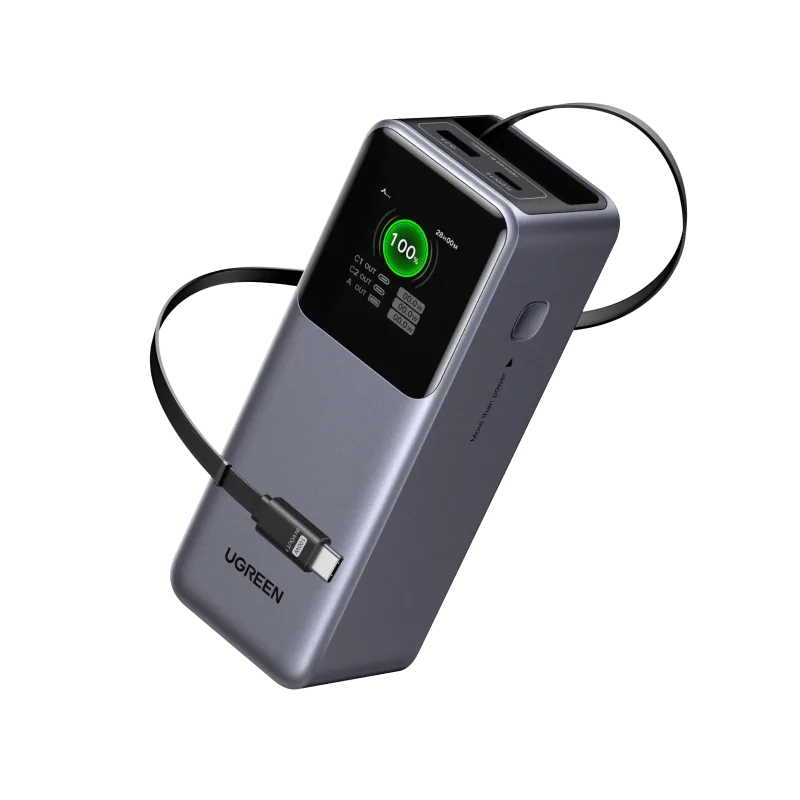
UGREEN Nexode 20000mAh 165W
UGREEN’s closest answer to the A1695: the same 165W ceiling and a built-in retractable USB-C cable, but at around 335g against 594g. You give up capacity, 20,000mAh rather than 25,000, and the second cable, for a bank that is far easier to carry every day.
Need it to run a laptop? Compare every high-wattage pick in our laptop power banks hub.
FAQ
Questions readers ask
Is the Anker A1695 any good?
Yes, for the right buyer. It is one of the best laptop power banks you can carry if you actually carry a laptop, because it delivers up to 100W per port and brings its own cables. The catch is the weight: at around 594g it is too heavy for phone-only users.
Can the Anker A1695 charge a MacBook Pro?
Yes. Its top USB-C port delivers up to 100W, which charges a 14-inch or 16-inch MacBook Pro at full speed, the same as the charger in the box. Anker quotes a 16-inch MacBook Pro to 50 percent in 33 minutes.
What are the Anker A1695 specs?
The A1695 holds 25,000mAh (90Wh), delivers up to 165W across three USB-C ports (each up to 100W) and one USB-A port, and carries two built-in retractable USB-C cables. It weighs around 594g and measures roughly 152 x 70 x 34mm. At 90Wh it sits under the 100Wh airline carry-on limit.
What is the Anker A1695H11?
The A1695H11 is the full product code for the black version of the Anker A1695 Laptop Power Bank (25K, 165W). The H11 suffix identifies the color variant. The specifications, ports and performance are identical to the A1695 reviewed on this page.
Can you take the Anker A1695 on a plane?
Yes. At 90Wh it sits well under the 100Wh carry-on limit that applies on most airlines worldwide, so no special approval is needed. It must travel in your carry-on, never in a checked bag.
Does it really output 165W?
Any one USB-C port supplies up to 100W. The 165W is the total when two devices charge together, easing to about 130W across three or four. So a single laptop gets its full 100W, and the 165W headline is the multi-device total.
How many devices can it charge at the same time?
Up to four, across three USB-C ports and one USB-A, sharing the 165W total.
Are the built-in cables any good?
Yes. There are two, one retractable USB-C and one lanyard-style USB-C, and both carry the bank’s high output, so the built-in cable alone can charge a laptop.
How long does it take to recharge?
With a 100W charger it refills quickly for its size, because it accepts up to 100W input. Anker quotes 30 percent in 20 minutes on a 100W charger. A low-power phone charger will be slow.
Is it worth it over a cheaper power bank?
If you charge a laptop, yes, because few cheaper banks can supply laptop-speed power. If you only charge a phone, a cheaper, lighter bank is the smarter buy.
Anker 737 vs A1695: which is better?
Both sit under the 100Wh airline carry-on limit. The A1695 is lighter at 594g, has two built-in retractable USB-C cables, and shares up to 165W across its ports. The 737 holds 24,000mAh and delivers up to 140W with higher single-port output for demanding laptops. Pick the A1695 for convenience and built-in cables; pick the 737 for maximum single-port power.
Final word
A focused bank that knows what it is for
The Anker A1695 is a focused bank that knows what it is for. It will not win on size or pocketability, but it delivers genuine laptop-grade charging, carries its own cables, and clears airline rules, which is exactly the combination most 25,000mAh banks only hint at.
If you want one bank to carry a laptop and a phone through long days and longer journeys, it belongs on your shortlist. See how we test, or see where it ranks against the rest in our best 20,000mAh power banks roundup.
Keep reading
Browse all our power bank guides and reviews.
Anker 737 Power Bank Review
The higher-wattage rival with a smart display but no built-in cable.
Anker 87W Power Bank Review
The lighter alternative with one built-in cable and a lower output.
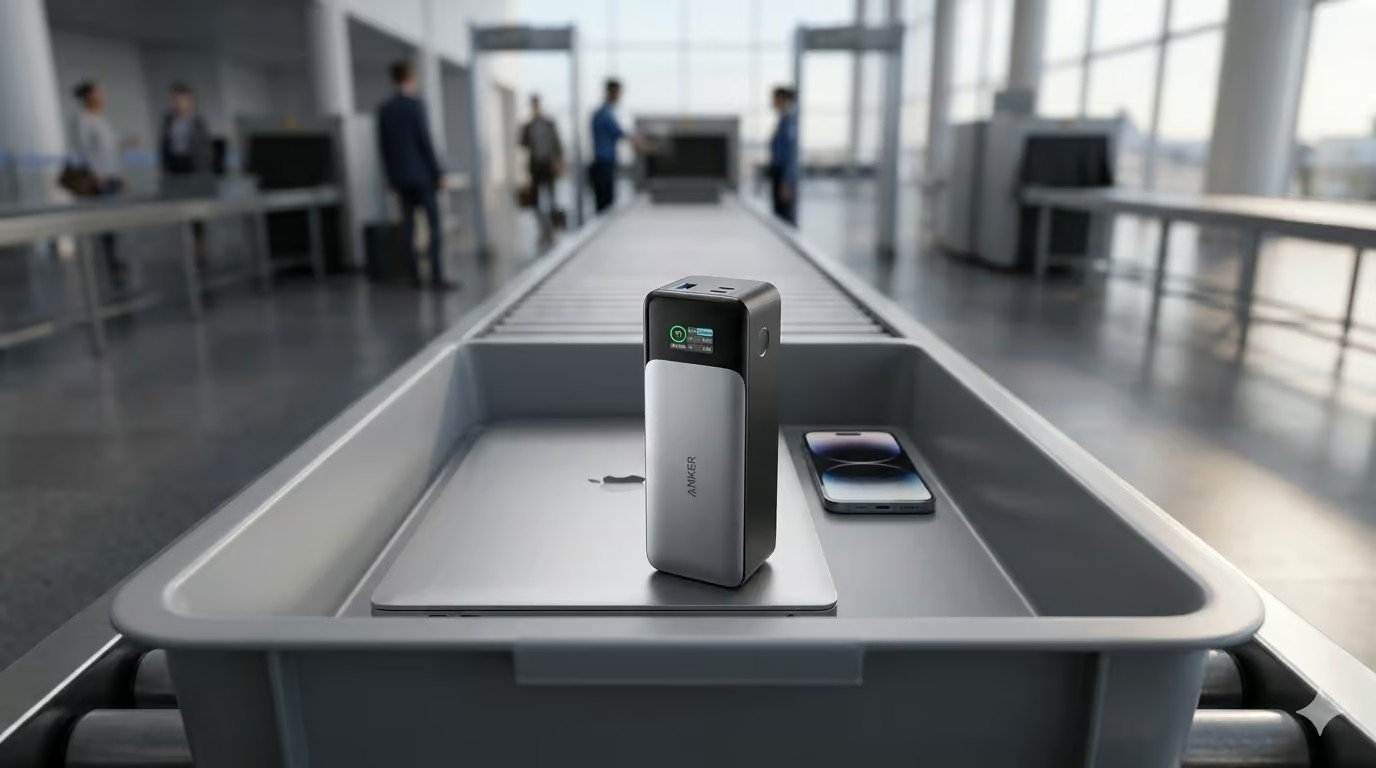
Can You Take a Power Bank on a Plane?
The full airline rules for power banks, including capacity limits and carry-on rules.
Latest from SmartGadgetKit
 Lithium Ion Battery Fire Statistics 2026
 LISEN Power Bank Review: The Qi2.2 25W MagSafe 10000mAh, Measured
 How Long Does a Power Bank Last? Charges, Years and Sizing
 Anker Prime 250W Charger Review: 6-Port Desktop Hub
 Anker Prime 300W Power Bank Review: Two Laptops, One Socket-Free Table
 Jackery Explorer 2000 v2 Review: The Lightest Way to Carry 2kWh?
 EcoFlow DELTA 3 Max Plus Review: What 2,048Wh Really Gives You
 BLUETTI AC70 Review: What 2,000W Power Lifting Is Worth
Tested by people who know what the numbers mean
SmartGadgetKit checks every spec against the manufacturer and independent sources, and tells you the trade-offs, not only the wins. Our verdicts combine hands-on testing by the SGK team with manufacturer and retailer specs.