Explainer
How long does a power bank last?
How long does a power bank last? Two questions hide inside that one, and most answers only deal with the easy one. Both are answered directly below.
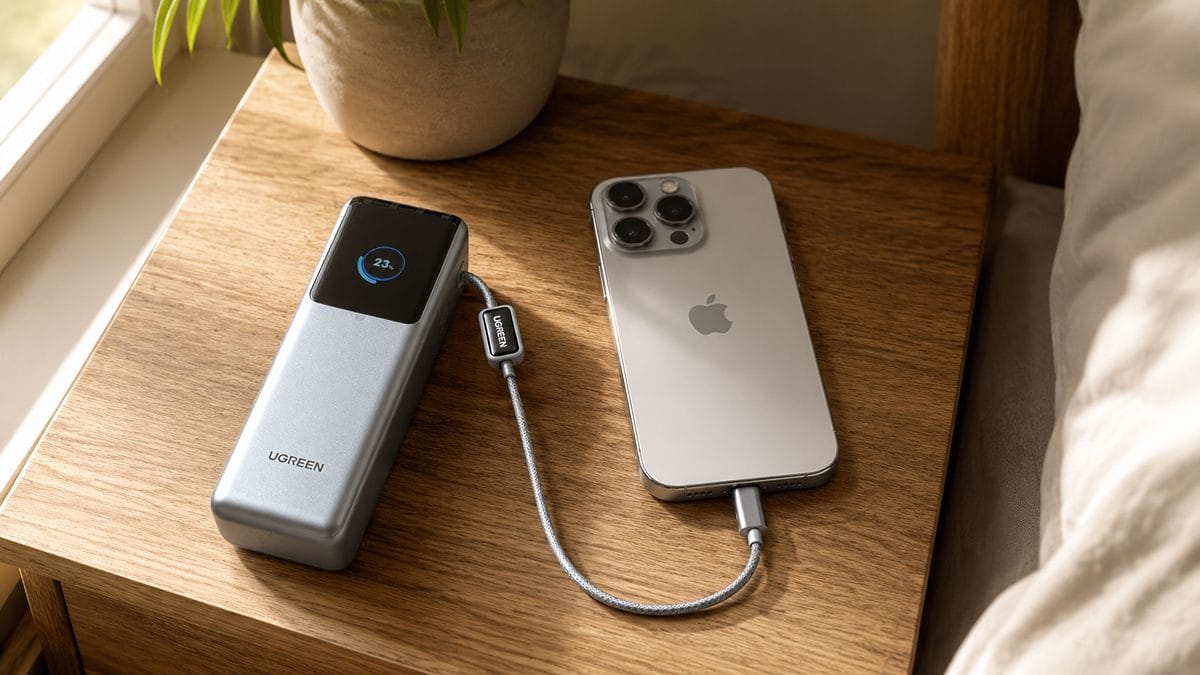
The short answer
About two phone charges from a 10,000mAh bank. Two to four years before it fades.
How long does a power bank last depends on two separate things: how many charges you get from one fill, and how many years it keeps doing that. A 20,000mAh bank gives most phones about four charges. Both sizes should keep working for two to four years, though not at full strength by the end. Those are calculated estimates and the working is below, so you can redo it for your own phone.
- On one fill: roughly 2 phone charges from 10,000mAh, 4 from 20,000mAh
- Over its life: 2 to 4 years, decided far more by how you store it than how often you use it
- The bit nobody says: heat and sitting fully charged age it faster than charging does
Facts checked 29 Aug 2026 against Battery University, the UK Civil Aviation Authority and IATA. How we test and score.
The short version
The 4 numbers that matter
Everything below explains these. If you only remember 4 things, make it these 4.
On one fill
How many charges will I actually get?
The number printed on a power bank is not the number that reaches your phone, and the gap is bigger than most people expect. Some energy is lost as heat, some to the voltage conversion the cable has to do, and some to the electronics inside the bank itself. About 15 percent is the working assumption for a decent USB-C setup.
There is a second trap, which is that mAh is close to useless for comparing anything. A capacity in mAh means nothing without the voltage it was measured at. Watt-hours already include the voltage, which is why airlines use them and why we do too. To convert, divide the mAh by 1,000 and multiply by 3.7, the nominal voltage of the cells inside almost every power bank.
The laptop rows in the table below are the ones worth pausing on. A 20,000mAh bank will not fully charge a large laptop, and no power bank of a size you would carry every day will. What it does is add several hours of working time, which is usually the thing you actually wanted.
The reference table
Charges by capacity, for every device
Filter to your kind of device. Every row stays on the page either way; the filter only narrows what you are looking at.
| Device | Battery | 5,000mAh | 10,000mAh | 20,000mAh | 26,800mAh |
|---|---|---|---|---|---|
| Phones | |||||
| iPhone 16Checked Aug 2026 | 13 Wh | 1.2 | 2.4 | 4.8 | 6.5 |
| Samsung Galaxy S24 UltraChecked Aug 2026 | 19 Wh | 0.8 | 1.7 | 3.3 | 4.4 |
| Tablets | |||||
| iPad Pro 11-inchChecked Aug 2026 | 31 Wh | 0.5 | 1.0 | 2.0 | 2.7 |
| Laptops | |||||
| MacBook Pro 16-inchChecked Aug 2026 | 100 Wh | 0.2 | 0.3 | 0.6 | 0.8 |
Calculated estimates on the watt-hour method: rated Wh multiplied by 0.85 for transfer losses, divided by the device battery. Real figures vary with cable quality, ambient temperature and the condition of your battery. Checked Aug 2026.
How we checked this
- Capacities converted with the standard formula airlines themselves use: watt-hours equals mAh divided by 1,000, multiplied by 3.7 volts
- The 15 percent transfer loss is the standard USB-C working assumption, applied identically to every row so the columns compare fairly
- Device battery sizes are the published manufacturer capacities, held constant across our pages so figures agree site to site
- Nothing in this table was measured by us. It is arithmetic, shown so you can check it
Update log
Table built. Standardised on the watt-hour method across the site so our pages stop giving different answers to the same question.
Device rows refresh as new phone and laptop generations publish their capacities.
Want the number for your exact phone? Our charges calculator does the sum for you, model by model.
Open the charges calculatorOver its life
How long before it wears out?
Nearly every page that answers how long does a power bank last repeats the same figure, that a power bank is good for 300 to 500 charge cycles. It is not wrong so much as incomplete, and the missing half changes the advice.
Battery University, published by Cadex Electronics, which sells battery test equipment rather than power banks, puts numbers on it. A typical lithium-ion cell taken from full to empty and back manages around 300 cycles before it drops to 70 percent of its original capacity. The same cell, used in shallow top-ups of around 20 percent at a time, manages around 2,000.
That is a difference of nearly seven times, from the same battery, decided entirely by how you use it. It is also the opposite of how most people treat a power bank, which is to run it flat and then fill it.
It helps to know what a cycle actually means. It is not one plug-in. It is one full battery’s worth of energy, however you accumulate it. Five separate 20 percent top-ups are one cycle, not five.
Left in a drawer
Heat and a full battery age it faster than you do
Battery University’s storage figures: a lithium-ion cell kept at a normal room temperature of 25 degrees Celsius, sitting at full charge, holds about 80 percent of its capacity after one year. The same cell at 60 degrees, still full, is down to about 60 percent after three months.
Read that again with a real place in mind. A power bank left fully charged in a car in summer, or in a bag in direct sun, or on a windowsill, is ageing faster sitting there doing nothing than it would if you used it every day.
If you are putting one away for a while, leave it part charged rather than full, and keep it somewhere that does not get hot. That is the whole trick.
So how long does it hold its charge?
You will see a flat figure quoted for this, usually two to three percent a month. That figure is real but it describes ideal conditions, and quoting it alone is how people end up surprised.
The fuller picture, again from Battery University: under standard conditions a lithium-ion cell loses roughly one to two percent a month, plus about another three percent to the protection circuitry every power bank carries. Stored at room temperature but at full charge, that climbs to around 20 percent a month. Stored at a comfortable 40 to 60 percent charge instead, it falls back to about 4 percent.
So the honest answer to whether it will still be charged when you need it is: that depends on the state you left it in. Half charged and cool, it will still have most of it months later. Full and warm, check it before you rely on it.
No, that part is fine. Charging it up shortly before a trip is exactly right. The mistake is charging it to full and then leaving it that way for the eleven months in between.
The other question
How long does it take to refill?
Calculated estimates. Real times run longer as the bank approaches full, because charging slows deliberately near the top to protect the cells.
The jump from 30W to 65W is the one that changes how you live with a power bank. At three hours it is an overnight job. At under an hour and a half it is something you do while you get ready to go out.
Buying
What size do I actually need?
The airline ceiling is the real limit on size
Airlines measure in watt-hours and the widely applied cabin limit is 100Wh, which works out at roughly 27,000mAh at standard cell voltage. That is not a rule any manufacturer will highlight, and it is why the biggest bank you can buy is not the biggest bank you can travel with.
Is a 20,000mAh bank overkill? For one phone and one day, yes, and you will notice the weight. For anything longer, or for two people, it is the size most travellers settle on.
Flying with it? Our watt-hours calculator converts any capacity and checks it against the airline bands.
Open the flight calculatorKeep reading
Where this page’s readers usually go next
Charges calculator
The same sum as the table above, done for your exact phone model.
Open the calculator ›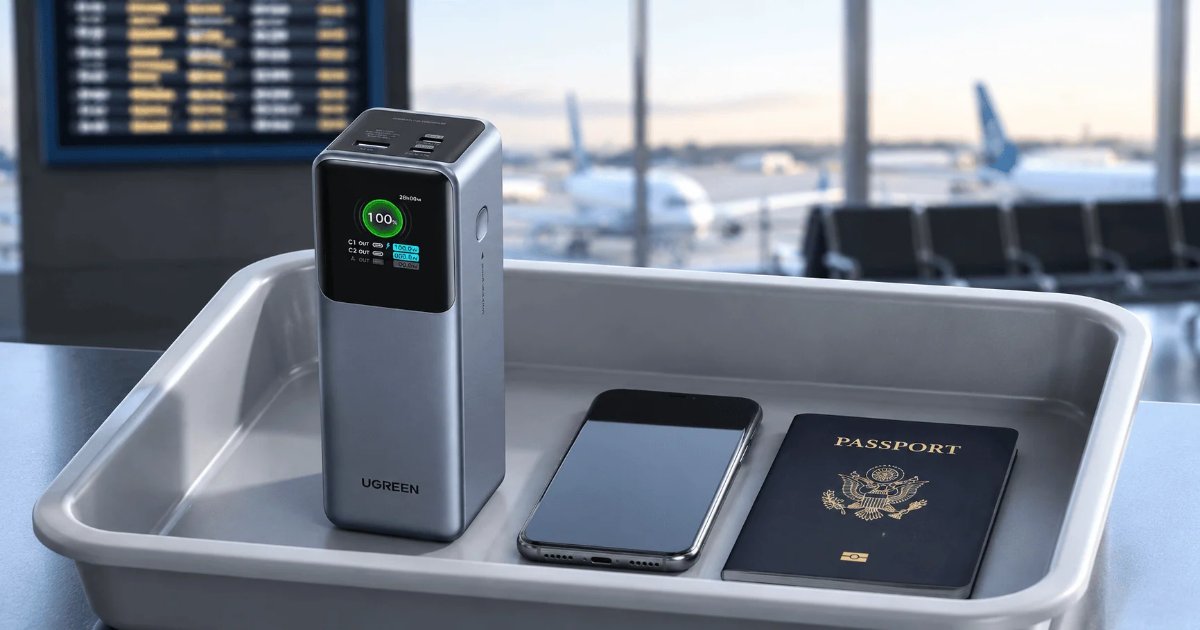
mAh to Wh calculator
Convert any capacity to watt-hours and check it against the airline limit.
Open the calculator ›
How to choose a power bank
Size, speed and the numbers to shop with, in five minutes.
Read the guide ›
The best power banks you can buy
Once you know the size you need, this is where to start looking.
Read the roundup ›For more sizing and battery help, browse all our charging guides and fixes.
Figures on this page come from Battery University, the UK Civil Aviation Authority and IATA, or are calculated from published capacities using the method shown above. See how we test and score.
Quick answers
How long does a power bank last: your questions, answered
The questions readers ask most, with the direct answer first.
How long does a 20,000mAh power bank last?
About four full charges for a typical phone, or two for a tablet. As a rough guide that is a weekend for one person, or a long day for two. Calculated estimate, and the working is in the table above.
How long does a 10,000mAh power bank last?
About two full phone charges, which for most people is one full day away from a socket with some left over. Calculated estimate.
How many years does a power bank last?
Two to four years for most people. The spread is wide because it depends far more on how you store it than on how often you use it. Kept cool and not left sitting at full charge, four years is realistic. Left full in a hot car, it can be noticeably weaker inside a year.
Do power banks lose charge when you are not using them?
Yes, all of them do. Under good conditions it is only a few percent a month. Stored fully charged in a warm room it can be around 20 percent a month, according to Battery University. Store it around half full and somewhere cool if it is going away for a while.
How long does a power bank take to charge itself?
Divide its watt-hours by your charger’s wattage and add ten to twenty percent. A 20,000mAh bank on a 30W charger takes about three hours; on a 65W charger, about an hour and twenty minutes. Check the bank’s input rating, which is often lower than its output rating.
Is a 20,000mAh power bank overkill?
For one phone for one day, yes, and you will feel the weight. For a weekend, for two people sharing, or for anything with a tablet in it, it is the size most people end up happy with.
What size power bank do I need for a week away?
Usually still 20,000mAh, because you will almost certainly find a socket at some point. Only go larger if you know for a fact there will not be one, and remember that past roughly 27,000mAh you cannot take it in the cabin.
Why does my power bank die faster than it used to?
Normal ageing accounts for some of it, but if the drop seems fast, think about where it has been living. Heat and long spells sitting at full charge do more damage than daily use. A bank that spends summers in a car ages much faster than one kept in a drawer indoors.
Does leaving a power bank plugged in damage it?
Leaving it plugged in for a few extra hours is fine, since the electronics stop charging when it is full. The problem is the state it then sits in. Keeping it at 100 percent for months is what shortens its life, not the act of charging.
Behind this guide
SGK verdicts combine hands-on testing by our team with trusted independent lab data, and we tell you the trade-offs, not only the wins.