
By Alan, network engineer. Updated May 2026.
This page contains affiliate links. If you buy through them, we may earn a small commission at no extra cost to you. As an Amazon Associate I earn from qualifying purchases.
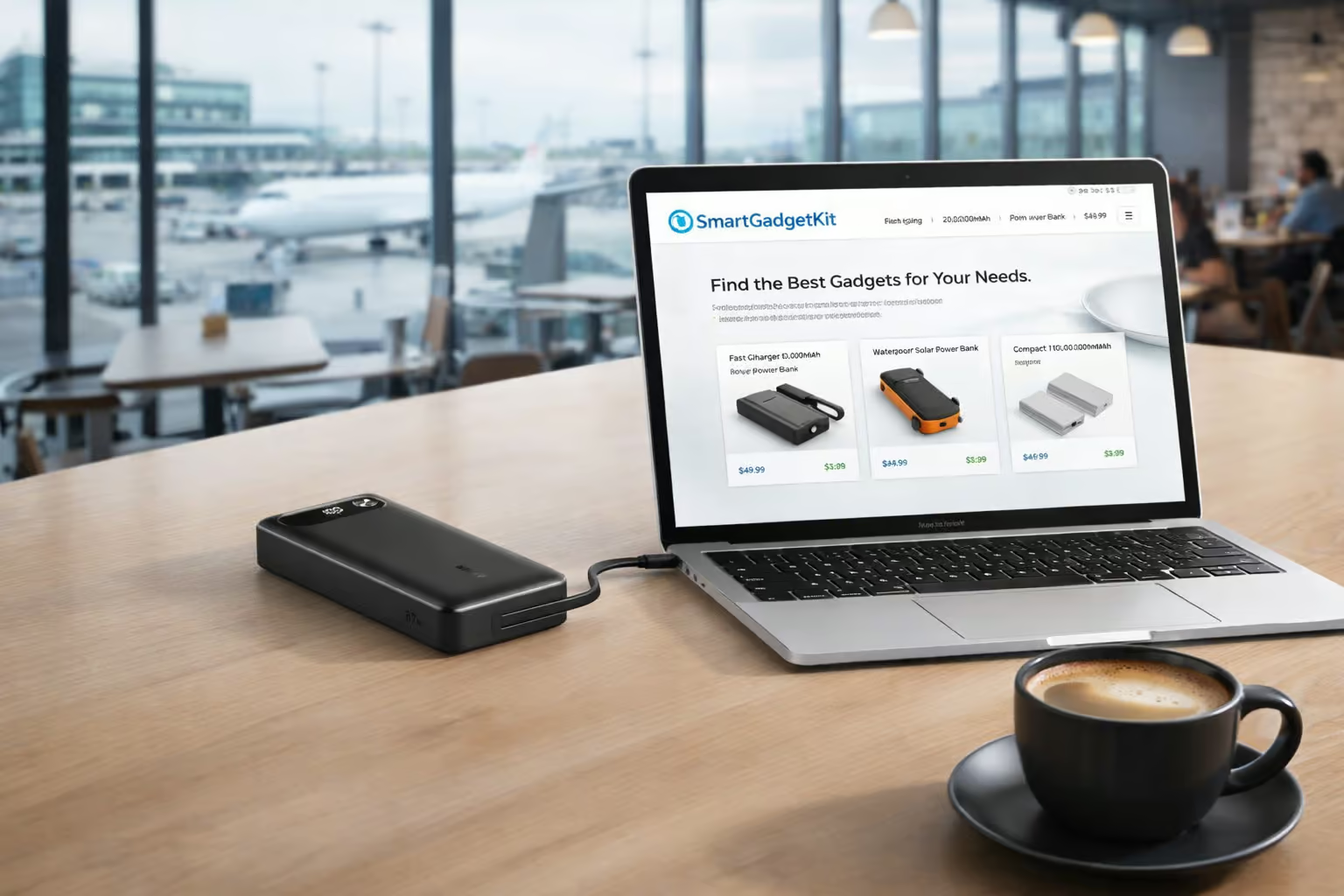
Anker 87W Power Bank 20,000mAh (A1383) BEST FOR LAPTOP TRAVEL
Anker 87W Power Bank
Quick specs
| Spec | Detail |
|---|---|
| Capacity | 20,000mAh (approx 72Wh) |
| Total output | 87W |
| Max single-port output | 65W (USB-C port or built-in cable) |
| Max input | 65W |
| Weight | Around 440g |
| Dimensions | 157.5 x 73.7 x 25.4mm |
Source: https://www.anker.com/eu-en
This Anker 87W Power Bank review puts the A1383 through real travel-day testing instead of bench numbers. Most power banks that claim to charge laptops are only half-telling the truth. Push 18W or 30W through a USB-C port and the laptop barely keeps pace with its own drain. That is not fast-charging, that is treading water. The Anker A1383 is one of the few carry-on banks that closes that gap. At 65W single-port output it genuinely recovers a MacBook or XPS, not just maintains them. Heavy at around 440g and no pass-through charging. For a laptop travel bank at this price, it earns its place.
For this Anker 87W power bank review, Alan ran the A1383 through a full travel day at Heathrow Terminal 5, charging a laptop and phone simultaneously from a single bank. Output figures and recharge times are cross-referenced against independent lab testing by Charge-Test. For the full methodology, see how we test.
First impressions
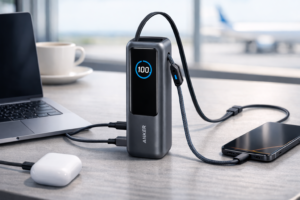
Familiar Anker form factor: matte black, four LED dots on the side panel, and a USB-C cable tucked into a recessed slot at one end. The cable has some stiffness to it, which is useful when you are plugging into a laptop on a plane tray table or hotel desk. Pick it up and the 440g registers straight away. This is not a pocket carry, and it does not pretend to be.
In the box: the bank, a USB-C cable, and documentation. No wall charger included. The port layout in the next section explains where the build attention went.
Design and build
The Anker 87W power bank is compact for its capacity class. At 157.5 x 73.7 x 25.4mm it lays flat in the main compartment of a travel organiser without dominating it. Three ports on one face: built-in cable recessed on the left, USB-C in the centre, USB-A on the right. The USB-C port handles input and output, so you can recharge the bank and run a connected device from the same socket when the built-in cable is free.
Four LED dots give a clear read on remaining charge. At 25% per dot, that is precise enough to decide whether to top up before boarding.
Anker rates the cable for 10,000 bends and 5,000 twists. I have not put that to the test yet. Short-term handling shows reinforced joints at the root, which is the typical failure point on integrated cables. That is a claim worth revisiting after months of regular use, not first impressions.
The design holds up on inspection. The charging numbers are where the A1383 has to justify the weight.
Anker 87W Power Bank: charging performance
At approximately 72Wh rated capacity with a typical 15% USB-C transfer loss, you get around 61.2Wh of usable output. That is a calculated estimate, not a stopwatch test.
| Device | Battery (approx) | Full charges |
|---|---|---|
| iPhone 16 | 13Wh | ~4.7 |
| Samsung Galaxy S24 Ultra | 19Wh | ~3.2 |
| iPad Pro 11-inch | 31Wh | ~2.0 |
Calculated estimates based on manufacturer specs and typical USB-C transfer losses. Real-world charge counts vary with cable quality, ambient temperature, and device condition.
Recharge time: 72Wh at 65W input gives a theoretical minimum of around 66 minutes. Independent testing by Charge-Test measured full recharge at 1 hour 38 minutes with a 65W source. Anker’s own figure is approximately 1.5 hours, which is close. To hit that window you need a 65W-capable USB-C wall charger. Pairing the A1383 with a best GaN travel charger makes full use of the 65W input and keeps recharge close to the 90-minute mark.
Running both USB-C outputs simultaneously reduces per-port wattage below the 65W peak, confirmed by independent testing by Charge-Test. You still get useful wattage on both, but not full speed to each device.
The A1383 also supports PPS (Programmable Power Supply) on both USB-C outputs. PPS lets compatible phones negotiate the exact voltage they need rather than accepting a fixed output. In practice that means faster and more efficient charging on Samsung Galaxy models and other PPS-compatible devices. Confirmed by independent testing by Charge-Test.
At a Heathrow Terminal 5 gate, I ran both a laptop and a phone from this bank at the same time. The phone went from low to full in around 90 minutes. The laptop went from 15% to roughly 75% in the same session. That is exactly the use case this bank is built for.
That output comes with a weight penalty that matters for travel. The next section settles the carry question.
Portability and airline travel: 2026 rules
At around 440g the A1383 is bag-carry only. It does not fit in a jeans pocket. At 157.5 x 73.7 x 25.4mm it lays flat in the back pocket of most travel backpacks and sits cleanly in a tech organiser alongside cables and a charger.
For air travel, the A1383 comes in at approximately 72Wh, which sits 28Wh under the 100Wh carry-on threshold used by most carriers for spare lithium batteries. That is a meaningful margin if you ever encounter a security agent checking the rating sticker. Banks like the A1695 (95Wh) sit only 5Wh under the limit, which is fine in theory but tighter in practice.
In April 2026, Ryanair, easyJet, and TUI tightened their power bank rules following in-flight safety incidents. The capacity limit is unchanged at 100Wh, but the new operating rules matter for buyers planning to use the bank on board.
Pack it in hand luggage only. Lithium batteries are not permitted in checked bags.
Power bank rules for 2026
| Carrier | Capacity limit | In-flight use | Overhead locker | Max units |
|---|---|---|---|---|
| Ryanair | 100Wh per bank | Not permitted | Not permitted | Up to 20 spare batteries, 100Wh each |
| easyJet | 100Wh per bank | Not permitted | Not permitted | 2 per person, 100Wh each (160Wh max with prior approval) |
| TUI | 100Wh per bank | Not permitted | Not permitted | Standard limit |
| British Airways | 100Wh per bank | Permitted (under FAA-aligned rules) | Carry-on only | Spare batteries must be in hand luggage, not checked |
| United / Delta / American | 100Wh per bank | Permitted under FAA rules | Carry-on only | Capacity must be clearly marked, otherwise refused |
Rules sourced from carrier websites, valid May 2026. Verify with your airline before flying.
Pack it in hand luggage only. Lithium batteries are not permitted in checked bags on any major carrier. For the full breakdown of UK and EU rules, see can you take a power bank on a plane?
Specifications
| Capacity | 20,000mAh |
| Rated energy | Approx 72Wh |
| Max total output | 87W |
| Max single port output USB-C | 65W |
| Built-in cable output | 65W |
| USB-A max output | 22.5W |
| Max input | 65W (20V/3.25A) |
| PPS support | Confirmed on both USB-C outputs (independent testing by Charge-Test) |
| Pass-through charging | Not supported (independent testing by Charge-Test) |
| Recharge time at 65W | Approx 1h 38 min (independent testing by Charge-Test) |
| Built-in cable | USB-C, recessed, rated 10,000 bends / 5,000 twists |
| Weight | Approx 440g |
| Dimensions | 157.5 x 73.7 x 25.4mm |
| Warranty | 18 months (Anker standard) |
Pass-through charging: can you charge while it charges?
The Anker A1383 does not support pass-through charging. If the bank is plugged into a wall charger, it prioritises recharging itself and does not pass usable output to connected devices at the same time.
Practical impact: this matters if you wanted to use the A1383 as a desk-side hub that keeps your phone topped up while it also recharges. That use case is not supported here. For travel use, where the bank is recharged separately from being used, this is not a daily-use issue. If pass-through is on your must-have list, the Anker A1695 supports it.
Safety certifications and protections
The A1383 carries the standard set of safety certifications you would expect from an Anker laptop bank:
- FCC (US electromagnetic compliance)
- CE (EU/EEA safety conformity)
- UL (US safety testing)
Internal protections cover overcurrent, overvoltage, short-circuit, and temperature monitoring. In normal use the unit stays comfortably warm rather than hot, and current is throttled if it crosses safe thresholds. Anker also rates the built-in USB-C cable for 10,000 bends and 5,000 twists, which is the typical wear point on integrated cables.
This is standard hardware insurance, not a differentiator. What it does mean: if you are nervous about putting an unbranded power bank in your carry-on, the A1383 sits firmly inside the certifications most airlines and security checkpoints recognise.
Anker 87W Power Bank 20,000mAh (A1383) BEST FOR LAPTOP TRAVEL
Source: https://www.anker.com/eu-en
Why we rated it 7.4/10
Charging Speed: 7.5/10 (30% weight). 65W single-port output handles genuine laptop fast-charging. Independent testing by Charge-Test confirmed recharge in 1 hour 38 minutes at 65W input, closely matching Anker’s 1.5-hour claim. PPS is confirmed on both USB-C outputs. No pass-through and 100W rivals at a similar price cap the ceiling.
Carry Rating: 7.0/10 (25% weight). Around 440g is the expected weight for a 20K/65W bank. Bag-carry, not pocket carry. Airline compliance at approximately 72Wh is a genuine plus. The built-in cable trims overall kit weight slightly.
Value for Money: 7.5/10 (25% weight). 4.5 out of 5 from over 7,000 Amazon ratings signals broad buyer satisfaction. The INIU 25K offers more capacity and output at a similar price, which limits the value ceiling. Anker brand reliability and built-in cable convenience partially offset that.
Cable Design: 7.5/10 (20% weight). The built-in cable delivers the full 65W, identical to the USB-C port. Anker rates it for 10,000 bends and 5,000 twists. Not retractable and not replaceable if damaged. The recessed housing design is practical for travel.
The Anker A1383 scores 7.4 because it delivers genuine laptop-speed charging at 65W, includes a built-in cable running at the same output as the port, and sits comfortably under the 100Wh carry-on threshold. It concedes on weight (around 440g) and lacks pass-through charging. For a 20K laptop bank at this price, the package is harder to match than the headline wattage suggests.
Anker 87W Power Bank 20,000mAh (A1383) BEST FOR LAPTOP TRAVEL
How does the Anker 87W Power Bank compare?
Alternatives to the Anker 87W Power Bank
Baseus Blade H1 20,000mAh 100W
Same 20K capacity in a noticeably slimmer profile (under 20mm thick) with 100W single-port output. The Blade H1 charges laptops faster than the A1383 and sits flat in laptop sleeves and slim shoulder bags. No built-in cable. Worth considering if peak output and slim profile matter more to you than cable convenience.

Baseus Blade H1 20,000mAh 100W Best slim profile
INIU 25,000mAh 100W
More capacity and higher output in a package that is actually slightly lighter than the A1383. If you need more headroom for longer trips or heavier device loads, the INIU 25K is the natural benchmark.
INIU 25,000mAh 100W Best for longer trips
Anker A1695 25K 165W (the newer step-up)
The newer Anker laptop bank. Triple USB-C ports each up to 100W, 165W total output, and two built-in cables including a retractable one. The right move if you regularly charge two USB-C laptops at full speed or want fewer cables in the bag. Heavier than the A1383 at around 595g and sits closer to the airline 100Wh limit at approximately 95Wh. Read the full Anker A1695 review for the deeper breakdown.
Anker A1695 (25K, 165W) Step-up pick
Anker A1383 vs the new Anker A1695 25K: which should you buy?
The Anker A1695 25K is the newer step-up in the Anker laptop bank range. Capacity, output, and cable count all jump up. The trade-offs are weight, price, and how close the unit sits to the airline 100Wh limit. If you are choosing between the two, the table below is the short version.
The A1695 wins on raw output, port count, and cable convenience. The A1383 wins on lower weight, more comfortable airline headroom, and lower price. If you regularly charge two USB-C laptops or want triple 100W simultaneous output, the A1695 is the move. If you carry one laptop, want a bag-friendly weight, and value a comfortable margin under airline limits, the A1383 still earns its place.
Full breakdown: Anker A1695 review.
Anker 87W Power Bank Review FAQs
-
Is the Anker A1383 allowed on planes?
Yes, it is typically within carry-on limits. At approximately 72Wh, the A1383 sits well under the 100Wh threshold used by most carriers for spare lithium batteries. It must travel in hand luggage, not checked bags. Individual airlines apply different quantity and in-flight use restrictions, so it is worth checking your carrier’s own policy before you travel.
-
Can the Anker A1383 charge a laptop properly?
Yes. At 65W from either the USB-C port or the built-in cable, the A1383 delivers genuine laptop-speed charging. Most USB-C laptops, including current MacBooks and XPS models, will accept 65W input and charge at a useful rate. You are not getting a slow trickle or a maintenance charge; you are getting a real fast-charge session.
-
How many phone charges do you really get from the Anker A1383?
Based on approximately 72Wh rated capacity with a 15% transfer loss applied, you get around 4.7 full charges of an iPhone 16 or about 3.2 full charges of a Samsung Galaxy S24 Ultra. These are calculated estimates. Your real-world results will sit close to these figures depending on cable quality, ambient temperature, and device battery condition.
-
How long does the Anker A1383 take to fully recharge?
With a 65W charger, around 1 hour 38 minutes based on independent testing by Charge-Test. Anker’s own figure is approximately 1.5 hours with a 65W input. Both are consistent. You need a 65W-capable USB-C charger to hit that window; a slower charger extends the recharge time considerably and is worth factoring into your travel kit.
-
Does the built-in USB-C cable charge as fast as the USB-C port?
Yes. Both deliver up to 65W, so you are not trading output speed for cable convenience. The practical limitation is length: the integrated cable is shorter than a standard cable. For desk use with your phone held in hand the shorter reach can feel limiting, but for laptop-on-desk or bag-to-device use it works without issue.
-
Does the Anker A1383 support pass-through charging?
No. The A1383 does not support pass-through charging. If the bank is plugged into a wall charger, it prioritises recharging itself and does not deliver usable output to connected devices at the same time. For desk-side hub use where pass-through matters, look at the Anker A1695 instead.
-
What is the warranty on the Anker A1383?
Anker offers an 18-month warranty as standard on the A1383, with support handled directly through Anker customer service rather than via the retailer. Register your unit on the Anker site after purchase to make any claim straightforward.
-
What safety certifications does the Anker A1383 have?
The A1383 is FCC, CE, and UL certified, covering US and EU/EEA safety conformity. Internal protections include overcurrent, overvoltage, short-circuit, and temperature monitoring. The built-in USB-C cable is rated by Anker for 10,000 bends and 5,000 twists.
-
Is the Anker A1383 still worth buying now the Anker A1695 25K is out?
Yes, if your priority is a lighter bank with more airline headroom under the 100Wh limit. The A1383 at approximately 72Wh sits comfortably below the carry-on cap, weighs around 440g, and costs less than the A1695. The A1695 is the better buy if you want 165W total output, triple 100W USB-C ports, and two built-in cables, but you are paying for it in weight (around 595g) and price. For one laptop and a phone, the A1383 is still a solid 2026 pick.
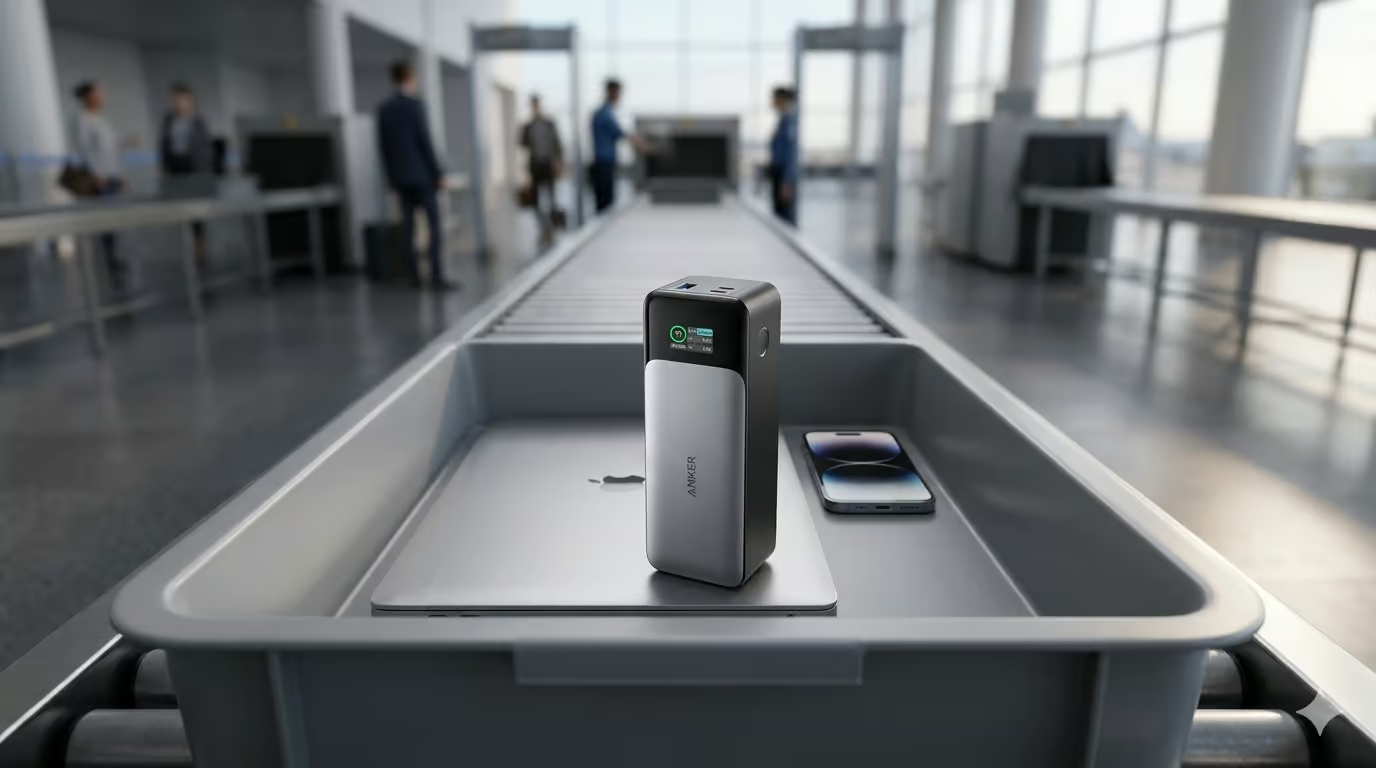

All technical claims in this Anker 87W power bank review are verified against manufacturer specs and independent sources. Find out how we test at SmartGadgetKit.


[…] Anker Power Bank 20,000mAh 87W Review: The One That Actually Charges Your Laptop […]
[…] Anker 87W 20K (74Wh) – best mainstream pick. Read the full Anker 87W review: https://smartgadgetkit.com/anker-power-bank-20000mah-87w-review-the-one-that-actually-charges-your-l… […]
[…] Read our full Anker 87W 20K review. […]
[…] Read the full Anker 87W 20,000mAh review. […]
[…] The one bank that handles phones, tablets, and most laptops without needing a separate cable. Built-in USB-C, 65W single-port output, 20K, and airline-safe at ~74Wh Check latest price Read full review […]