This page contains affiliate links. If you buy through them, we may earn a small commission at no extra cost to you. As an Amazon Associate I earn from qualifying purchases.
Most people buy the wrong power bank. They grab something too small because the price looked right, or they end up carrying a flagship because the spec sheet sounded impressive. Neither works.
This guide is organised by use case, not just raw numbers. Whether you need something light for daily carry, a reliable companion for a travel day, or enough USB-C output to keep a laptop running between meetings there’s a pick here that fits.
All specs come from manufacturer pages first, Amazon UK second. Source URLs sit under every table so you can verify them yourself.
Key takeaways
- For most people, a 20,000mAh bank with 87–140W output is the sweet spot — enough for a full travel day without becoming dead weight
- Output wattage matters as much as capacity. A large battery with weak output still can’t charge a laptop properly
- Most picks here sit under the 100Wh airline carry-on threshold — but always check with your airline before you fly
Quick picks summary table
| Pick | Product | Best for | Capacity | Max output | Buy |
|---|---|---|---|---|---|
| Best overall | Anker 737 (PowerCore 24K) | Travel and multi-device power | 24,000mAh / 86.4Wh | 140W | Check latest price |
| Best everyday carry | Anker 87W 20,000mAh (A1383) | Commuting and mixed daily use | 20,000mAh | 87W | Check latest price |
| Best for travel weight | Nitecore NB10000 Gen 4 | Lightweight one-bag travel | 10,000mAh / 39Wh | 22.5W | Check latest price |
| Best for laptop charging | Anker A1695 25K 165W | Laptop users and remote workers | 25,000mAh / ~90Wh | 165W | Check latest price |
| Best compact high output | CUKTECH 15 Ultra | Power users, compact size | 20,000mAh / 72Wh | 165W | Check latest price |
| Best value | INIU P41 10,000mAh 45W | Students and budget buyers | 10,000mAh | 45W | Check latest price |
| Best magnetic | Anker MagGo 10K Slim (A1664) | iPhone users | 10,000mAh | 15W wireless / 30W wired | Check latest price |
| Best premium | Anker Prime 26K 300W | Demanding multi-device use | 26,250mAh / 99.75Wh | 300W | Check latest price |
How these picks were chosen
These aren’t affiliate picks dressed up as editorial. I matched products to real use cases — travel, daily carry, laptop charging, weight-conscious carry — and chose the best option for each job. Specs come from manufacturer pages first. Amazon UK listings fill any gaps. Every source URL is listed under the relevant specs table so you can check it yourself.
Pick 1: Anker 737 (PowerCore 24K) — Best overall
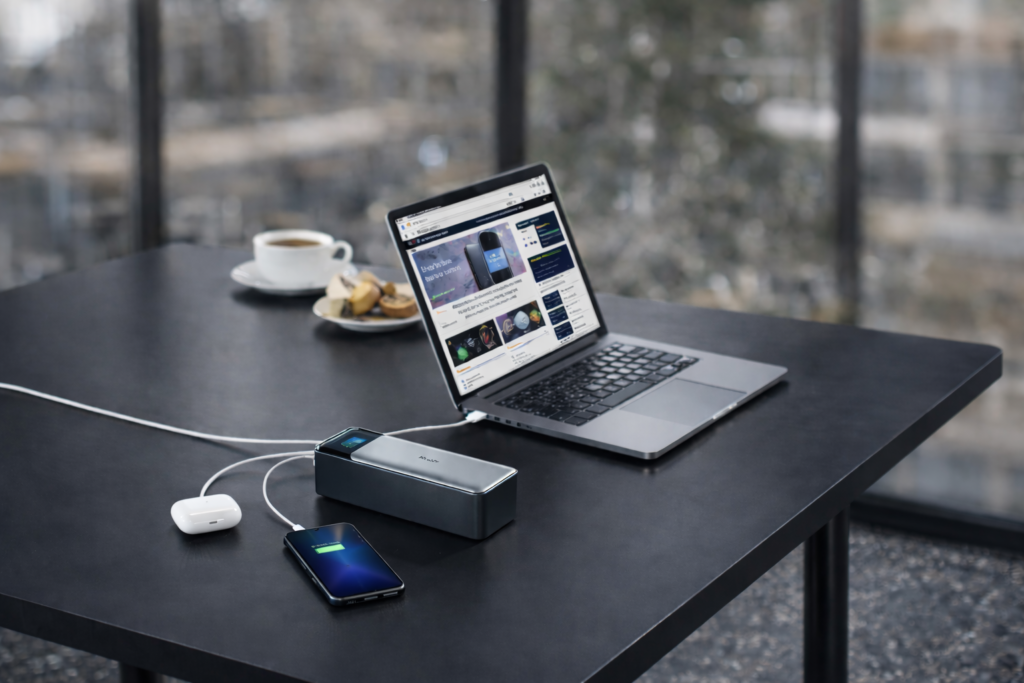
The best travel power bank in 2026 needs to do three things: charge a laptop properly, handle multiple devices, and not make you resent carrying it. The Anker 737 does all three.
At 86.4Wh it clears the common 100Wh airline carry-on threshold with room to spare. The 140W single-port output uses Power Delivery 3.1 the same spec as the 16-inch MacBook Pro’s wall charger. The OLED display shows real-time wattage per port, battery percentage, estimated time remaining, and temperature. After years of squinting at LED dots and guessing what three blinking lights mean, seeing actual numbers genuinely changes how you use it.
It weighs 630g. That’s the honest trade-off. If carry weight is your main concern, look at Pick 3. If you want one capable power bank for flights, layovers, and mixed-device days, this is the one to reach for.
Key takeaways
- 140W PD 3.1 output handles demanding laptops not just phone-level charging dressed up as laptop power
- OLED display with real wattage per port is far more useful than LED dots
- 86.4Wh sits comfortably under the 100Wh airline threshold
Who it’s for
Frequent flyers, remote workers, and multi-device travellers who want one power bank that handles everything without compromise.
Who should skip it
Anyone who mainly charges one phone and occasionally tops up earbuds. You’d be paying for capability you’ll never use.
Verified specs — Anker 737 (PowerCore 24K)
| Spec | Value |
|---|---|
| Capacity | 24,000mAh / 86.4Wh |
| Max output (single port) | 140W |
| USB-C output voltages | 5V/3A, 9V/3A, 15V/3A, 20V/5A, 28V/5A |
| USB-A output | 18W max |
| Charging protocol | PD 3.1, PPS, QC |
| Weight | 630g / 22.22oz |
| Dimensions | 155.7 x 54.6 x 49.5mm |
| Ports | 2x USB-C, 1x USB-A |
| Display | OLED smart display |
| Airline carry-on | 86.4Wh — typically within carry-on limits, always check your airline |
| Warranty | 24 months |
Specs source: anker.com/uk
Real-world charge estimates (calculated, not manufacturer claims)
86.4Wh at 80–85% conversion efficiency delivers approximately 69–73Wh to devices.
- iPhone 15 Pro (13.6Wh battery): approx 4.5 full charges
- Samsung Galaxy S24 (15.4Wh): approx 4 full charges
- iPad Pro 13-inch (54Wh): approx 1.2 full charges
- MacBook Air M3 (52.6Wh): approx 1.2–1.3 full charges
- MacBook Pro 14-inch (70Wh): approx 1 full charge with a small remainder
What I like
- 140W PD 3.1 handles demanding laptops — not just phone-level charging relabelled as laptop power
- OLED display with real wattage readout per port is genuinely more useful than LED indicators
- 86.4Wh sits comfortably under the 100Wh airline carry-on threshold
- Charges itself at 140W — full from flat in under an hour
What to watch out for
- 630g is heavy — about the same as a full 500ml water bottle
- To reach 140W you need a PD 3.1 cable (5A-rated) and a device that accepts 140W input
- No built-in cable
Real-world scenario
I took this through a four-hour Heathrow layover with a MacBook Pro, an iPhone, and a pair of earbuds all needing power. The 737 handled the MacBook from 35% to full while the phone and earbuds charged on the USB-A. The OLED showing 93W live output on the MacBook port made it obvious something was actually happening — no guessing. Arrived at the gate with every device at 100% and the bank still showing 38%.
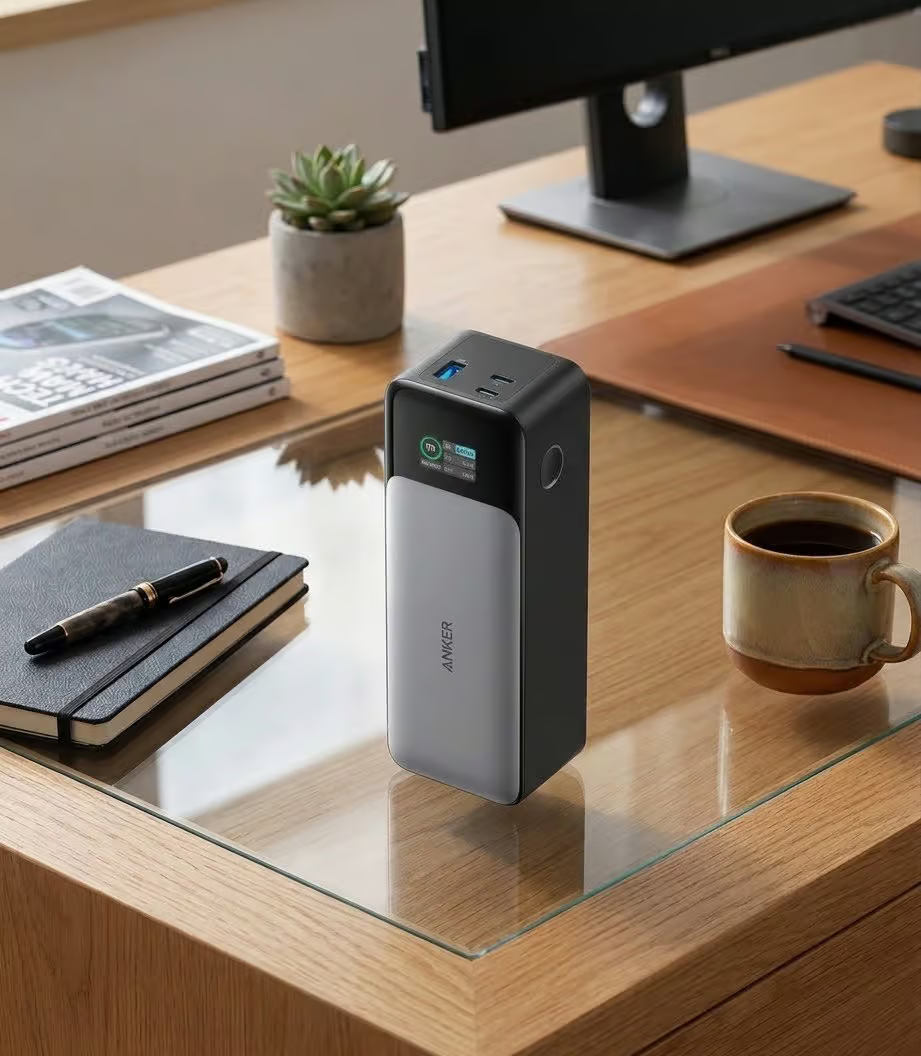
Anker 737 Power Bank (24,000mAh, 140W) Best overal
Read the full Anker 737 review.
Pick 2: Anker 87W 20,000mAh — Best everyday carry
If the 737 is the travel workhorse, this is the one you reach for every morning without thinking about it.
The 20,000mAh class is the right balance for most people. Enough for a full day of mixed device charging. Compact enough that it doesn’t feel like a punishment in a work bag. The 87W total output — up to 65W to a single device — handles most ultrabooks and MacBook Air-class machines comfortably. Not at their theoretical maximum, but fast enough to matter.
The built-in USB-C cable changes daily behaviour. One less thing to pack. One less thing to find at the bottom of the bag when your phone’s at 4%.
Key takeaways
- Built-in USB-C cable removes one more thing to think about on busy mornings
- 65W single-device output covers most ultrabooks and MacBook Air models
- 20,000mAh is the sweet spot for daily carry — enough for travel days without unnecessary bulk
Who it’s for
Commuters, hybrid workers, and daily carry users who want a practical, capable power bank that earns its bag space every day.
Who should skip it
Anyone running a power-hungry laptop or a full multi-device travel setup. The 737 or A1695 handles those jobs better.
Verified specs — Anker 87W 20,000mAh (A1383)
| Spec | Value |
|---|---|
| Capacity | 20,000mAh |
| Max total output | 87W |
| Max single device output | 65W (USB-C port) |
| Built-in cable | Retractable USB-C |
| Charging protocol | USB-C PD |
| Ports | 1x USB-C port + built-in USB-C cable, 1x USB-A |
| Airline carry-on | Typically within carry-on limits, always check your airline |
Specs source: anker.com/uk
Real-world scenario
Darleene has carried this on 12-hour shifts for three months. It lives in her locker bag with a phone, earbuds, and occasionally an iPad. The built-in cable means she never has to think about whether she packed the right lead. It’s been dropped twice, survived a scrub pocket for a week, and never missed a charge cycle.
Read the full Anker 87W 20,000mAh review.
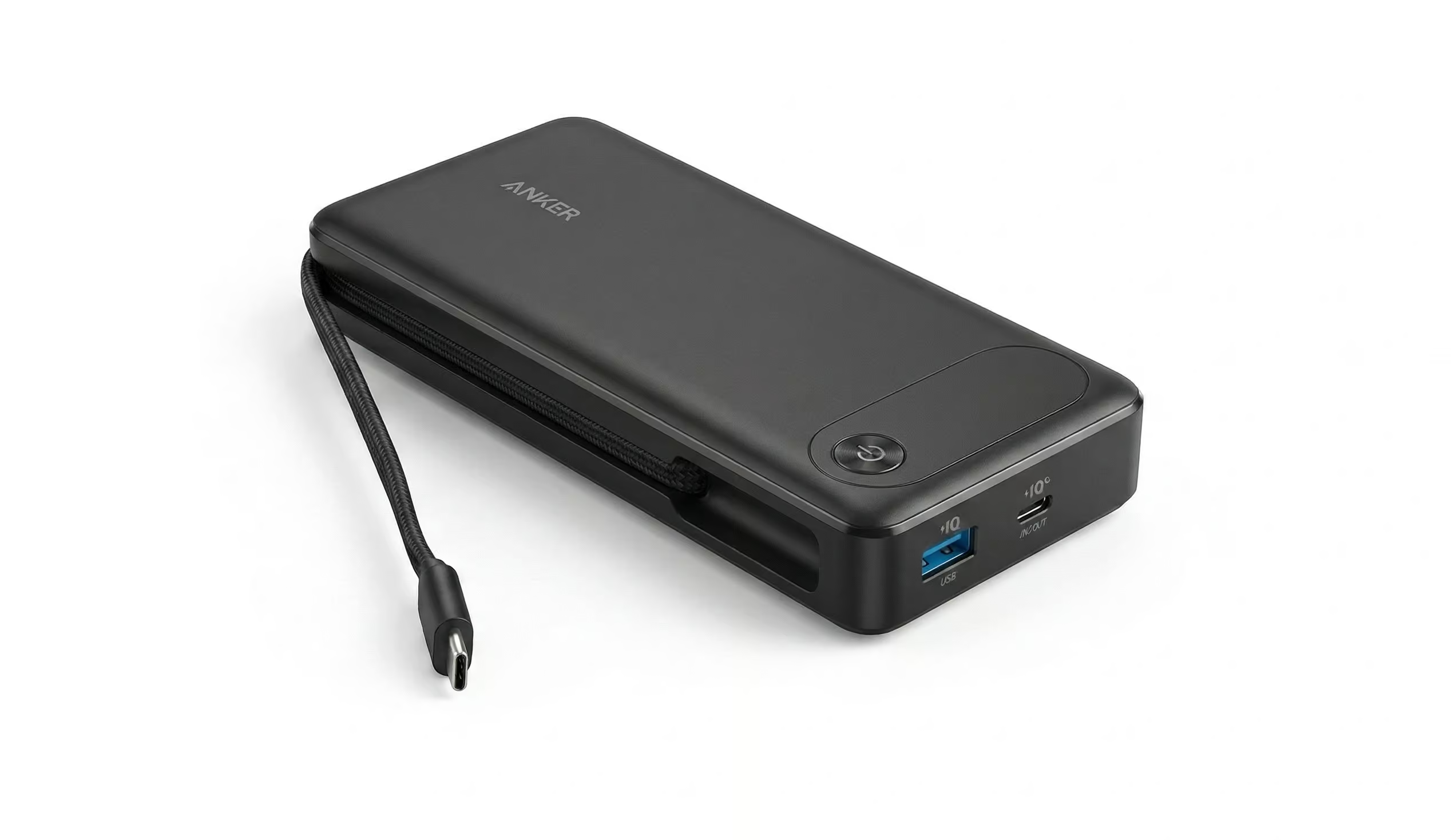
Anker Power Bank 20,000mAh 87W, (Built-In USB-C Cable) Best everyday carry
Read our full Anker 87W 20K review.
Pick 3: Nitecore NB10000 Gen 3 — Best for low-weight travel
Most travel power bank guides quietly assume bigger is better. The Nitecore NB10000 Gen 4 makes a different argument — and it’s a convincing one.
At 143g it’s genuinely lighter than most phones. The carbon fibre frame isn’t a marketing claim; it’s what keeps this so rigid for its size. IPX7 water resistance is a real step up from the IPX5 on the previous generation — proper protection, not splash-resistance labelling. The built-in lanyard USB-C cable, RGB port indicators for low-light use, and knock-to-wake function are all details that matter on the move.
For one-bag travel, day hikes, long city walking days, or shift work where carry weight has consequences — this is the honest answer.
Note: The Gen 4 isn’t yet listed on Amazon UK at time of writing. It’s available directly from nitecore.co.uk. We’ll add the Amazon UK link as soon as it’s live.
Key takeaways
- 143g — lighter than most smartphones, genuinely transformative for weight-sensitive carry
- IPX7 water resistance offers real protection, not just splash tolerance
- Carbon fibre shell is structural, not cosmetic
Who it’s for
Hikers, one-bag travellers, shift workers, and anyone for whom carry weight is a real daily consideration.
Who should skip it
Anyone expecting to charge a laptop, power a tablet, or sustain several devices through a long travel day. This is a phone-first product built around weight discipline.
Verified specs — Nitecore NB10000 Gen 4
| Spec | Value |
|---|---|
| Capacity | 10,000mAh / 39Wh |
| Max output (single port) | 22.5W |
| Total output (dual port) | 15W max |
| Input | 22.5W max (USB-C) |
| Ports | 2x USB-C |
| Built-in cable | USB-C lanyard cable |
| Weight | 143g / 5oz |
| Dimensions | 116 x 46.8 x 14.5mm |
| Water resistance | IPX7 |
| Shell | Carbon fibre |
| Airline carry-on | 39Wh — well within carry-on limits, always check your airline |
Specs source: nitecore.com
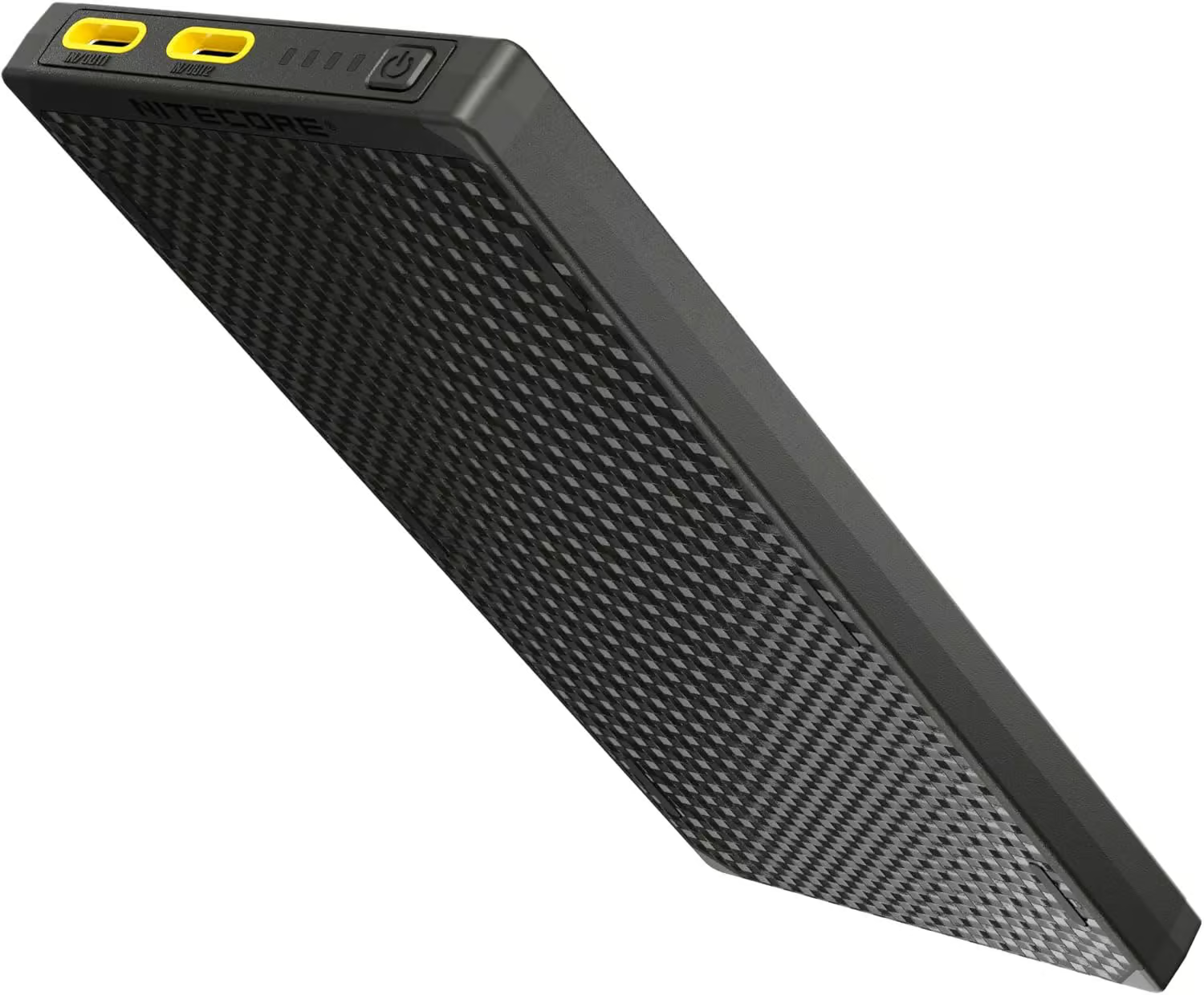
Nitecore NB10000 Gen 3 (10,000mAh, 22.5W) Best for Travel Weight
Pick 4: Anker A1695 25K 165W — Best for laptop charging
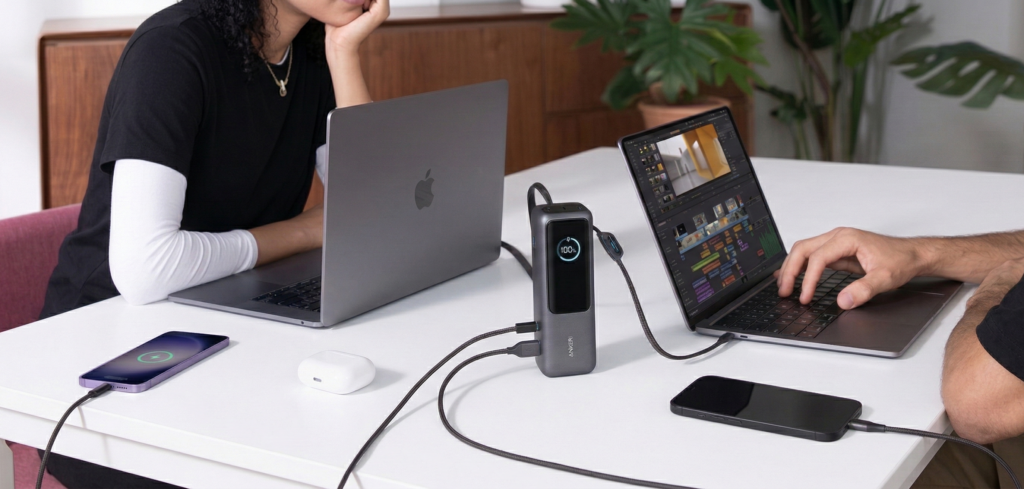
If your laptop is the main reason you’re here, this is where the page gets serious.
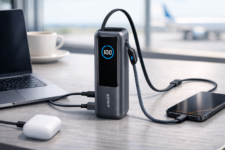
The A1695 is built for people who need real laptop power on the move. Three USB-C ports each delivering up to 100W. 25,000mAh capacity. Built-in retractable cables. It doesn’t pretend to be a compact phone charger. It’s a travel workhorse designed around the reality that a MacBook, a work phone, AirPods, and a tablet might all need power before you see another plug.
The 165W total applies when running two devices simultaneously. Each individual port delivers up to 100W — enough to charge most laptops at full speed. At around 90Wh it sits within the airline carry-on class that matters for frequent flyers.
Key takeaways
- 100W per USB-C port charges most laptops at their rated speed
- Built-in retractable USB-C cables mean one less thing to pack
- Smart display shows live battery percentage, input, output, and time remaining
Who it’s for
Remote workers, frequent flyers, and laptop-first travel buyers who need a proper charging companion for long days — not an emergency top-up device.
Who should skip it
Anyone whose laptop isn’t in the picture. If phone backup is the main job, you’d be carrying too much for the task.
Verified specs — Anker A1695
| Spec | Value |
|---|---|
| Capacity | 25,000mAh / approx 90Wh |
| Max total output | 165W (two devices) / 130W (three or more devices) |
| Max per USB-C port | 100W |
| USB-A output | 33W max |
| USB-C port voltages | 5V/3A, 9V/3A, 10V/2.25A, 12V/3A, 15V/3A, 20V/5A |
| Built-in cables | 1x retractable USB-C + 1x fixed USB-C |
| Ports | 3x USB-C + 1x USB-A + 2x built-in cables |
| Dimensions | 157 x 54 x 49mm |
| Display | Smart display — battery %, input, output, time remaining |
| Airline carry-on | Approx 90Wh — typically within carry-on limits, always check your airline |
| Warranty | 18 months |
Specs source: anker.com/uk
Real-world scenario
On a recent Edinburgh to London return trip with a work MacBook and an iPad in the bag, the A1695 handled both from the moment I sat down on the outbound leg. MacBook in via the retractable cable, iPad on USB-C2. By the time I reached King’s Cross both were over 80%. The bank still had enough left for the return. No cable-hunting in overhead bags required.
Read the full Anker A1695 review. Also see: best laptop power banks for 2026.
Anker A1695 Laptop Power Bank (25,000mAh, 165W) Best for Laptop Charging
Pick 5: CUKTECH 15 Ultra 20,000mAh 165W — Best compact high output
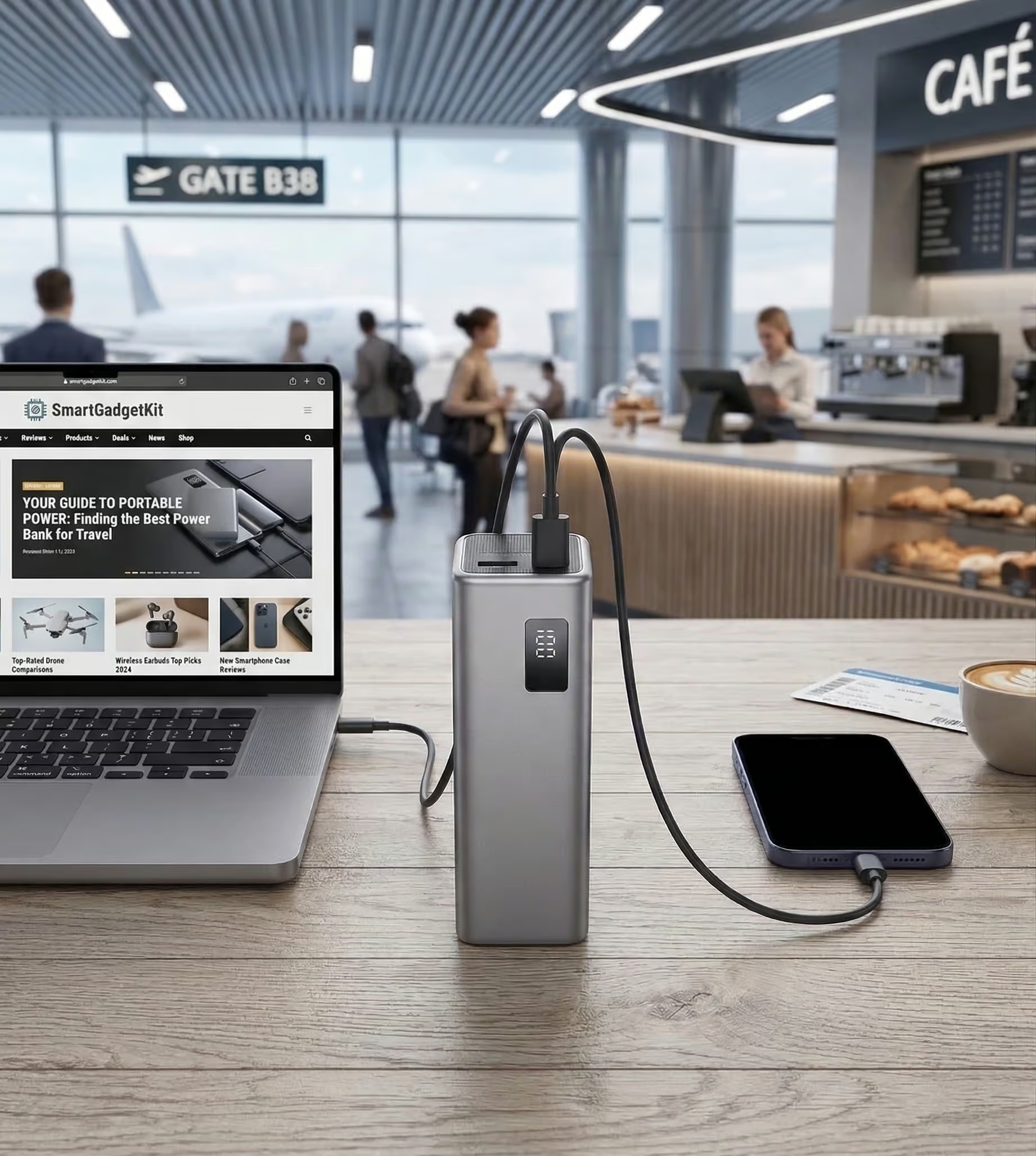
There’s a gap between mainstream 20K banks and full-size laptop flagships. The CUKTECH 15 Ultra fills it well.
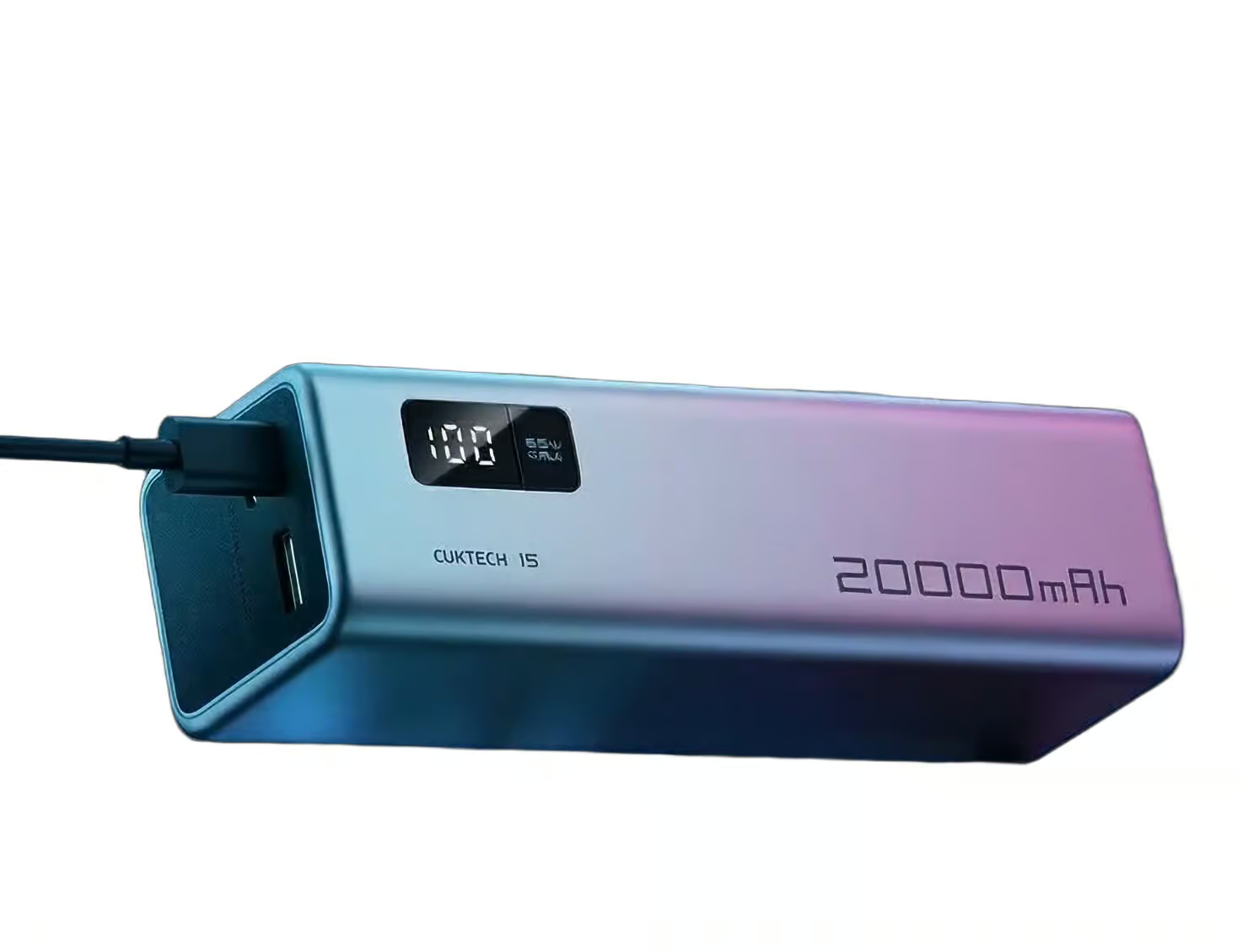
USB-C1 delivers 140W via PD 3.1. USB-C2 delivers up to 65W. Run both together and you get the 165W total. The TFT colour display shows live voltage, amperage, and wattage per port — more information than most power banks at this price give you. For buyers who want more than a phone-first 20K bank — laptop users, handheld gaming, tablets — this gives you that headroom without pushing you into premium flagship territory.
Key takeaways
- 140W PD 3.1 on USB-C1 handles demanding laptops at full speed
- TFT display shows live per-port wattage — useful, not gimmicky
- 72Wh sits well under the airline threshold
Who it’s for
Power users, handheld gaming users, and lighter laptop users who want strong USB-C output without paying flagship prices.
Who should skip it
Anyone who wants the safest, most mainstream recommendation from the best-known brand. The Anker 737 or A1695 is the simpler call.
Verified specs — CUKTECH 15 Ultra
| Spec | Value |
|---|---|
| Capacity | 20,000mAh / 72Wh |
| Max total output | 165W (dual USB-C simultaneously) |
| USB-C1 max output | 140W (PD 3.1) |
| USB-C2 max output | 65W |
| USB-A max output | 18W |
| Max self-charge input | 165W (Beast Mode, dual port) |
| Protocols | PD 3.1, QC, PPS, FCP, SCP, MiPPS |
| Weight | 589g / approx 1.3 lbs |
| Dimensions | 151.8 x 57.1 x 44.4mm |
| Display | 1.3-inch TFT colour display |
| Airline carry-on | 72Wh — typically within carry-on limits, always check your airline |
| Warranty | 18 months |
Specs source: cuktech.com
See also: CUKTECH 15 SE review.
CUKTECH 15 Ultra Power Bank (20,000mAh, 165W) Best Compact High Output
See also our CUKTECH 15 SE review.
Pick 6: INIU P41 10,000mAh 45W — Best value
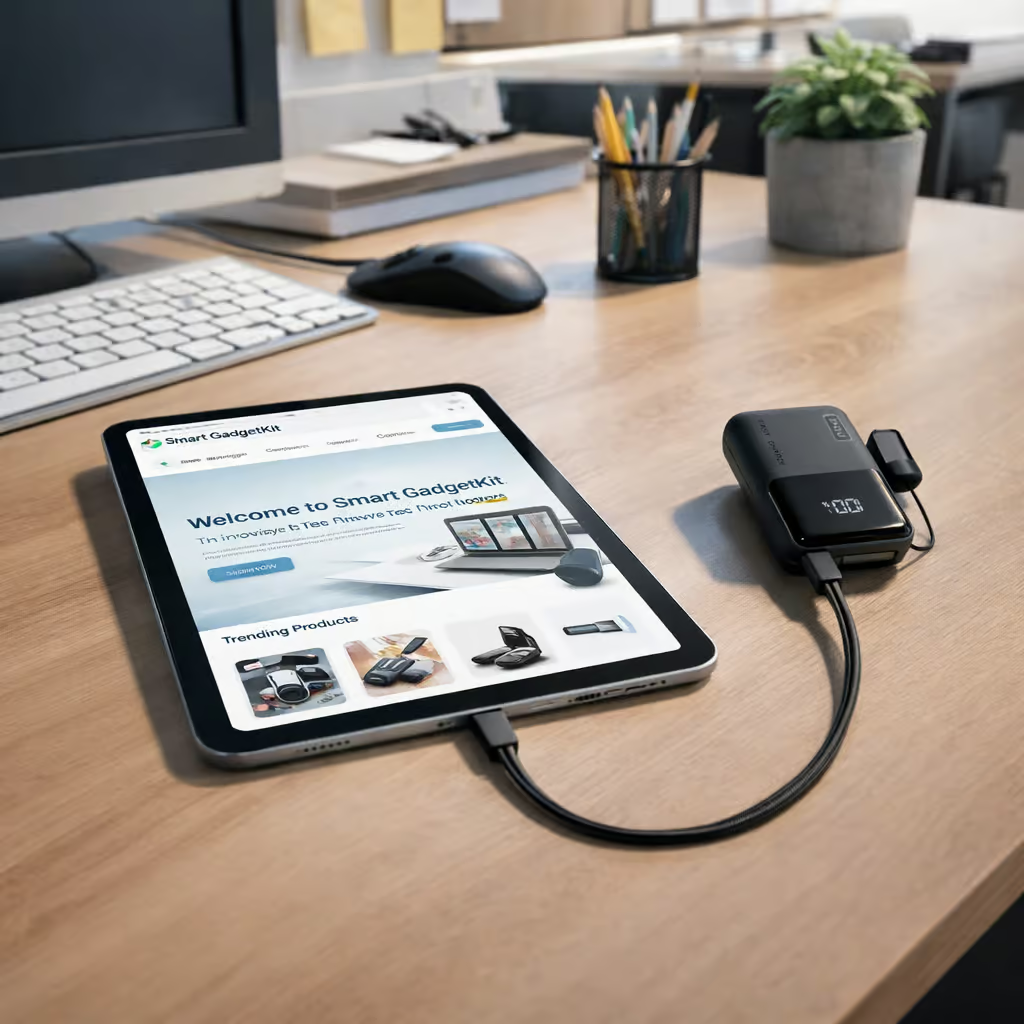
A value pick should do more than just cost less. It should be well-judged for what most people actually need.
The INIU P41 earns its place because it gives a lot of buyers enough. If you mainly need to save your phone on a commute, top up earbuds, and keep a light USB-C accessory going — a 10,000mAh bank at 45W is the smarter call than paying for a larger model you’ll never use to capacity. The 45W output separates this from budget banks that are only really comfortable charging a phone at pace. Two USB-C ports both support input and output. The detachable lanyard USB-C cable is a small touch that solves an actual daily annoyance.
Key takeaways
- 45W output is genuinely useful — not just phone-speed charging with inflated marketing
- Both USB-C ports support input and output — more flexible than most at this price
- 3-year warranty (INIU Care) is longer than most competitors in this class
Who it’s for
Students, commuters, budget-minded buyers, and phone-first users who want solid USB-C performance at a price that makes sense.
Who should skip it
Anyone expecting to charge a laptop or run several devices through a long travel day.
Verified specs — INIU P41
| Spec | Value |
|---|---|
| Capacity | 10,000mAh |
| Max output | 45W |
| Ports | 2x USB-C (input and output), 1x USB-A |
| Built-in cable | USB-C detachable lanyard cable |
| Charging protocol | PD, QC |
| Airline carry-on | Under 37Wh — well within carry-on limits, always check your airline |
| Warranty | 3 years (INIU Care) |
Specs source: iniushop.com
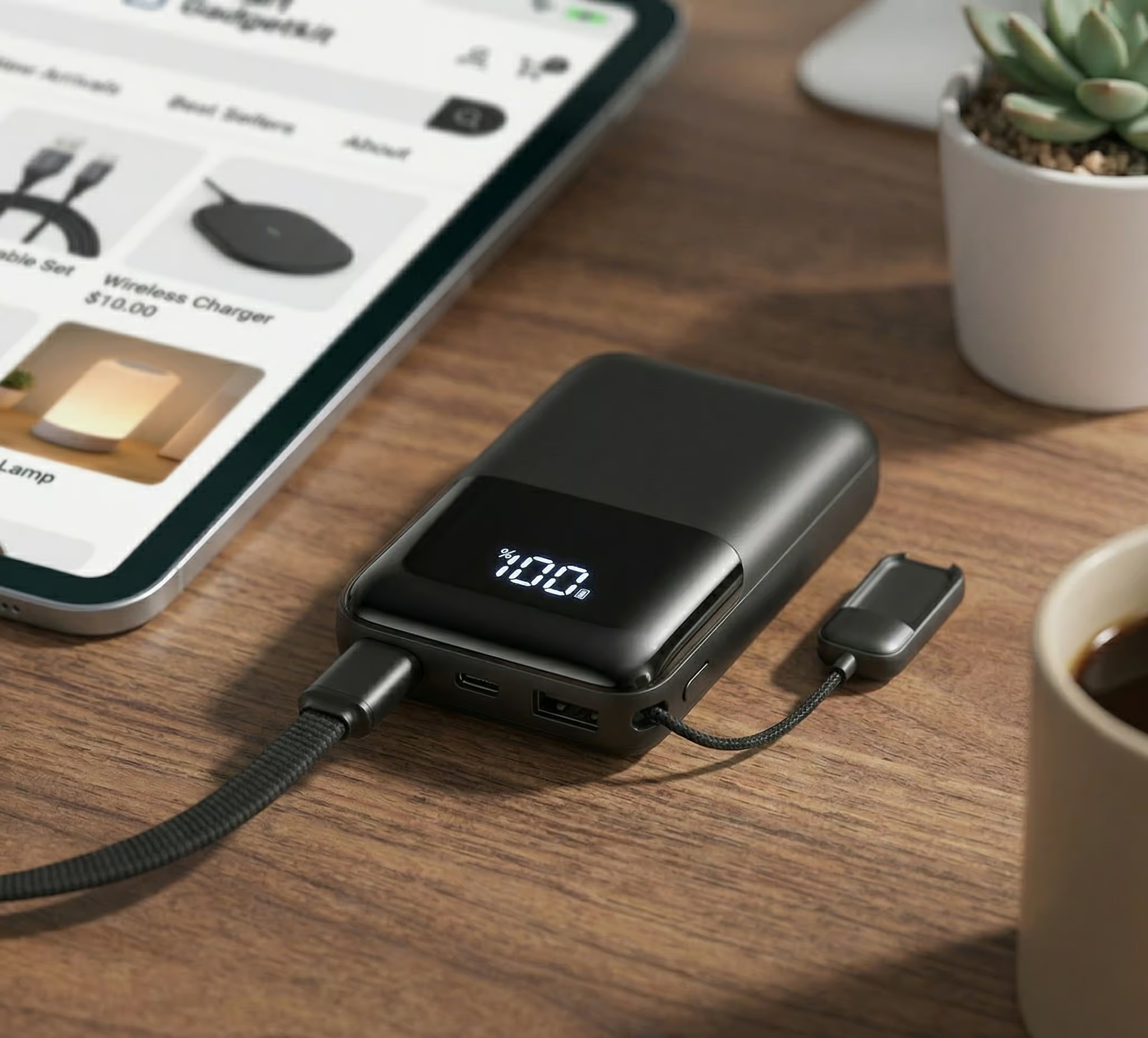
INIU P41 Power Bank (10,000mAh, 45W) Best Value
Pick 7: Anker MagGo Power Bank 10K Slim — Best magnetic
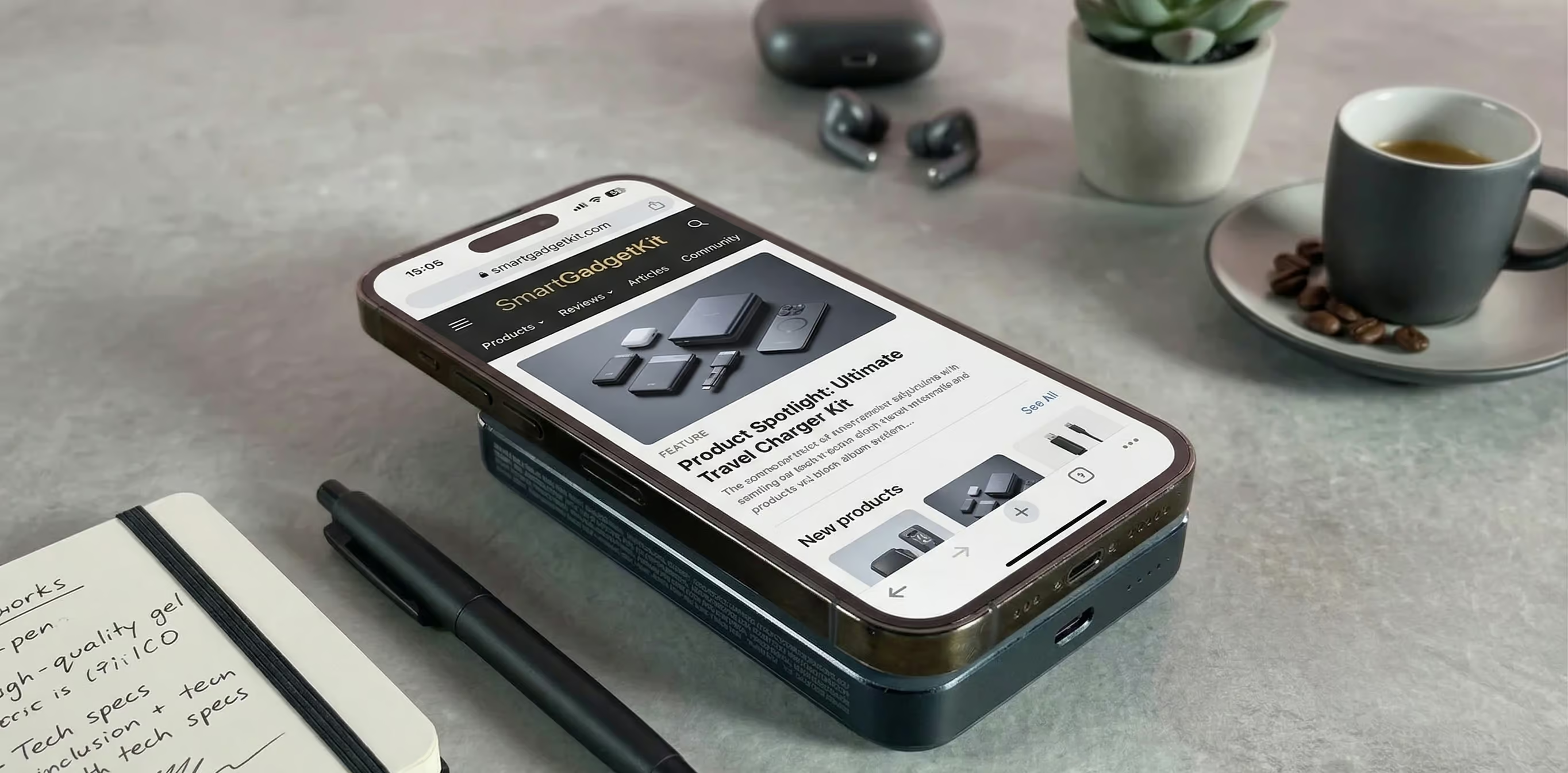
Magnetic charging is a trade-off between convenience and efficiency. For the right buyer it’s an easy trade to make.
The MagGo 10K Slim snaps onto a compatible iPhone, stays put while you use your phone, and charges it without you needing to think about it. No cable dangling, no fumbling around. The Qi2 certification means the 15W wireless output is standardised and reliable — not a marketing number. There’s also a 30W wired USB-C port when you need faster output for a tablet or a quicker phone top-up.
Key takeaways
- Qi2-certified 15W wireless — standardised output, not a headline figure
- Snaps on and stays — genuinely usable while the phone is in your hand
- 30W wired USB-C port covers non-MagSafe and faster charging needs
Who it’s for
iPhone users who value a neat, frictionless daily charging setup over maximum efficiency from each charge cycle.
Who should skip it
Anyone who cares mainly about charging efficiency or broad device compatibility. Wired delivers more energy from the same capacity. This is a convenience pick, not a performance one.
Verified specs — Anker MagGo 10K Slim (A1664)
| Spec | Value |
|---|---|
| Capacity | 10,000mAh |
| Wireless output | 15W max (Qi2 certified) |
| Wired USB-C output | 30W max |
| USB-C input | 30W max |
| USB-C output voltages | 5V/3A, 9V/3A, 12V/2.5A, 15V/2A, 20V/1.5A |
| Weight | 200g |
| Dimensions | 104 x 70.6 x 14.7mm |
| Compatibility | iPhone 12 and later (Qi2), other Qi2 devices |
| Airline carry-on | Typically within carry-on limits, always check your airline |
Specs source: anker.com/uk
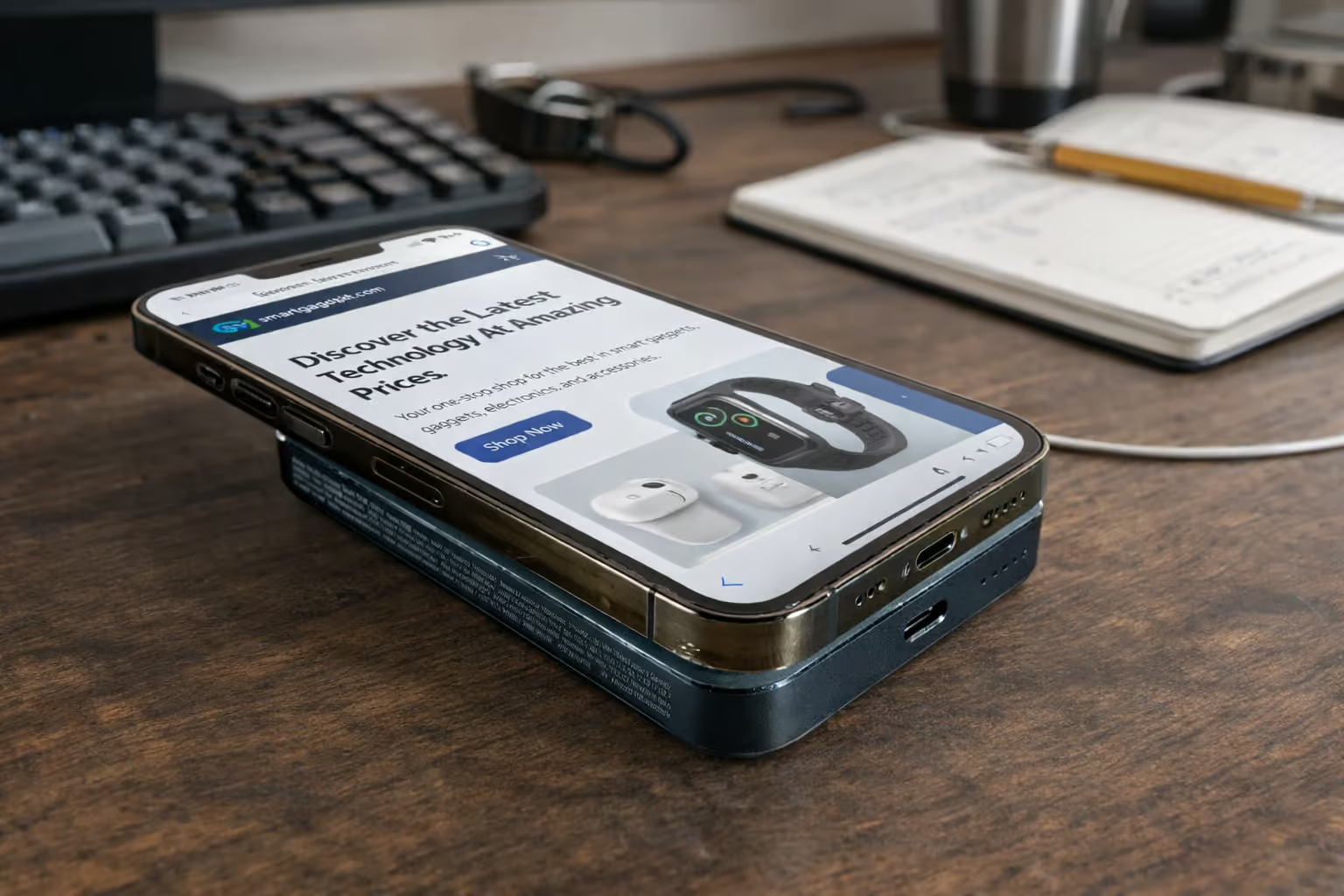
Anker MagGo Power Bank 10K Slim Best Magnetic Pick
Pick 8: Anker Prime 26,250mAh 300W — Best premium
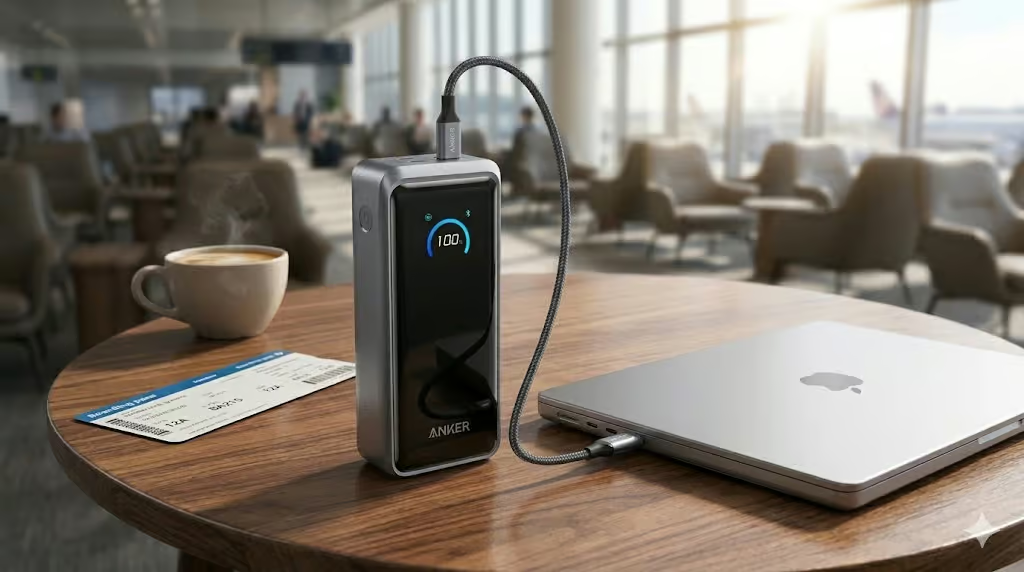
The Prime 26K is easy to admire and easy to oversell. I’ll try to avoid the second part.
300W total output with 140W per USB-C port is serious. If you regularly run a demanding laptop and several devices simultaneously — and you want a portable power hub that won’t feel stretched by any realistic multi-device load — this handles that. At 99.75Wh it just clears under the 100Wh airline carry-on threshold. Smart display, app control via Bluetooth, and 250W dual-port input for fast self-charging.
Most people don’t need 300W. The Anker 737 handles 95% of real travel needs at a lower price and weight. Ask honestly whether you need this level of output before buying.
Key takeaways
- 300W total output for multi-device setups that would stretch a mainstream bank
- 99.75Wh just clears the airline threshold — carry-on compatible
- App control via Bluetooth adds per-port monitoring beyond what the display shows
Who it’s for
Creators, advanced laptop users, and premium buyers who need a serious portable power hub for demanding multi-device workflows.
Who should skip it
Almost anyone who just wants a reliable everyday power bank.
Verified specs — Anker Prime 26K 300W
| Spec | Value |
|---|---|
| Capacity | 26,250mAh / 99.75Wh |
| Max total output | 300W |
| Max per USB-C port | 140W |
| USB-C output voltages | 5V/3A, 9V/3A, 12V/3A, 15V/3A, 20V/5A, 28V/5A |
| Max input | 250W (dual USB-C) |
| Ports | 2x USB-C, 1x USB-A |
| Display | Smart digital display |
| App control | Yes — Anker app via Bluetooth |
| Airline carry-on | 99.75Wh — typically within carry-on limits, always check your airline |
| Warranty | 24 months |
Specs source: anker.com/uk
How to choose the right power bank
Start with the job, not the number
A 300W flagship sounds impressive. It’s also wasted money if you’re charging one phone on a commute. Start by asking what devices you actually charge and when — then work backwards to the spec you need.
Capacity: what the mAh number actually tells you
Manufacturers quote capacity at battery cell voltage, typically 3.7V. A 10,000mAh bank at 3.7V is about 37Wh. At 5V USB output, accounting for conversion losses, you typically deliver around 65–75% of rated capacity as usable energy. That’s why a 10,000mAh bank rarely charges a 4,500mAh phone battery twice from flat.
- 10,000mAh: Phone backup and light daily carry. Two to three realistic phone charges.
- 20,000mAh: The travel sweet spot. Mixed device days, commuting, flights.
- 25,000mAh and above: Laptop-first travel and multi-device work setups.
Output wattage: why this matters more than most guides say
A 20,000mAh bank at 18W and a 20,000mAh bank at 100W have the same battery. They do not charge your laptop the same way. Output wattage determines what a power bank can actually support. Most budget banks can’t sustain high wattage consistently. The Anker 737, A1695, and CUKTECH 15 Ultra can.
Airline rules
Most picks here sit under the common 100Wh threshold, above which most airlines require prior approval. Airline handling of lithium batteries is not universal. Always check before you fly.
For the full picture: Can you take a power bank on a plane? UK rules for 2026.
Built-in cables
Convenient and practical. The trade-off: the cable can’t be replaced if it fails, and it limits flexibility with unusual port setups.
Magnetic vs wired
Magnetic charging is better for convenience, not efficiency. Wired delivers more energy per milliamp-hour. If you want the most charges from a bank, wired wins.
Frequently asked questions
What is the best power bank for most people in 2026?
For most people, the Anker 737 (PowerCore 24K) is the strongest all-round choice. It has 24,000mAh capacity, 140W USB-C PD 3.1 output, an OLED display, and 86.4Wh — comfortably under the 100Wh airline carry-on threshold.
What size power bank do I need?
Buy 10,000mAh for emergency phone backup and easy carry. Buy 20,000mAh for the best daily and travel balance. Buy 25,000mAh and above if laptop charging or multi-device travel days are a regular requirement.
Can a power bank charge a laptop?
Yes, but not all power banks can do it well. You need enough output wattage to push charge into your laptop at a useful rate. The Anker 737 (140W per port), Anker A1695 (100W per port), and CUKTECH 15 Ultra (140W on USB-C1) are all capable. A bank with only 45W output will charge a laptop slowly and may struggle to keep pace under active use.
Are power banks allowed on planes?
Most power banks under 100Wh are allowed in carry-on baggage on most airlines — but not in checked luggage. Rules vary by airline. Always check with your specific carrier before flying. See our power bank airline rules guide.
Is magnetic charging worth it on a power bank?
For iPhone users who prioritise convenience over efficiency, yes. The trade-off is that wireless charging is less efficient than wired — meaning fewer overall charges from the same capacity. It’s a convenience pick, not a performance one.
Are bigger power banks always better?
No. Match the bank to your actual use case. Most people get better value from a well-chosen 20,000mAh bank than from an oversized flagship they rarely use to capacity.
What should I watch out for when buying a power bank?
Inflated wattage claims from unknown brands. Naming confusion across similar models in the same range. Marketing that treats every high-output flagship as the right pick for everyone. Pay attention to carry weight, and always check Wh figures against airline rules before travelling.
Final recommendation
The best power bank for 2026 depends on your use case far more than the biggest number in the spec sheet.
For most people — travel, commuting, mixed devices — start with the Anker 737. It’s the one I reach for first.
If everyday carry is the priority, the Anker 87W 20,000mAh is the more practical daily choice.
If carry weight matters more than output, the Nitecore NB10000 Gen 4 is the honest answer.
If your laptop is the reason you’re shopping, the Anker A1695 was built for that job.
For more detail: best laptop power banks for 2026.